
 Your Underperforming Digital Marketing Agency


Your creative agency is burning your budget because they can’t do the math. In 2026, the average B2B buying committee has ballooned to 11.2 stakeholders. If you’re still chasing superficial clicks or low-intent leads, you’re already behind. Most demand generation agencies talk about brand awareness while your acquisition costs spiral out of control. You know the frustration of zero transparency and internal teams that lack the data science expertise to scale. It’s a broken model that rewards vanity metrics over actual outcomes. RESULTS matter. Fluff doesn’t.
We agree that the status quo is failing your bottom line. This article shows you how to move beyond basic lead generation and build a high-velocity demand engine that dominates national markets. You’ll discover how to lower acquisition costs through programmatic precision and technical optimization. We’re breaking down the exact framework for engineering intent so you can achieve predictable revenue growth. It’s time to stop guessing and start scaling with a partner that acts as an elite internal extension of your business. No excuses; just performance.
Key Takeaways
- Stop wasting budget on gated fluff and start orchestrating brand authority to capture genuine buyer intent.
- Leverage cross-channel programmatic and video data to predict and trigger high-value behaviors at a national scale.
- Partner with a Demand Generation Agency NYC that replaces traditional agency bloat with a fully managed growth model focused on execution.
- Audit your scaling math by evaluating your LTV/CAC ratio to ensure your growth engine remains sustainable and profitable.
- Gain an unfair advantage by integrating specialized data science and programmatic expertise directly into your internal growth infrastructure.
Demand Generation Agency NYC: Why Most ‘Lead Gen’ is Just Expensive Noise
Lead magnets are dead. It’s 2026. Your prospects are exhausted by gated fluff and generic PDFs that offer zero value. If your current strategy relies on tricking people into an email list, you aren’t marketing; you’re annoying. Most firms acting as a Demand Generation Agency NYC are still stuck in 2018. They sell you “impressions” and “brand awareness” while your acquisition costs skyrocket. These are vanity metrics. They look great in a slide deck but do nothing for your bank account. You need revenue, not a pat on the back for a high click-through rate.
Real growth requires a shift from “finding” customers to “creating” a market. This is Demand generation: the strategic orchestration of brand authority and intent capture. We don’t wait for buyers to find us. We engineer the environment where they realize they need us. This is data-driven dominance. It’s aggressive. It’s precise. It’s the only way to scale in a hyper-competitive landscape where everyone is shouting for attention. Stop buying into the lie that more leads equals more growth.
To better understand this concept, watch this helpful video:
Lead Generation vs. Demand Generation: The Performance Gap
MQLs are a vanity trap. Marketing Qualified Leads often represent nothing more than someone who clicked a link by mistake or wanted a free template. They don’t represent revenue. Transitioning from volume-based metrics to intent-based revenue targets is the only way to survive. Demand generation is a revenue-first framework that prioritizes high-intent actions over empty clicks. When you stop chasing volume and start chasing value, your sales team stops complaining and starts closing. It’s about quality, math, and ruthless optimization.
The Death of the Traditional Marketing Funnel
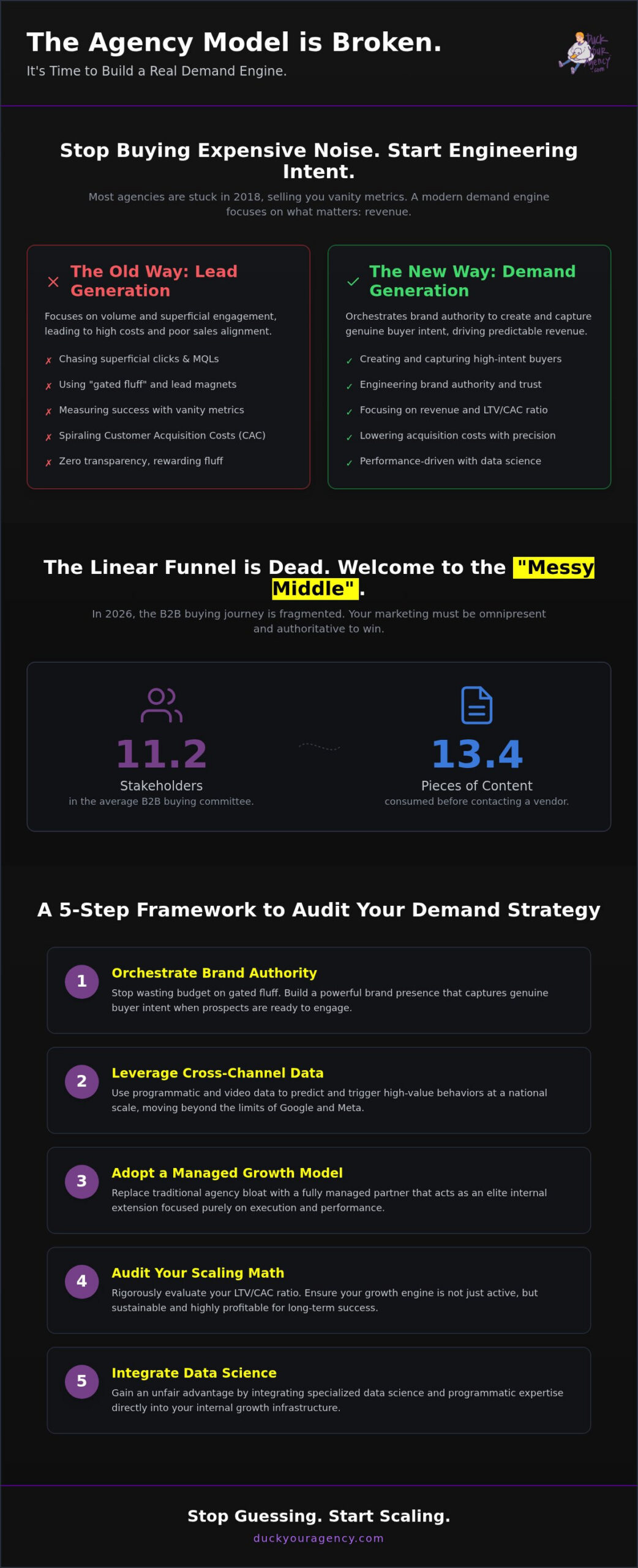
The linear funnel is a relic. In 2026, the buyer journey is a fragmented “Messy Middle.” With an average of 11.2 stakeholders involved in B2B deals over $50,000, your marketing must be omnipresent and authoritative. Buyers consume an average of 13.4 pieces of content before they ever reach out to a vendor. How a Best Digital Marketing Agency NYC should be structuring your spend involves programmatic precision across every touchpoint. A specialized Demand Generation Agency NYC understands that you can’t force a buyer through a straight line; you have to surround them with intent-triggering data until the sale is inevitable.
The Mechanics of Intent Engineering: Programmatic, Video, and Search
Content is a commodity. Intent is the currency. Intent engineering uses cross-channel data to predict and trigger buyer behavior before your competition even knows a prospect exists. A top-tier Demand Generation Agency NYC doesn’t just wait for search volume; it creates it. We integrate data science to optimize bids in real-time across the entire ecosystem. This isn’t guesswork. It’s engineering. We use predictive modeling to identify high-value targets and surround them with authoritative messaging until conversion is the only logical step. If you aren’t using math to drive your creative, you’re just gambling with your board’s money.
Before you commit to national scale, you must ensure your strategic foundation is bulletproof by Auditing Your Demand Generation Strategy. Without a rigorous plan, you’re just feeding the algorithms without a map. Most firms fail because they treat data as a post-campaign report rather than the engine that drives the spend.
Programmatic Dominance: Scaling Beyond the Walled Gardens
Relying solely on Google and Meta is a recipe for high CPA. You’re fighting for scraps in over-saturated walled gardens where the house always wins. Programmatic advertising is the backbone of national scale. It allows you to reach prospects on the open web, precisely where they spend 80% of their time. High-impact programmatic video builds brand recall that search alone can’t touch. We leverage your first-party data to build predictive models for new markets, ensuring your entry is backed by statistical probability rather than hope. This is how you scale fast without the traditional agency bloat. If you want to see how these mechanics apply to your vertical, you can explore our fully managed digital marketing solutions.
Search in 2026: From SEO to Generative Engine Optimization
Search is changing. AI-driven models are replacing the traditional list of blue links. If your strategy is still focused on simple rankings, you’re already losing. Generative Engine Optimization (GEO) is the new standard for a Demand Generation Agency NYC. Your brand needs to be the definitive answer that AI models provide to complex buyer queries. Integrating AI Paid Search Agency NYC tactics into a broader demand gen strategy ensures you capture intent at the exact moment it’s expressed. Focus on “Answer Engine” visibility. Be the solution the AI recommends. Anything less is just noise.
Strategic Comparison: Fully Managed Growth vs. Traditional Agency Bloat
Consulting retainers are where growth goes to die. You pay for “analysis” that results in paralysis. Most traditional firms acting as a Demand Generation Agency NYC sell you a 50-page strategy document that sits in a Google Drive folder gathering digital dust. They love meetings. We love execution. The “Fully Managed” model eliminates the gap between strategy and spend. It ensures that every dollar you commit to the market is backed by immediate, senior-level action. If your agency spends more time discussing “brand vibes” than it does optimizing your bidding logic, you’re subsidizing their overhead instead of driving your revenue.
Transparency in 2026 is non-negotiable. You must demand an end to hidden fees and artificial ROAS inflation. Many agencies hijack your brand search or take credit for organic sales just to make their reports look pretty. This is a lie. Speed is the only KPI that actually matters for national growth. Every day you spend waiting for a “creative review” or a “strategic alignment meeting” is a day your competitors are capturing market share. We operate with a “no-nonsense” business vernacular that prioritizes velocity and tangible outcomes above all else. No fluff. Just scale.
The Hidden Costs of Inefficient Agency Structures
Large NYC firms often lure you in with a senior partner and then dump your account on a junior manager who started last Tuesday. This is the “junior account manager” trap. Your billable hours shouldn’t be their profit margin. When you work with a specialized Demand Generation Agency NYC, you shouldn’t be paying for an entry-level employee to learn the ropes on your budget. Our approach focuses on senior experts only. We don’t hide behind a wall of account coordinators. We focus on technical industry terminology and high-level performance metrics because we assume you’re smart enough to care about the math. Efficiency is our default setting. Before signing any retainer, use a rigorous Performance Marketing Agency NYC selection checklist to vet your next growth partner and ensure they prioritize data science over vanity metrics.
Building vs. Outsourcing: The Hybrid Recruitment Model
You shouldn’t rely on external retainers forever. A sustainable growth engine eventually requires internal muscle. This is where most agencies get nervous; they want you dependent on them. We take the opposite approach. We help you bridge the talent gap through specialized digital marketing recruitment services. This hybrid model allows you to leverage our elite data science and programmatic expertise while simultaneously building your own internal team. We act as an extension of your business until you’re ready to fly solo. It’s about your long-term dominance, not our short-term billing cycle.
A 5-Step Framework for Auditing Your Demand Generation Strategy
Most audits are a joke. They check your brand colors and social media frequency while your revenue stays flat. That’s fluff. A real Demand Generation Agency NYC starts with the numbers. If you can’t prove the math, you don’t have a strategy; you have a hobby. We’ve built a five-step framework to strip away the noise and focus on what actually moves the needle for national scale. No vanity metrics allowed. Just data.
Step 1 & 2: The Foundations of Profitable Scale
Step one is simple: Audit the math. Stop looking at your ad platform dashboard. It’s lying to you. You need to calculate the true cost of a customer, including every touchpoint and stakeholder interaction. A healthy LTV/CAC ratio for 2026 is 4:1 or higher to sustain aggressive national growth. Anything lower means you’re just trading dollars for pennies. Step two is mapping the intent. You must identify “dark social” signals and unmeasured intent where your prospects are actually making decisions, such as private Slack communities or direct peer recommendations. If you aren’t measuring the unmeasurable, you’re missing half the picture.
Step 3-5: Optimization and Accountability
Step three is stress-testing your tech stack. GA4 is the bare minimum. In a cookieless world, your data science setup must provide actionable insights, not just historical data. You need predictive modeling that tells you what will happen, not just what already did. Step four is evaluating the creative. Does it drive action or just look pretty? We have no patience for “creative” that ignores the math. Interestingly, the high-velocity tactics found in a Family Entertainment Marketing Agency playbook often work perfectly for complex B2B funnels because they prioritize immediate engagement and psychological triggers. Finally, step five is the execution check. Is your current partner “setting and forgetting” your budget? We set strict 30-day “kill or scale” milestones for every experiment. If it doesn’t perform, we kill it. If it works, we pour gasoline on it. This is how you win. Stop settling for mediocre audits and get a real demand generation audit that prioritizes your bottom line.
Duck Your Agency: The No-Nonsense Partner for Aggressive Growth
Most agencies are built to bill. We are built to perform. As a Demand Generation Agency NYC, we’ve seen the wreckage of traditional marketing engagements. We don’t do fluff. We do fully managed, data-driven dominance. If you want a partner to hold your hand and tell you how great your logo looks, go elsewhere. If you want a partner that treats your capital like their own and hunts for ROI with predatory precision, you’re in the right place. We are the elite alternative to the bloated status quo that rewards activity over outcomes.
Our background in programmatic and video ads gives us an unfair advantage that most “creative” firms can’t touch. We don’t just buy media; we engineer intent. The DYA guarantee is simple: absolute accountability, total transparency, and relentless optimization. We don’t hide behind complex jargon or opaque reporting. We focus on the math of growth. If the numbers don’t work, the strategy doesn’t work. Period.
Our Performance-First Methodology
Integrating growth marketing with high-level data science isn’t a luxury; it’s a requirement for national scale. We lower CPA for national brands through tactical programmatic hunts that find high-intent buyers in places your competitors aren’t even looking. We don’t just set a budget and hope for the best. We use data science-led optimization models to refine your bidding logic in real-time. We’ve successfully scaled partners beyond basic automation by identifying intent signals that traditional platforms simply ignore. We focus on the “Messy Middle” of the buyer journey to ensure your brand is the only logical choice when a prospect is ready to move. RESULTS. Not excuses.
Ready to Scale? Let’s Cut the Noise
Our onboarding process for fully managed advertising is fast because we value speed as a competitive weapon. We don’t waste months on “strategic alignment” meetings that just repeat your own internal data back to you. We audit your existing framework, identify the leaks, and start engineering demand immediately. Unlike other firms, we also help you build your internal team through specialized recruitment services. We want to be the elite extension of your business that eventually helps you own your growth engine entirely.
Stop wasting your budget on “lead gen” that produces nothing but empty MQLs and frustrated sales reps. It’s time to start engineering demand with a Demand Generation Agency NYC that actually understands the mechanics of high-velocity growth. Let’s cut the noise and start scaling your revenue. No fluff. Just dominance.
Engineering Dominance: Your 2026 Revenue Roadmap
Stop burning cash on “leads” that never close. The market in 2026 has no room for passive collection or gated fluff. Success requires aggressive intent engineering and a ruthless focus on the math of your LTV/CAC ratio. You now have the framework to audit your strategy and identify where traditional agency bloat is draining your budget. Every dollar you commit must be a calculated move toward national market share. No excuses. Just execution.
As the landscape evolves, it is critical to discover Disousa and their insights on the functional assessment of online marketing services to ensure your growth partner is actually delivering value.
Choosing the right Demand Generation Agency NYC means selecting a partner that prioritizes speed and transparency over billable hours. We provide the data science-led optimization and expert programmatic management needed to outpace the competition. Whether you need a fully managed engine or specialized recruitment services to scale your internal team, the goal remains the same: predictable revenue growth without the bureaucracy.
Stop the fluff. Get a fully managed demand engine with Duck Your Agency. It’s time to reclaim your budget and dominate your vertical. Let’s get to work.
Frequently Asked Questions
What is the difference between demand generation and lead generation?
Lead generation focuses on volume and contact collection, often resulting in cold MQLs that your sales team hates. Demand generation is the strategic orchestration of brand authority and market creation. It ensures prospects already want to buy before they even reach out. We focus on building a high-velocity engine that captures revenue, not just email addresses. It’s the difference between a crowded waiting room and a signed contract.
Why should I hire a demand generation agency instead of an SEO firm?
An SEO firm lives and dies by blue links and keyword rankings. A specialized Demand Generation Agency NYC views search as just one component of a broader intent-capture ecosystem. We integrate programmatic, video, and data science to surround your prospects wherever they live. While SEO waits for someone to type a query, we engineer the environment that triggers the search in the first place. Rankings are fine; revenue is better.
How do you measure the ROI of demand generation in 2026?
ROI in 2026 isn’t found in a basic ad dashboard. We measure success through marketing-sourced pipeline contribution and the health of your LTV/CAC ratio. A sustainable engine targets a 4:1 ratio for national scale. We track the “Messy Middle” of the buyer journey to see how touchpoints influence the final sale. If a tactic doesn’t move the revenue needle within our 30-day “kill or scale” window, it’s gone.
What role does programmatic advertising play in demand generation?
Programmatic advertising is the backbone of high-velocity demand. It allows you to scale beyond the expensive walled gardens of Google and Meta. By using tactical programmatic hunts on the open web, we find your buyers where they spend 80% of their time. We use this data to feed our predictive models, ensuring your brand stays omnipresent. It’s about precision targeting at a national scale that traditional PPC simply can’t match.
Can you help us hire an internal marketing team while managing our ads?
We absolutely help you build your internal team while we manage your ads. Our digital marketing recruitment services are designed to bridge the talent gap so you aren’t dependent on external retainers forever. We act as an elite extension of your business until your internal infrastructure is ready to take over. Most agencies want you stuck in a perpetual billing cycle. We want you to own your growth engine.
How long does it take to see results from a demand generation campaign?
You’ll see actionable data signals within the first 30 days. However, building a mature, high-velocity demand engine typically takes three to six months of relentless optimization. We set strict milestones to ensure we’re moving toward profitable scale from week one. Real growth isn’t an overnight “hack.” It’s the result of technical precision and data science-led adjustments. We prioritize speed, but we don’t sacrifice the math for a quick win.
What is intent engineering and why does it matter for my CPA?
Intent engineering is the use of cross-channel data to predict and trigger buyer behavior. It matters for your CPA because it eliminates wasted spend on low-intent clicks. By identifying prospects who are already showing “dark social” signals, we can target them with surgical precision. This lowers your acquisition costs by focusing only on the stakeholders likely to convert. It’s about engineering the sale before the prospect even realizes they’re in a funnel.
How does DYA handle transparency in ad spend and agency fees?
We provide total transparency with no hidden fees or artificial ROAS inflation. You see exactly where every dollar of your ad spend goes. We don’t hijack your brand search or take credit for organic sales just to make our reports look pretty. Our billing is straightforward and results-oriented. We have zero patience for the traditional agency bureaucracy that hides underperformance behind opaque dashboards. You get the truth, the data, and the results.