 Your Underperforming Digital Marketing Agency



Your expensive data stack is likely a liability. While 56% of marketing organizations have adopted AI-driven automation as of 2026, a massive jump from 31% in 2024, most are still suffocating under GA4 dashboards that offer zero execution. If your Marketing Analytics Agency hands you “insights” without a roadmap for aggressive action, you aren’t buying strategy; you’re buying expensive noise. You’re right to be fed up with high fees, zero accountability, and the total inability to track how a click actually becomes a customer. Most agencies hide behind complexity. We don’t.
It is time to pivot. We’ll show you how to stop the bleeding and start scaling with a data science framework that prioritizes cold, hard ROI over vanity metrics. This isn’t about “feeling good” about your numbers. It’s about actionable business intelligence and lowering your CPA through ruthless, data-backed optimization. We’re diving into how you can reclaim total data ownership and finally turn your analytics into a weapon for growth. You want RESULTS. Not just more graphs. Stop settling for reports that don’t move the needle and start demanding performance that actually scales your bottom line.
Key Takeaways
- Stop paying “Reporting Bureaus” for pretty charts that don’t drive growth. Data is a liability unless it is weaponized for immediate, aggressive execution.
- Move beyond GA4 by integrating CRM and offline data into a unified framework that tracks the true path to conversion across every channel.
- When vetting a Marketing Analytics Agency NYC, prioritize technical data science depth over the expensive bureaucracy and junior staffing of legacy firms.
- Reclaim total control of your marketing technology stack and data warehouse to eliminate the “Agency Lock-in” trap once and for all.
- Shift your focus from vanity metrics to aggressive ROI by bridging the gap between high-level analytics and fully managed digital marketing.
The Reporting Bureau Trap: Why Most Marketing Analytics Agencies Fail
Most agencies are glorified librarians. They collect your data, organize it into a pretty PDF, and present it once a month like a gift. This is the “Reporting Bureau” model. You’re paying for the privilege of looking at your own numbers. These firms sell charts. NOT outcomes. If you’re hunting for a Marketing Analytics Agency NYC, you’ve already seen that “Data-Driven” is a hollow buzzword. It’s the corporate equivalent of “synergy.” Usually, it just means an account manager has a GA4 login and a template. They offer observations. We offer execution.
Passive observation is a luxury your bottom line can’t afford. When an agency focuses on descriptive reporting, they’re looking in the rearview mirror. They tell you why you lost money last month. They don’t tell you how to make it back tomorrow. Dashboard fluff creates a false sense of security while your budget evaporates into inefficient channels. You don’t need more graphs; you need a strategy that actually scales.
Passive Analytics vs. Active Data Science
Passive analytics is a history lesson. It tells you what happened. That’s useful for an autopsy but useless for a growth strategy. Active data science is different. It uses statistical techniques like Marketing Mix Modeling to predict future performance. It tells you exactly where to allocate spend to move the needle. Research shows 87% of marketers report using generative AI in their workflows as of 2026, yet most still can’t tell you which dollar drove which sale. Active data science is the bridge between raw numbers and ROI. It shifts the focus from “what happened?” to “what is the next move?”
The Accountability Crisis in Modern Marketing
Agencies love complexity. Why? Because complexity hides FAILURE. If they can drown you in click-through rates and “engagement” scores, you might forget to ask about profit margins. This is an accountability crisis. A real Marketing Analytics Agency NYC uses data as a weapon. Never a shield. You can spot a shield agency easily. If they can’t tie every single data point back to a business-critical KPI, they’re hiding. Stop paying for observations. Start paying for execution. If the data doesn’t lead to a direct, aggressive change in strategy, it’s just noise. You need an ally who hates underperformance as much as you do.
Beyond Dashboards: A Framework for Actionable Marketing Data Science
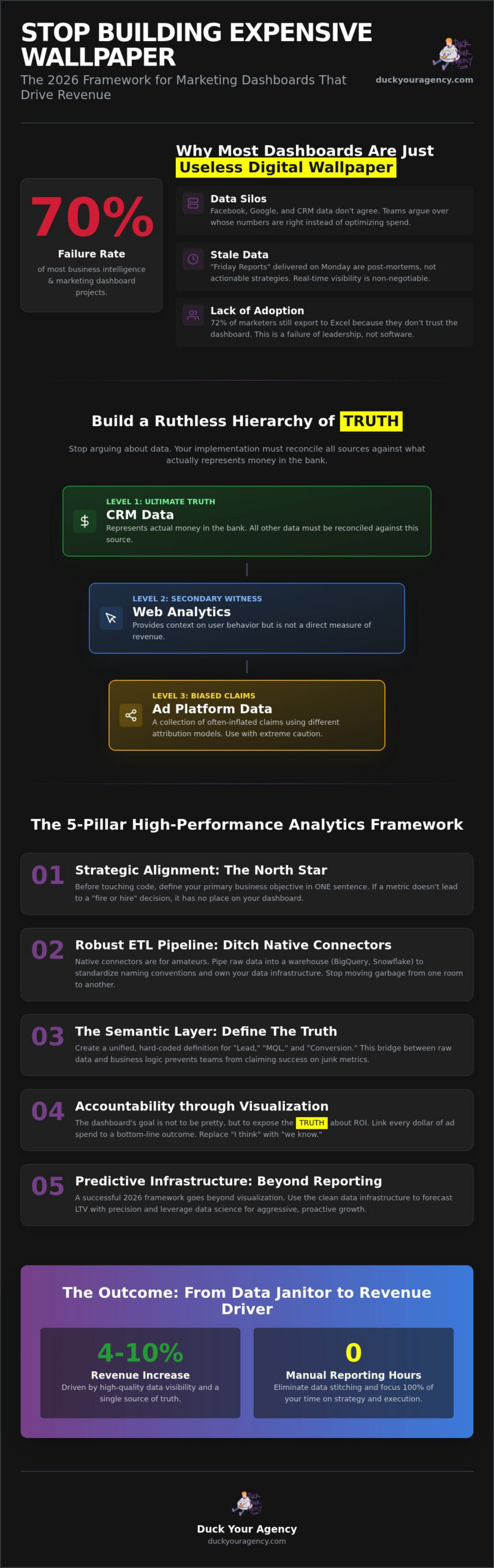
Dashboards don’t sell products. Decisions do. If your current Marketing Analytics Agency NYC spends more time formatting slides than optimizing your bid strategy, you have a visualization problem. A real data science framework moves beyond the surface level of GA4. It builds a Truth Engine. We integrate your CRM, ad platforms, and offline conversion data into a single, aggressive source of truth. This eliminates the attribution bias that plagues most NYC brands. You stop guessing which channel works and start knowing exactly where your next dollar belongs.
This integration is critical for optimizing cross-channel programmatic advertising. When your data is siloed, you overspend on redundant audiences. By unifying your stack, we use data science to detect patterns that human analysts miss. We identify the exact touchpoints that drive high-value conversions. This isn’t just “reporting”; it is weaponized intelligence designed to lower your CPA through ruthless optimization. Many organizations are catching on. According to recent 2026 data, 56% of marketing organizations have adopted AI-driven automation in their analytics. If you aren’t one of them, you’re already behind.
Predictive Modeling for Growth
Predictive modeling is the difference between reacting to the market and dictating it. We use historical data to forecast future campaign performance with surgical precision. This allows us to identify high-intent audience segments before they even hit a search bar. Data science scales fully managed digital marketing beyond human limitations by automating the “heavy lifting” of pattern recognition. We don’t wait for a trend to finish. We predict its arrival and position your brand to capture the demand. This is how elite partners maintain a competitive edge while others wait for a monthly report.
Cross-Channel Attribution Mastery
Last-click attribution is a myth. It’s a lie told by platforms to claim credit for sales they didn’t earn. In a multi-touch world, your Shopify or CRM data might be lying to you by oversimplifying the customer journey. We implement custom models that reflect reality. Even large-scale initiatives like the Digital Analytics Program emphasize the importance of unified measurement across vast digital ecosystems. We apply that same rigor to your brand. By mapping every interaction, we reveal the true path to conversion. If you’re tired of fragmented insights, it might be time to audit your data infrastructure for actual performance. Stop settling for “good enough” numbers and start demanding a framework that prioritizes ROI over vanity.
NYC Agency Comparison: Boutique Specialists vs. Legacy Firms
Hiring a Marketing Analytics Agency NYC shouldn’t feel like a trip to a DMV with better coffee. Yet, that is exactly what happens when you sign with a legacy firm. You’re sold a vision by a high-level partner who disappears the moment the ink is dry. In their place, you get a junior analyst who is still learning the difference between a bounce rate and a conversion event. Massive agencies are built on bureaucracy and billable hours. They aren’t built for speed. They’re built for volume. You aren’t a partner; you’re a line item on their quarterly earnings report.
Boutique specialists operate on a completely different frequency. We don’t have 500 employees to feed or a Midtown skyscraper to subsidize. This lack of bloat means your budget goes directly into the talent actually touching your data. While legacy firms often demand monthly retainers between $100,000 and $500,000+, boutique teams provide deeper technical expertise without the massive overhead. You also have to consider the NYC agency rate premium. Agencies in the city typically charge 15-30% more than remote firms. If you’re paying that extra “Manhattan tax,” you better ensure it’s for elite execution, not just for the prestige of a logo on your slide deck.
The Boutique Advantage
Direct access is the ultimate competitive edge. In a boutique model, the “A-Team” you meet during the pitch is the same team that builds your models. There are no layers of account managers to filter your feedback or slow down implementation. You get faster cycles and bespoke reporting structures that reflect your specific business goals. Smaller, specialized teams consistently outperform generalists because they have skin in the game. Their reputation depends on your ROI, not on their ability to hide underperformance behind a 40-page PDF of vanity metrics.
Red Flags in Legacy Agency Contracts
Beware of the “Proprietary Portal” trap. If an agency insists you view your insights through their specific dashboard, they’re likely holding your data hostage. This is a classic “Agency Lock-in” tactic designed to make switching impossible. You must own your data warehouse and every single ad account. Another red flag is a contract focused on billable hours rather than growth targets. If they’re too big to care about your specific bottom line, they’ll prioritize their internal processes over your profit. Accountability isn’t just a buzzword; it’s a requirement for survival in a high-stakes market. Don’t subsidize someone else’s bureaucracy. Demand a partner that prioritizes your scaling over their own stability.

The Data Ownership Audit: Stop Overpaying for Your Own Insights
Your data is your property. Or at least, it should be. Too many brands in the city are trapped in “Agency Lock-in,” a toxic dynamic where the vendor owns the data warehouse, the visualization templates, and sometimes even the ad accounts. If you can’t fire your Marketing Analytics Agency NYC today without losing years of historical performance data, you aren’t a client. You’re a hostage. This “managed stack” model is a parasite. It creates a dependency that masks underperformance and inflates fees through artificial complexity. You’re paying them to gatekeep your own intelligence.
Real scale requires total data portability. By 2027, it’s anticipated that 88% of marketing data will be first-party data, driven by increased privacy regulations. If you don’t own the pipes that move that data, you’re building your growth strategy on rented land. You need a Truth Engine that resides in your own cloud environment; not a proprietary black box that disappears when the contract ends. Ownership isn’t just about security. It’s about agility. When you own the stack, you can pivot faster than any legacy agency can schedule a “sync” meeting. This same strategy-execution gap that plagues traditional marketing strategy consulting agencies is exactly what kills data initiatives when there’s no clear ownership of the underlying infrastructure.
Stack Evaluation Checklist
Take five minutes to audit your current setup. If you can’t answer “YES” to every point below, your agency has too much leverage and your ROI is likely suffering from hidden friction:
- Direct Access: Do you have primary admin-level access to Google Ads, Meta, and GA4?
- Direct Billing: Is your data warehouse (BigQuery, Snowflake, etc.) billed directly to your corporate account?
- Historical Continuity: If you terminated your agency this afternoon, would you retain every single day of historical tracking and custom audience data?
If you failed this audit, you’re overpaying for the privilege of being locked out of your own business intelligence. It is time to reclaim control.
Building Internal Capability
The goal isn’t necessarily to do everything yourself. It’s to have the OPTION to do so. Many elite brands are moving toward a hybrid model. They use digital marketing recruitment services to build a lean internal team for execution while relying on a specialized partner for advanced data science. This approach keeps your agency honest. When you have internal eyes on the raw data, the “dashboard fluff” and vanity metrics disappear instantly. You get the best of both worlds: specialized expertise and total internal accountability. Don’t let a vendor own your insights. If you’re ready to stop the gatekeeping, contact us for a stack ownership audit and take back your data.
Scaling with Duck Your Agency: Data Science as a Competitive Weapon
Data science is only as good as the execution it triggers. You can have the most sophisticated predictive models in the world; but if they don’t result in an aggressive bid adjustment or a budget reallocation, they’re worthless. This is where most firms fail. They provide the “what” but ignore the “how.” As a premier Marketing Analytics Agency NYC, we close that gap. We don’t just hand you a dashboard and wish you luck. We weaponize your data to drive immediate, tangible growth.
Our secret isn’t just the math. It’s the integration. We combine high-level data science with fully managed digital marketing to ensure that every insight we uncover is instantly applied to your campaigns. If our models detect a shift in audience intent, your programmatic advertising agency NYC bids change in real time. If we see a decay in creative performance, the spend shifts before your morning coffee is cold. This is proactive scaling. We move from data confusion to performance clarity by cutting out the middleman between the analyst and the executor.
Our High-Performance Framework
We don’t do fluff. We do RESULTS. Our framework is designed for speed and total transparency. We start by stripping away the broken tags and fragmented tracking that plague most legacy stacks. We build a clean, unified data layer that serves as your single source of truth. Once the foundation is solid, we move into continuous optimization:
- Rapid Audit: We identify and fix attribution leaks within the first 14 days.
- Real-Time Signals: We optimize spend based on live performance data, not last month’s PDF.
- Revenue-First Reporting: We track profit, CPA, and LTV. We ignore “likes” and “impressions.”
The Elite Ally Partnership
We are not a distant vendor. We are an extension of your team. We act as your specialized ally against the underperformers and the “Reporting Bureaus” that have held your ROI hostage for years. Our data scientists don’t just understand code; they understand business. They know that a 10% increase in click-through rate means nothing if it doesn’t lead to a corresponding jump in bottom-line revenue. We have zero patience for industry fluff or bureaucratic delays. We value speed, accuracy, and aggressive scaling above all else. If you’re tired of drowning in dashboards and ready to start dominating your vertical, Let’s talk performance.
Stop Watching Charts. Start Owning Outcomes.
The era of paying for passive observations is officially over. You’ve seen how legacy firms hide behind proprietary portals and junior staff, but your bottom line doesn’t care about their overhead. Scaling requires a Truth Engine you actually own and a partner that integrates advanced GA4 models directly into your advertising execution. If you don’t weaponize your data, you’re just subsidizing someone else’s Midtown rent. Stop settling for descriptive autopsies. You need prescriptive growth.
Choosing the right Marketing Analytics Agency NYC means demanding accountability. We bring a disruptive, results-first approach that turns raw numbers into aggressive ROI through fully managed advertising integration. You deserve an elite ally that hates underperformance as much as you do. The path to performance clarity starts with taking back your data and firing the bureaus that treat your growth like a hobby. It is time to stop the noise and start the execution. You have the numbers; now use them to dominate your market.
Stop overpaying for “pretty” charts. Scale your business with Duck Your Agency.
Frequently Asked Questions
What does a marketing analytics agency actually do?
A marketing analytics agency bridges the gap between raw data and aggressive business growth. While standard firms stop at visualization, an elite partner uses data science to optimize programmatic bids, refine audience targeting, and predict future performance. They build the technical infrastructure required to track every dollar across the customer journey. It’s about turning fragmented signals into a unified Truth Engine that dictates your next strategic move.
How much does it cost to hire a marketing analytics agency in NYC?
Costs vary based on agency size and project complexity. Research from July 2026 shows boutique performance agencies in NYC typically charge retainers between $15,000 and $50,000 per month. Legacy firms often demand $100,000 to $500,000+. You’re paying for specialized expertise and the NYC rate premium, which is estimated to be 15-30% higher than remote alternatives. Always ensure you’re paying for technical execution, not just account management overhead.
How is marketing analytics different from basic reporting?
Basic reporting is a history lesson; marketing analytics is a roadmap. Reporting tells you what happened last month using static charts and vanity metrics. Analytics uses statistical modeling and data science to explain why it happened and what you should do next. It identifies attribution bias and reveals hidden inefficiencies in your spend. If your Marketing Analytics Agency NYC isn’t offering prescriptive strategies, they’re just librarians with a GA4 login.
Can an analytics agency help with GA4 migration?
Yes, but simple migration isn’t enough. An advanced agency handles full GA4 implementation, including custom event tracking, server-side tagging, and BigQuery integration. By August 2026, most enterprise clients have completed basic migration but still struggle with data accuracy. An elite partner cleans up the “noise” in your setup to ensure your predictive models are built on a solid, reliable foundation. Don’t settle for a default installation.
Why is data ownership important when working with an agency?
Data ownership prevents “Agency Lock-in” and ensures your business intelligence remains your asset, not the agency’s leverage. If a vendor owns your data warehouse or ad accounts, you can’t fire them without losing historical performance data. Ownership is also a legal necessity. With 88% of data expected to be first-party by 2027, you must control the pipes. You should pay for the strategy, never for access to your own numbers.
How do you measure the ROI of a marketing analytics partner?
Measure success through tangible performance metrics like reduced Customer Acquisition Cost (CPA) and increased Lifetime Value (LTV). A partner should pay for themselves by identifying wasted spend and reallocating it to high-intent channels. If they can’t show a direct correlation between their “insights” and your bottom-line revenue growth, they’re a cost center, not a growth engine. Demand accountability. ROI is the only metric that matters in an elite partnership. If you’re ready to stop obsessing over CPA alone and start building a customer lifetime value marketing strategy in NYC that drives sustainable growth, the framework starts with owning your data.
What technical skills should a data-driven agency have?
Look for deep expertise in SQL, Python, and advanced statistical modeling. A Marketing Analytics Agency NYC must be proficient in Marketing Mix Modeling (MMM) and server-side tracking to navigate the post-cookie landscape. They should also have experience integrating CRM data with programmatic platforms. If their “technical” team is just account managers who know how to use a drag-and-drop dashboard builder, they lack the depth required for aggressive scaling. Equally important is how they handle paid search: passive fully managed Google Ads management that relies on “set and forget” automation will actively cannibalize your margin in 2026’s AI-driven landscape.
How long does it take to see results from a data science audit?
You should see “quick win” optimizations within the first 14 to 30 days. This involves identifying attribution leaks and cutting obvious waste in your ad spend. Complex predictive models and full-funnel attribution mastery typically take 90 days of clean data to reach peak accuracy. The goal is a rapid shift from data confusion to performance clarity. Speed is a competitive advantage; don’t wait months for a report that should take weeks.