Proximity is the most expensive vanity metric currently rotting your marketing budget. You’ve been told that hiring a Google Ads Agency NYC requires a local zip code for “better collaboration” or frequent face-to-face meetings. It’s a comfortable lie that makes you feel secure while your competitors use lean, performance-first execution to eat your market share. We get it. You want to trust the people managing your capital, and a local presence feels like an insurance policy against underperformance.

Stop hiring for zip codes and start hiring for ROI. In a 2026 landscape defined by new AI disclosure laws and “all-in” pricing mandates, the traditional agency model is failing to keep pace. This article provides a direct comparison between the bloated bureaucracy of traditional firms and the aggressive, data-science-led execution partners that actually scale revenue. You’ll learn how to identify artificial ROAS inflation, why slow response times are killing your conversion rates, and how to pivot from wasted ad spend to high-performance growth that ignores geographical boundaries.

Key Takeaways

  • Stop prioritizing physical proximity and start auditing technical execution. Learn why a local Google Ads Agency NYC search often leads to bloated overhead rather than better ROAS.
  • Discover the “Managed Execution” model that replaces passive monthly reporting with real-time optimization powered by predictive data science.
  • Expose account neglect using our 5-minute audit framework to identify if your current partner is inflating performance by counting page views as leads.
  • See how a lean, senior-led structure eliminates junior account manager bottlenecks to focus strictly on aggressive CPA reduction for high-competition brands.
  • Master the transition from managed services to internal growth with a framework for building your own high-performance marketing team via specialized recruitment.

Beyond the ‘Google Ads Agency NYC’ Search: Why Performance Beats Proximity

Searching for a Google Ads Agency NYC is a legacy reflex. It’s a comfort search. You want a partner you can see, someone who claims to know the local market, and someone you can hold accountable over a face-to-face meeting in a high-rent office. This is a mistake. In 2026, proximity is a distraction that masks incompetence. The algorithm does not care about your commute. It certainly doesn’t reward you for having a partner with a specific local area code. It rewards execution.

The traditional agency model is built on management. They manage your expectations. They manage their own internal overhead. They manage to send you a report once a month that highlights green arrows while your actual bank balance remains stagnant. We reject this. You don’t need management. You need aggressive, data-led execution that treats your capital as a tool for growth, not a recurring fee for the agency’s rent. High-competition search intent, especially for NYC-based queries, requires a level of technical sophistication that basic bid adjustments can’t reach.

The Myth of the ‘Local Advantage’

Does an expensive corporate address improve your Quality Score? No. Does being within driving distance of a financial district make your bidding strategy more efficient? Absolutely not. A local address is a vanity metric for the agency, not a performance lever for the client. When you hire based on a zip code, you’re intentionally shrinking your talent pool. You’re choosing the best person in a small radius instead of the best person for the job.

Performance execution doesn’t care about geography. It cares about data. The elite talent capable of navigating high-competition markets isn’t tethered to a specific neighborhood. They are wherever the data is. By prioritizing a local partner, you are often paying a premium for their physical office space rather than their technical ability to lower your CPA. This same trap catches businesses searching for a Google Ads Agency Brooklyn — proximity feels safe, but it consistently costs you performance. Performance doesn’t care about your zip code. It cares about your data.

What You’re Actually Buying: Clicks vs. Revenue

Most businesses fall into the Premier Partner trap. They see the badge and assume it equates to expertise. In reality, that badge is often a participation trophy for spending high volumes of client capital. Google rewards spend. We reward profit. There is a massive divide between an agency that buys clicks and a partner that engineers revenue. You aren’t buying hours; you’re buying business outcomes.

If your current partner focuses on vanity metrics like impressions or “brand awareness” without a direct line to your bottom line, they are managing your decline. You need a system that integrates Google Ads data with deep-funnel analytics to find the margin. Performance Execution is the aggressive application of data science and growth frameworks to bridge the gap between raw platform metrics and scalable business revenue. Stop buying management. Start buying outcomes.

Management vs. Managed Execution: The Performance Divide

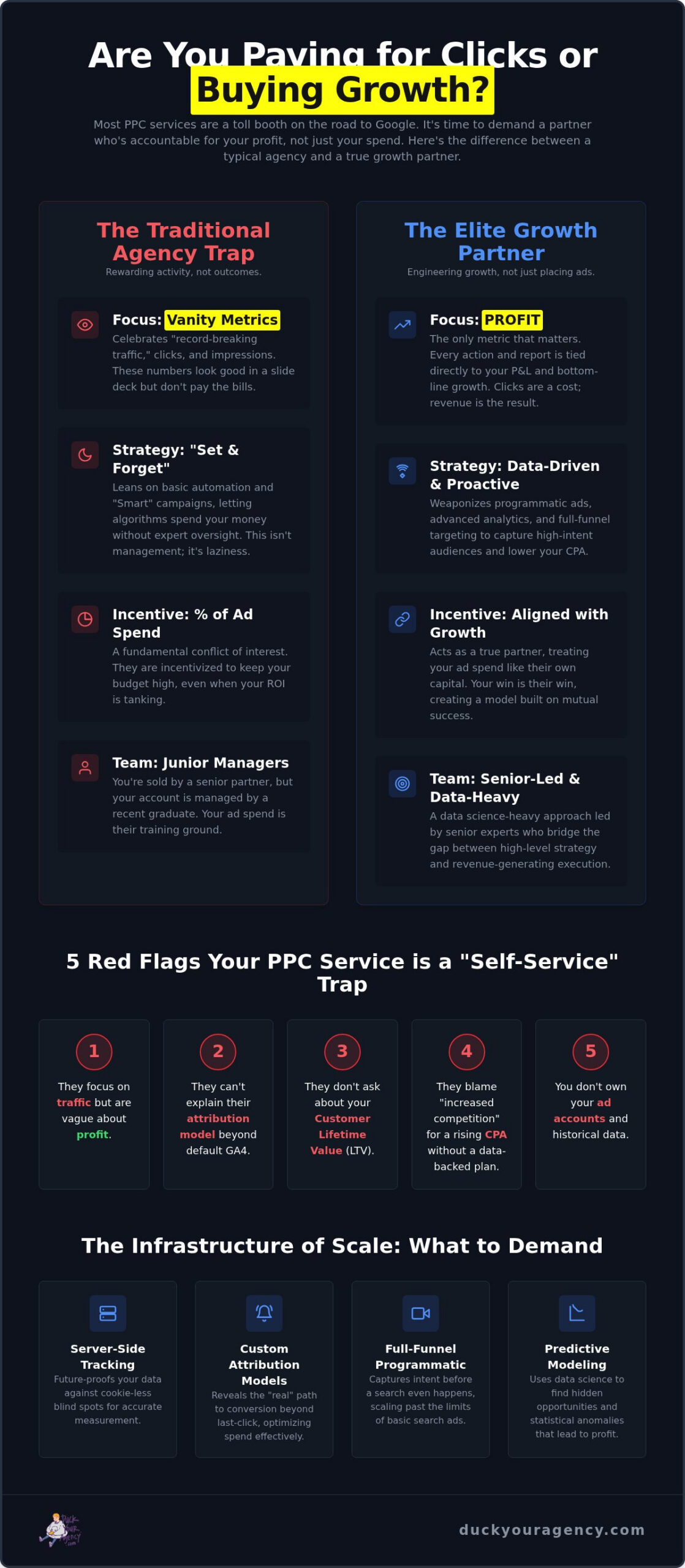
Standard management is a post-mortem. Your typical Google Ads Agency NYC spends their time explaining why you lost money thirty days ago. They deliver PDF reports filled with vanity metrics that look pretty but don’t pay the bills. This is passive management. It’s a slow death by a thousand bid adjustments that reactive agencies use to justify their retainers. We reject the idea that a monthly check-in is sufficient for high-stakes capital management.

We do Managed Execution. This is the difference between a partner who reports on history and one who engineers the future using predictive data science. While others wait for the end of the month to optimize, we utilize real-time modeling to shift capital toward high-intent opportunities before the competition wakes up. Static accounts are failing accounts. In fact, Fully Managed Google Ads Management is the only way to combat the set and forget mentality that is currently killing your ROI.

Technical Execution: The Data Science Edge

Stop clicking Google’s “Recommendations” button. Those automated prompts are designed to maximize Google’s revenue, not your profit. True Performance marketing requires looking beyond the dashboard. We build custom attribution models that track the full path to conversion, identifying how your programmatic and video ads are actually feeding the search funnel. If you can’t see the connection between a YouTube view and a search conversion, you’re flying blind. Execution means knowing exactly where every dollar goes and what it brings back.

CPA Crisis: Solving for High-Competition Markets

In high-competition sectors, standard bidding strategies are a race to the bottom. When everyone uses the same Target CPA settings, the only winner is the platform. We solve the CPA crisis by integrating landing page psychology with technical bid precision. It’s about more than just the click. It’s about ensuring the traffic we buy actually converts at a rate that justifies the spend. If your cost-per-acquisition is climbing, it’s likely because your execution lacks the aggressive optimization required in 2026.

For those ready to stop the bleed, our Fully Managed Digital Marketing services focus on lowering CPA through technical dominance, not just higher budgets. We don’t just manage your account; we execute a strategy that demands performance from every keyword and creative asset you own.

The Anti-Agency Framework: Scaling Without the Bureaucracy

The legacy agency model is a bloated relic. Most firms operate on a “pyramid” structure designed for their profit, not yours. You meet the charismatic founder during the pitch, but your account is handed to a junior manager with six months of experience the moment the contract is signed. You’re paying for senior-level strategy but getting entry-level execution. This is the fundamental reason most businesses feel their Google Ads Agency NYC is just going through the motions. They hire for volume. We hire for performance.

We built the Anti-Agency Framework to destroy this bureaucracy. Instead of high overhead and layers of account executives, we maintain a lean, senior-led team. We don’t care about billable hours. We care about Return on Ad Spend (ROAS). If a campaign isn’t hitting its target, we fix it. We don’t hide behind “strategic sessions” or “brand alignment” fluff. This is exactly Why Traditional Firms Fail in 2026. They are built to sustain their own existence, not your growth.

Senior-Led Strategy, Every Time

Stop tolerating the “bait and switch.” When you work with an execution partner, you get direct access to the experts actually pushing the buttons. There is no account executive firewall. This lack of friction means we move faster. In the 2026 landscape, speed is your greatest asset. While a traditional Google Ads Agency NYC is waiting for a scheduled weekly sync to discuss a performance dip, we’ve already identified the anomaly and pivoted the capital. You shouldn’t have to wait for permission to scale.

Transparency as a Competitive Advantage

Most agencies treat their data like a state secret. They send curated, “beautified” PDFs once a month that hide the messy reality of campaign testing. We believe in full exposure. You get real-time dashboards that show exactly what is happening right now. If a creative asset is failing, you see it. If a keyword is burning cash, you know it. We prioritize truth over comfort.

When finding a digital marketing agency, the most critical question is about ownership. You must own your ad accounts and your data. ALWAYS. We don’t hold your account hostage. We prove our value through execution every single day. Honest reporting on what isn’t working is just as valuable as celebrating a win. It’s the only way to build a truly scalable growth engine that ignores the status quo.

Google Ads Agency NYC: Why Performance Execution Beats Local Zip Codes in 2026

How to Audit Your Google Ads Partner (Before You Fire Them)

Your Google Ads Agency NYC is likely gaslighting you with “strategic” fluff. They point to a dashboard of green arrows while your actual revenue remains stagnant. It’s time to stop taking their word for it and start looking at the raw data. An audit isn’t a suggestion; it’s a survival tactic. Most agencies rely on your lack of technical knowledge to hide their inactivity. We are here to give you the tools to expose the “Set and Forget” culture that is draining your capital.

The Change History Audit

The “Change History” tab is the only honest part of the Google Ads platform. It’s a timestamped log of every action taken in your account. If your agency hasn’t made meaningful changes in the last 14 days, you aren’t paying for management. You’re paying for a subscription to a ghost. Look for specific actions: bid adjustments, negative keyword additions, and ad copy experiments. Automation is a tool for experts to leverage, not a blanket excuse for agency laziness or account abandonment.

Check the Search Terms Report next. This is where the “junk” traffic hides. If you see your budget being eaten by broad, low-intent queries that have nothing to do with your business, your agency is failing. They are buying volume to make the reports look busy. In a world where AI Paid Search Agency NYC: Why Traditional PPC is Dead in 2026 is the new standard, manual oversight of search intent is still the differentiator between a lead and a bounce.

Attribution and Tracking Sanity Check

The “Conversion Trap” is the most common way agencies inflate their value. Check your conversion settings. If they are counting “page views” or “time on site” as conversions, your ROAS is a lie. In 2026, tracking must be tied to revenue or high-intent actions. This requires GA4 integration and server-side tracking to bypass the limitations of modern browsers. Without this, your data is incomplete and your bidding strategy is based on hallucinations.

Watch out for Artificial ROAS inflation. Agencies love to dump budget into branded search campaigns because the ROAS looks incredible. In reality, those people were already looking for you. If your agency isn’t showing you how they are acquiring new customers at a sustainable CPA, they are just taking credit for your existing brand equity. Stop settling for vanity metrics.

Ready for a partner that actually executes? Hire Duck Your Agency for a performance-first approach that prioritizes real revenue over agency inactivity.

Scaling Your Internal Capabilities: Management vs. Recruitment

The legacy Google Ads Agency NYC model is designed to keep you on a leash. Most firms view your desire for independence as a threat to their recurring revenue. They build black boxes around your data and create complex dependencies that make “firing the agency” feel like a catastrophic business risk. We reject this. Our goal isn’t to hold your account hostage for a decade. It’s to scale your revenue to the point where an internal team becomes a mathematical necessity.

When does it make sense to bring marketing in-house? It’s a question of volume and velocity. Once your ad spend and campaign complexity reach a specific threshold, the cost of an external retainer often outweighs the cost of a dedicated internal specialist. We bridge this gap. Unlike traditional partners, we help you hire your own replacement through our specialized Digital Marketing Recruiter NYC services. We find the 1% of performance talent that actually understands execution, ensuring you don’t end up with expensive amateurs.

The Hybrid Model of Growth

Scaling doesn’t have to be an “all or nothing” decision. Many of our most successful partners utilize a hybrid model. They use us for Fully Managed Digital Marketing and aggressive execution while we simultaneously help them build their core internal team. This ensures there is no dip in performance during the transition. You maintain the speed of a senior-led execution partner while slowly layering in internal resources that live and breathe your brand 24/7.

As your internal team matures, our role shifts from execution to Digital Marketing Consulting. We act as a Fractional CMO or a technical advisor, guiding your team through high-level data science models and programmatic strategy. This transition from a retainer model to a consulting partnership is the ultimate proof of our success. If we’ve done our job, your internal capabilities should eventually match the standards we set.

Your Next Move: Managed Execution or Team Expansion?

Assessing your current stage is critical. Do you need a “doer” to fix a broken CPA, or a “builder” to construct a department? If your account is currently suffering from neglect or “Set and Forget” management, you need execution first. You cannot build a team on top of a failing strategy. We use data science to stabilize your performance and lower your acquisition costs, creating the financial runway required for team expansion.

Execution is the foundation. Recruitment is the future. Whether you need us to run the engine or help you build your own, the focus remains on technical dominance and transparent results. Stop settling for a partner that wants to stay in the way of your growth. Choose a partner that facilitates it. If you’re ready to stop hiring for proximity and start recruiting for performance, our performance-focused digital marketing recruitment approach ensures every hire is evaluated on execution metrics, not zip codes.

Ready to scale? Let’s execute or build your team.

Ditch the Zip Code, Demand the ROI

Proximity is a legacy comfort that your business can no longer afford. Whether you are currently auditing a stagnant Google Ads Agency NYC or preparing to scale your internal team, the priority must remain on technical dominance. You’ve seen how “Set and Forget” management kills margin. You’ve seen how the right execution framework turns raw data into scalable revenue. The era of the bloated, high-overhead firm is over. The era of Managed Execution is here.

We provide the elite bridge between your current state and your growth goals. Through Advanced Data Science & Analytics Integration and Fully Managed Performance Execution, we eliminate the guesswork. When you’re ready to bring that power in-house, our Specialized Digital Marketing Recruitment ensures you hire the top 1% of talent rather than expensive amateurs. Accountability isn’t a buzzword; it’s our only operating mode. Stop paying for agency rent and start paying for performance. Your growth is too valuable to leave to the amateurs.

Stop settling for ‘management’—get execution that scales. Contact Duck Your Agency today.

Frequently Asked Questions

What should I look for in a Google Ads agency in NYC?

Prioritize technical execution and data science capabilities over a local office address. A high-performance partner focuses on ROAS rather than proximity. You need transparency in the Change History and direct access to the experts pushing the buttons. The right Google Ads Agency NYC acts as an elite extension of your team, not a passive vendor hiding behind an account executive firewall.

How much do Google Ads management services typically cost in 2026?

Management costs fluctuate based on campaign complexity and the level of technical dominance required. Avoid agencies that charge a percentage of spend, as this model rewards waste. Look for performance-led structures that align the agency’s incentives with your actual revenue growth. True value is found in the reduction of your CPA, not the price of a monthly retainer that funds agency overhead.

Why is my current Google Ads agency not delivering results?

Your current partner is likely suffering from “Set and Forget” syndrome. If their Change History shows zero activity for weeks, they aren’t managing your capital; they are collecting a subscription fee. They might also be inflating ROAS by over-investing in branded search or counting soft conversions like page views. You need a partner that executes real-time optimizations based on predictive data models.

Can an agency help me hire an internal Google Ads manager?

Yes, we provide specialized Digital Marketing Recruitment Services to help you build your own internal department. Most traditional agencies want you on a retainer forever. We believe the ultimate growth goal is bringing core capabilities in-house. We find the top 1% of performance talent to ensure your internal team operates at the same aggressive execution standards we set during management.

What is the difference between PPC management and growth marketing execution?

PPC management is often reactive and focused on basic platform-level bid adjustments. Growth marketing execution is a proactive, data-science-led framework that optimizes the entire funnel. It integrates programmatic ads, video creative, and landing page psychology to lower your overall CPA. Execution means bridging the gap between raw clicks and scalable business revenue through technical dominance and constant testing.

Is Google Ads still worth it for high-CPA industries?

Google Ads remains critical for high-CPA industries if you utilize advanced data science to find margins the competition misses. Standard bidding strategies fail in saturated markets. Success requires custom attribution modeling and server-side tracking to identify high-intent paths. If your CPA is climbing, it is usually a failure of execution and account neglect, not a failure of the platform itself.

How often should my Google Ads account be optimized?

High-competition accounts require daily oversight and real-time adjustments. Static accounts lose market share to agile competitors who use predictive modeling to shift capital toward winning segments. If your Google Ads Agency NYC only checks in once a month, they are leaving your revenue on the table. Consistent ad copy testing and negative keyword refinement are the bare minimum for maintaining performance. The same principle applies whether you are searching borough-by-borough or citywide — businesses evaluating a Google Ads Agency Brooklyn face the exact same risk of infrequent optimization hiding behind a local address.

  Category: Uncategorized
  Comments: Comments Off on Google Ads Agency NYC: Why Performance Execution Beats Local Zip Codes in 2026

Your current agency isn’t “managing” your account; they’re babysitting an algorithm that’s actively cannibalizing your margin. It’s a brutal truth most shops won’t admit. You signed up for fully managed google ads management expecting an elite ally, but instead, you got a “set and forget” template that lets Google’s Performance Max run wild on junk traffic. You see the high fees. You see the lack of transparency. You feel the sting of a budget being treated like someone else’s play money.

We agree that the standard agency model is broken. It’s built on bureaucracy, not performance. This article exposes the reality of the 2026 landscape, where Google’s September 1st AI Max upgrades and stricter Limited Ad Serving policies mean passive management is now a fast track to negative ROI. You’ll learn how to strip away the AI fluff and implement aggressive, human-led optimization that actually drives your CPA down. We are moving past vanity metrics to show you how a data-science-first approach turns your ad spend into a weapon for growth. It’s time to stop donating to Google and start demanding a partner who treats your budget like their own.

Key Takeaways

  • Identify the “set and forget” red flags that signal your agency is coasting on Google’s default automation instead of driving growth.
  • Discover why elite fully managed google ads management requires aggressive keyword forensics and intent-based segmentation to eliminate budget bleed.
  • Learn the critical art of bidding strategy governance to determine exactly when you must override AI-driven Smart Bidding to protect your profit margins.
  • Compare the hidden financial drains of the DIY fallacy and traditional fixed-fee agency models against high-performance, data-driven partnerships.
  • Shift your optimization focus from surface-level ROAS to deep-funnel business results by leveraging data science models that predict customer lifetime value.

The ‘Fully Managed’ Myth: Why Most Agencies are Just Babysitting Your Budget

In 2026, the term “fully managed” has been hijacked. Most agencies use it as a euphemism for “we’ll log in once a month to check if the lights are still on.” That isn’t management. It’s negligence. True fully managed google ads management isn’t about maintaining a status quo; it’s about constant, data-driven aggression. If your account hasn’t seen a significant structural pivot or a creative overhaul in the last thirty days, you aren’t being managed. You’re being billed for a pulse.

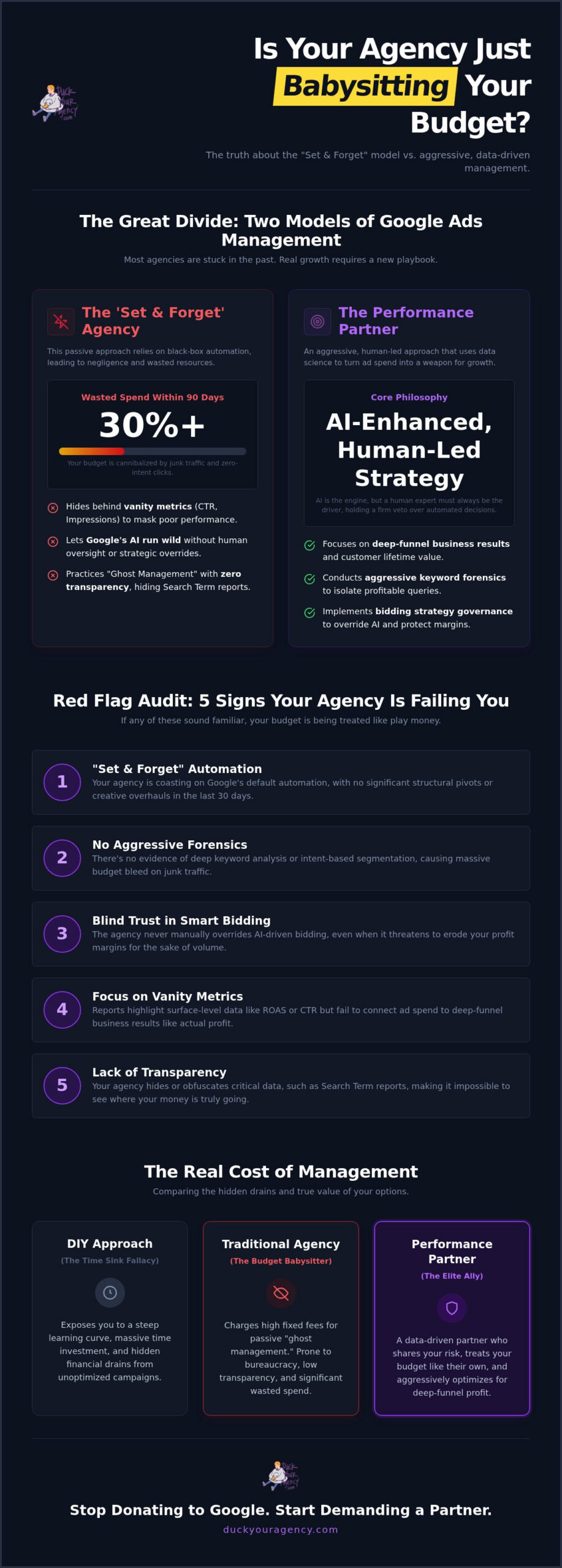
The “set and forget” mentality is a cancer in the online advertising space. Agencies love Google’s automation because it lets them scale their own internal inefficiencies. They let Performance Max and Smart Bidding do the heavy lifting while they sit back and collect a percentage of your spend. This laziness leads to a staggering reality: accounts under “passive” management often suffer from 30% or more wasted spend within the first 90 days. You are paying for junk traffic, brand cannibalization, and clicks that have zero intent to convert.

The Rise of ‘Ghost Management’ in PPC

Standard agencies have become addicted to Google’s “Recommendations” tab. These automated prompts are designed to increase Google’s revenue, not yours. Your account manager likely clicks “Apply All” and calls it optimization. They hide behind vanity metrics like Click-Through Rate (CTR) and Impressions to mask a lack of actual business growth. You don’t need reports that look pretty; you need reports that show profit.

Ghost Management is the practice of collecting management fees while letting black-box AI dictate budget allocation without human oversight.

Transparency vs. Obfuscation

Is your agency hiding the Search Terms report? If they aren’t showing you exactly what queries are triggering your ads, they’re likely hiding a mountain of waste. The “Black Box” of Performance Max has made it easier than ever for agencies to obfuscate poor performance. They claim they can’t see the placement data. We say they aren’t looking hard enough. Transparency is the only cure for budget bleed.

You need a “No-Fluff” policy. If a partner can’t explain the specific “Why” behind a spend increase or a strategy shift using raw data, they don’t know what they’re doing. A service provider follows a checklist; a performance partner shares your risk and treats your budget like it’s coming out of their own pocket. Stop settling for babysitters. Demand an elite ally who understands that fully managed google ads management means fighting for every cent of ROI.

The 2026 Playbook: What Real Google Ads Management Actually Looks Like

Real management in 2026 is a contact sport. If you’re paying for fully managed google ads management, you aren’t paying for a dashboard. You’re paying for a team that treats every auction like a high-stakes negotiation. The playbook has changed. It’s no longer about finding keywords; it’s about aggressive keyword forensics. We segment by intent, isolating the 5% of queries that drive 95% of your profit. Everything else is just noise.

Google pushes Smart Bidding because it’s good for Google. We implement bidding strategy governance to override the machine when it threatens your margins. This isn’t just about performance; it’s about compliance. Following FTC advertising guidelines ensures your messaging is as sharp as your strategy, avoiding the “black box” traps that lead to wasted spend and regulatory headaches.

AI-Enhanced, Human-Led Strategy

AI is the engine, but humans are the driver. We use AI for speed, but we maintain a strict human “veto” over every automated decision. In a world dominated by broad match, negative keyword sculpting is your only shield against budget bleed. You can’t just feed the machine; you have to steer it using high-quality first-party data. If you don’t own your data, the algorithm owns you.

Performance Max Governance

Performance Max is the ultimate black box, but we force the lid open. We demand transparency in placement data and ruthlessly optimize asset groups. Most agencies fail here because they treat creative as an afterthought. We treat it as a variable. Performance Max is a tool, not a strategy, and requires constant human guardrails to ensure it doesn’t spend your money on junk placements.

Creative refresh cycles are now mandatory every 14 to 21 days. Ad fatigue hits harder and faster in an AI-driven auction. If your headlines haven’t changed in a month, your ROI is already dying. We combine this with conversion tracking integrity to ensure the algorithm isn’t optimizing for “ghost” conversions. If the data is a lie, the results will be too. If you’re tired of the “set and forget” lies, it’s time to explore fully managed digital marketing that actually treats your budget like its own.

DIY vs. Traditional Agency vs. Performance Partners: The Real Cost

Choosing how to handle your fully managed google ads management is a decision between saving pennies and making millions. Most business owners fall for the DIY fallacy. They think “saving” the 15% to 20% industry standard management fee is a win. It isn’t. Without expert oversight, that saved fee usually results in 5x that amount being incinerated on junk traffic and broad-match errors. You aren’t saving money; you’re paying a “lack of expertise” tax directly to Google.

Traditional agencies aren’t much better. They lure you in with senior-level sales pitches but hand your account to a junior manager who is balancing 20 other clients. These agencies thrive on fixed fees and slow pivots. Because their revenue is locked in, they have zero incentive to hustle. They provide maintenance, not growth. If you want a partner who shares your risk, you need a performance partner who prioritizes data science and senior-level strategy over bureaucratic checklists. This is the same strategy-execution gap that plagues every marketing strategy consulting agency that delivers polished slide decks without the technical depth to execute in real-world auctions.

We believe that data is useless if it doesn’t lead to a kill. Our approach integrates Marketing Analytics Agency: Why Data Without Execution is Just Noise principles into every campaign. We don’t just report on what happened; we execute based on what the data says will happen next.

The Hidden Costs of ‘Cheap’ Management

Low management fees are a massive red flag. In 2026, a “budget” agency fee usually means your account is being handled by a script or an intern. These “churn and burn” shops don’t care if you leave after month three because their model relies on a constant stream of new, unsuspecting victims. You must quantify the opportunity cost of a stagnant ROAS. If your competitors are using fully managed google ads management to scale while you’re stuck in “testing” mode with a cheap provider, you’re losing market share every hour.

Building vs. Buying: The Scaling Ceiling

Hiring in-house sounds attractive until you see the bill. A qualified PPC specialist in 2026 costs between $60,000 and $85,000 per year plus benefits. Even then, an in-house team is a silo. They lack the “Agency-Level” data that comes from managing millions in spend across diverse industries. They often struggle to keep up with the rapid-fire pace of Google’s API changes, such as the September 1, 2026, mandatory AI Max upgrades. If you’re also evaluating your internal marketing talent strategy, working with a Digital Marketing Recruiter NYC who prioritizes performance execution over proximity can make the difference between a scaling engine and an expensive silo.

Duck Your Agency bridges the gap between high-level consulting and boots-on-the-ground execution. We provide the technical depth of a data science firm with the aggressive speed of an elite ad ops team. We don’t just fill a seat; we provide a scaling engine that an in-house hire simply cannot replicate. Many businesses searching for a Google Ads Agency NYC make the mistake of prioritizing proximity over performance execution, when the data consistently shows that results-driven partners outperform local shops regardless of zip code.

Fully Managed Google Ads Management: Why 'Set and Forget' is Killing Your ROI in 2026

Red Flag Audit: 5 Signs Your Current Google Ads Management is Failing You

If you haven’t looked under the hood of your account lately, you’re likely being robbed. Your agency calls it fully managed google ads management, but the data often tells a different story. Most agencies hide behind surface-level reports while your budget bleeds out through five specific wounds. If you spot even one of these red flags, your partner isn’t managing; they’re coasting at your expense.

The first sign is Search Query Bleed. Are you paying for your own brand name while your organic listing sits right below it? That’s brand cannibalization. Agencies love it because it inflates their ROAS with “easy” wins that would have converted anyway. Next is Stagnant Ad Copy. If your headlines haven’t changed in the last 90 days, your account is dead in the water. AI-driven auctions demand fresh creative to stay competitive. If they aren’t testing, they aren’t managing.

Attribution blind spots and the “Recommendation Score” trap are equally fatal. If your agency can’t track a lead from the first click to the final sale, they are just guessing with your money. They might brag about a 100% Optimization Score, but that usually means they’ve surrendered to Google’s “Apply All” button. This is exactly why AI Paid Search Agency: Why Traditional PPC is Dead is the only reality that matters in 2026. Traditional methods don’t cut it when the algorithm is designed to favor the house.

The Search Query Audit

Open your “Search Terms” report right now. If you see “Zero-Conversion” queries that have been eating budget for months, your agency is asleep. The “Broad Match” disaster is a common culprit. Without aggressive, human-led negative keyword sculpting, Google will match your ads to synonyms that have zero intent to buy. You are paying for “interest” when you need “intent.” A real partner identifies these leaks and plugs them weekly, not quarterly.

The ‘Apply All’ Red Flag

A 100% Optimization Score is a badge of surrender. It means your agency has allowed Google’s AI to dictate your strategy without oversight. You should almost always ignore recommendations to “Upgrade to Broad Match,” “Add Auto-Applied Assets,” or “Expand Your Reach” unless there is a specific, data-backed reason to comply. Human intuition still beats “Auto-Applied” scripts in high-stakes markets. If your current team can’t justify their “Apply” clicks with a profit-first logic, it’s time for a fully managed digital marketing audit to reclaim your margin.

Scaling with Duck Your Agency: Aggressive Management for Zero-Fluff Growth

The standard agency model is designed to scale the agency’s profit, not yours. We built the Anti-Agency Framework to destroy that conflict of interest. When you partner with us for fully managed google ads management, you aren’t being offloaded to a junior account manager who just graduated. You get senior-level strategy and a team that treats your budget like a high-stakes investment. We’ve eliminated the bureaucracy and replaced it with raw performance. We don’t do “check-ins.” We do execution.

Our approach lives at the intersection where Data Science meets Ad Ops. Most agencies stop at ROAS because it’s an easy metric to manipulate. We go deeper. We use custom models to predict Lead Lifetime Value (LTV) and optimize for actual bottom-line profit. This isn’t just about bidding on keywords; it’s about a total market takeover. By integrating Paid Search with Programmatic and Video Ads, we ensure your brand owns the auction across every relevant touchpoint. We discover what your customers are actually searching for, not just what’s easy for us to bid on.

Beyond the Click: Growth Marketing Integration

A click is just a cost until it converts. That’s why we align your Google Ads strategy with aggressive conversion rate optimization and content strategy. If your landing page is a conversion graveyard, we aren’t going to sugarcoat it. We’ll tell you exactly why it’s killing your ROI. This full-funnel mindset is why traditional firms are struggling to keep up. You can read more about why the old guard is crumbling in our breakdown of the Best Digital Marketing Agency: Why Traditional Firms Fail. We use YouTube and Programmatic channels not just for “awareness,” but to fuel the intent that drives your Search performance.

Your Elite Ally in the Auction

We are your elite ally, not a passive service provider. This is fully managed google ads management with a “tough love” edge. If your product pricing is off or your offer is weak, we’ll call it out. We aren’t here to be polite; we’re here to win. We act as a high-performance partner that identifies the inefficiencies your previous agency missed within the first 48 hours. We don’t wait for your monthly call to make a pivot. If the data shows a shift is needed at 2:00 AM on a Tuesday, we make it. Ready to stop babysitting your current agency and start scaling with a team that actually understands the math of growth? Let’s talk.

Reclaim Your Margin in the AI Era

The choice in 2026 is simple. You can keep donating your margin to Google’s automation, or you can take control of the auction. We’ve exposed the “Ghost Management” that’s draining your accounts. You now know that real fully managed google ads management is an active, aggressive process, not a monthly checklist. If you aren’t constantly auditing for search query bleed and overriding the machine, you are losing market share every day.

Duck Your Agency isn’t another shop hiding behind a dashboard. We deploy Data Science-led optimization models to find profit where others only see cost. We specialize in high-KD performance markets where the competition is brutal and the room for error is zero. You won’t be passed off to an intern. You get direct access to senior growth strategists who treat your budget like their own capital.

It’s time to stop the bleed and start the takeover. Stop wasting ad spend and start scaling with Duck Your Agency today. Let’s build the high-performance engine your business deserves. You’ve got the vision; we’ve got the data.

Frequently Asked Questions

What does fully managed Google Ads management actually include?

It includes aggressive keyword forensics, intent-based segmentation, and constant bidding strategy governance. We don’t just “maintain” your account. We actively refresh ad creative every 14 to 21 days and perform weekly negative keyword sculpting. You get senior-level strategy and data science models that optimize for profit, not just surface-level ROAS. It’s an elite partnership, not a passive service.

Is it better to manage Google Ads in-house or hire an agency?

Hiring in-house often leads to a scaling ceiling and high overhead costs. A qualified PPC specialist in 2026 costs between $60,000 and $85,000 annually. An elite agency provides access to senior growth strategists and cross-industry data that an in-house hire lacks. We bridge the gap between consulting and execution, offering a scaling engine that a single siloed employee simply cannot match.

How much should I pay for fully managed Google Ads management?

Industry standards for fully managed google ads management typically range from 15% to 20% of monthly ad spend. Most mid-sized accounts see agency fees in the $1,500 to $2,500 range. You should avoid “budget” providers offering low flat fees. These shops usually rely on scripts or interns, leading to massive budget bleed. Focus on value and ROI rather than just the management cost.

Can Google’s AI replace the need for a managed ads agency?

No, because Google’s AI is designed to maximize Google’s revenue, not your profit. While features like AI Max are powerful, they require constant human guardrails to prevent junk traffic. AI is a tool, not a strategy. Real management involves using data science to steer the algorithm, ensuring it prioritizes high-intent queries that actually drive business growth.

How long does it take to see results from managed Google Ads?

You should see structural improvements and a reduction in wasted spend within the first 48 hours. However, meaningful scaling and ROAS optimization typically take 30 to 90 days. Campaigns need at least 30 conversions per month to effectively utilize Google’s Smart Bidding. We prioritize immediate quick wins by plugging leaks while building a long-term strategy for total market takeover.

What are the biggest red flags to look for in a Google Ads agency?

Lack of transparency in the Search Terms report is the biggest warning sign. If your agency hides where your money is going, they’re likely hiding waste. Other red flags include stagnant ad copy, a 100% Optimization Score from auto-applying Google’s suggestions, and junior account managers handling high-spend budgets. If they can’t explain the why behind a spend increase, they’re just guessing.

How do you handle Performance Max in a managed account?

We treat Performance Max as a black box that needs to be forced open. Our team demands transparency in placement data and ruthlessly optimizes asset groups every few weeks. We don’t let PMax run wild on brand keywords or junk display sites. By using human intuition to set guardrails, we ensure this tool serves your bottom line rather than just inflating vanity metrics.

Do you require long-term contracts for managed advertising?

We believe in performance, not bureaucracy or lock-in contracts. If an agency needs a 12-month contract to keep you, they aren’t confident in their results. Our Anti-Agency framework focuses on radical accountability and tangible outcomes. We act as a high-performance partner. If we aren’t driving growth and lowering your CPA, we don’t deserve your business. It’s as simple as that.

  Category: Uncategorized
  Comments: Comments Off on Fully Managed Google Ads Management: Why ‘Set and Forget’ is Killing Your ROI in 2026

Google Ads Management for Scale: Stop Bleeding Cash and Start Dominating

You double your Google Ads budget and your ROAS doesn’t double. It collapses. CPCs blow out, lead quality tanks, and your agency sends you a slide deck full of impressions and click-through rates instead of answers. Sound familiar?

Here’s the brutal truth most agencies won’t tell you: scaling Google Ads isn’t a budget adjustment. It’s an infrastructure overhaul. The strategies that got you to $10k per month will actively destroy you at $100k. Google Ads management for scale operates by completely different rules, and most internal teams and traditional agencies simply don’t have the data science muscle or the accountability frameworks to play that game.

You already know something is broken. You’ve felt the performance ceiling. This article is going to show you exactly why it happens, what elite-level scaling actually requires, and how to build the kind of paid search operation that grows revenue without torching your margins. We’re covering the data models, the talent gaps, and the structural decisions that separate campaigns that dominate at scale from the ones that quietly bleed cash while everyone pretends the numbers look fine.

Key Takeaways

  • Doubling your budget without restructuring your campaigns is a guaranteed way to collapse ROAS — google ads management for scale requires a full infrastructure overhaul, not a spend adjustment.
  • Campaign consolidation using modern audience-first frameworks consistently outperforms granular keyword-heavy structures at high spend levels, and most agencies are still building the wrong way.
  • The talent running your accounts matters more than the budget fueling them — junior account managers and generalist hires are actively costing you money at scale.
  • Clicks and impressions are the metrics agencies hide behind; multi-touch attribution and revenue-tied data models are what actually tell you where your money is working.
  • There is a structural difference between passive campaign management and aggressive growth execution — and only one of them survives contact with serious scale.

The Scaling Plateau: Why Your Google Ads Budget is Bleeding

Scaling for scale isn’t about spending more. It’s the deliberate transition from tactical testing, where you’re validating what works, to aggressive market dominance, where you’re weaponizing what you know. That distinction sounds simple. Most businesses get it catastrophically wrong.

The core problem is structural. Pay-per-click advertising operates on an auction model where increased demand directly inflates costs. Push more budget into a mature campaign and you’re not buying more of the same traffic; you’re buying progressively worse traffic at progressively higher prices. This is the Law of Diminishing Returns in its most expensive form. The accounts that survive it are the ones built to anticipate it, not react to it.

There’s a hard line between spending more and scaling profitably. Spending more means increasing budgets and hoping the algorithm figures it out. Scaling profitably means expanding your addressable audience, deepening your data feedback loops, and maintaining CPA discipline as volume grows. One of these is a strategy. The other is an invoice.

Symptoms of a Broken Scaling Strategy

You’ll recognize the warning signs if you’re honest about your numbers. Rising CPAs that consistently outpace revenue growth is the first red flag. Not a temporary spike during a competitive window, but a sustained upward trend that your team keeps explaining away. Ad fatigue compounds this fast. Campaigns built around low-hanging fruit audiences saturate quickly, and once that initial performance window closes, you’re left with inflated frequency, declining CTR, and a creative strategy that hasn’t evolved to meet it.

The trap that quietly destroys scaling ambitions? Over-reliance on branded search to prop up ROAS figures. Branded campaigns convert well because the user already wants you. That’s not paid search doing work; that’s brand equity doing work. Padding your account-level ROAS with branded volume while non-branded campaigns bleed is one of the most common ways agencies manufacture good-looking reports from bad performance.

The Infrastructure Gap

Here’s the uncomfortable truth about most accounts attempting serious scale: the architecture was never built for it. Granular campaign structures that performed well at lower spend levels become brittle and data-starved at high volume. Google’s smart bidding algorithms need consolidated, clean conversion signals to function. Fragment your data across too many campaigns and you’re essentially asking the machine to optimize blind.

Effective google ads management for scale runs on data feedback loops: real-time conversion data flowing back into bidding systems, audience signals refreshing continuously, and creative performance informing budget allocation decisions. Without those loops, budget waste isn’t a possibility. It’s a certainty.

Scaling infrastructure is the combination of tracking, talent, and tech working as a single, integrated system. Miss any one of those three and the whole thing leaks. Proper google ads management for scale demands all three operating at a level that most internal teams and traditional agencies simply aren’t resourced to deliver.

Structural Integrity: Building Campaigns That Don’t Break

Most accounts hitting a scaling wall aren’t suffering from a budget problem. They’re suffering from an architecture problem. The granular, keyword-heavy structures that felt like best practice at $10k per month become a liability at $100k. Too many campaigns, too little data per campaign, and Google’s smart bidding algorithms are essentially flying blind. The fix isn’t more granularity. It’s less.

The Hagakure method, sometimes called the Modern Search approach, consolidates campaigns into fewer, broader structures that funnel maximum conversion data into each bidding pool. Instead of fragmenting signals across dozens of tightly themed ad groups, you’re concentrating them. The algorithm gets what it needs to optimize. Your team gets a cleaner account to actually manage. Both outcomes matter at scale.

The other structural shift that separates scalable accounts from stagnant ones is the move from keyword-first to audience-first targeting. Keywords tell you what someone typed. Audiences tell you who they are, what they’ve done, and how likely they are to convert. At high spend levels, layering Customer Match lists, in-market segments, and remarketing audiences onto your campaigns isn’t optional. It’s the difference between buying traffic and buying intent.

Performance Max deserves its own conversation because the instinct to avoid it is understandable but often wrong. pMax consolidates inventory across Search, Display, YouTube, Gmail, and Maps under a single campaign. The control trade-off is real, but the reach isn’t available any other way. The non-negotiable safeguard: brand exclusions and negative keyword lists applied at the account level before pMax goes live. Without those guardrails, pMax will happily cannibalize your branded search traffic and make the numbers look spectacular while doing it.

Broad Match paired with Smart Bidding is the high-volume engine most accounts are afraid to run. That fear is legitimate when supervision is weak. With strong conversion data, tight audience signals, and an experienced team monitoring search term reports actively, Broad Match unlocks reach that exact and phrase match simply can’t access. The keyword isn’t the lever. The audience signal and the bidding model are the levers.

Advanced Bidding Strategies for Volume

Target CPA is a starting point, not a destination. At serious scale, value-based bidding via tROAS is the only model that reflects what conversions are actually worth. Not all leads are equal. Not all purchases carry the same margin. Feeding revenue values back into your bidding signals lets Google optimize for profit, not just volume. Seasonality Adjustments layer on top of this during aggressive growth windows, signaling expected conversion rate changes so the algorithm doesn’t overcorrect and throttle spend at exactly the wrong moment. Budget capping is where most teams quietly sabotage themselves. Hard daily caps interrupt Google’s learning cycles, create uneven delivery patterns, and suppress performance during high-intent windows. At scale, budgets should be set with headroom, with CPA and ROAS targets doing the actual work of controlling spend efficiency.

YouTube and Programmatic: The Scale Multipliers

Search captures demand. It doesn’t create it. Businesses serious about google ads management for scale eventually hit the ceiling of what existing search demand can deliver, and that ceiling arrives faster than most expect. YouTube video ads build top-of-funnel awareness that replenishes the search pipeline, and the downstream effect on Search CPAs is measurable: warmer audiences convert more efficiently and bid less competitively against themselves. Programmatic extends this logic outside the Google ecosystem entirely, capturing intent signals across third-party inventory that Search and pMax can’t touch. Running these channels in isolation is a mistake. The accounts that scale without margin collapse are the ones treating Search, YouTube, and Programmatic as a single, coordinated system, not three separate budget lines.

Building that kind of integrated infrastructure requires more than good campaign settings. It requires the right people running it. If you’re evaluating whether your current team or agency has the capability to execute at this level, explore what elite-level paid search management actually looks like before your next budget increase goes live.

The Talent Gap: Managed Services vs. Marketing Recruitment

Fix the campaign structure. Nail the bidding model. Build the attribution framework. None of it matters if the person running the account can’t execute at the level the strategy demands. This is the talent gap, and it’s the reason most scaling attempts collapse even when the technical foundations are solid.

The agency model has a dirty secret: your $50k per month account is being managed by someone earning $45k per year. Junior account managers get handed high-spend accounts because agencies are built to maximize margin, not maximize your results. They know the interface. They can pull reports. What they can’t do is diagnose why your tROAS target is suppressing volume during a high-intent window, or architect a data feedback loop that keeps smart bidding calibrated as spend scales. That gap costs you more than their salary ever will, which is why many brands in the Gulf prefer working with a dedicated performance marketing specialist like mohit.ae to ensure their budget is managed with senior-level expertise.

In-house isn’t automatically the answer either. Hiring a generalist “Digital Marketing Manager” to oversee serious google ads management for scale is a different version of the same problem. Generic resumes signal generic capability. High-spend paid search demands specialists who’ve operated at volume, made expensive mistakes on someone else’s budget, and built the pattern recognition that only comes from managing real complexity. If you’re unsure whether your current setup qualifies, a review of what genuine paid search consulting services actually deliver at scale will make the gap immediately obvious.

Why Your HR Department Can’t Hire for Growth

Standard recruitment processes aren’t designed to identify performance talent. HR screens for credentials and culture fit. Neither predicts whether someone can manage a $200k monthly paid search budget without bleeding margin. The top 1% of performance marketers don’t look different on paper. They think differently under pressure, they interrogate data instead of reporting it, and they hold themselves accountable to revenue outcomes rather than activity metrics. Identifying that requires a filter that most internal hiring processes simply don’t have.

Duck Your Agency’s recruitment service exists precisely because this problem is structural, not accidental. The process is built around performance-specific vetting: technical depth, analytical rigor, and a demonstrated track record of scaling accounts without destroying efficiency. Culture matters too, but a culture of accountability has to survive budget scaling, and that means hiring people who are uncomfortable with mediocre numbers, not people who are comfortable explaining them away.

The Managed Consulting Hybrid

There’s a decision point every scaling business hits: do you outsource execution or build internal capability? The honest answer is that the timing matters as much as the choice. Fully managed services offer speed-to-market that recruitment simply can’t match. When you need performance now, not in three months after onboarding, a managed execution model removes the lag entirely.

The smarter play for businesses with genuine long-term scaling ambitions is the hybrid: external consulting and managed execution running in parallel with a recruitment process that’s building toward internalization. This isn’t a gap-fill. It’s a deliberate transition that protects performance during the talent acquisition window while transferring institutional knowledge to an internal team that’ll own the accounts long-term.

What separates a real partner from a retainer-chasing agency is simple: one of them is invested in your growth beyond the contract, and the other is invested in renewing it. For google ads management for scale, that distinction is the difference between a team that builds your capability and one that quietly depends on you never developing it.

Data Science & Attribution: Scaling Beyond the Click

Clicks don’t pay salaries. Impressions don’t close deals. At serious spend levels, reporting on either is the equivalent of measuring how many times your sales team picked up the phone without asking whether anyone bought anything. Vanity metrics are the comfort food of underperforming agencies, and if your weekly report leads with CTR, you’re being managed by someone who’s optimizing for the report, not the revenue.

Effective google ads management for scale treats every dollar as a data point in a predictive model, not a line item in a spreadsheet. The question isn’t “how many clicks did we get?” It’s “which signals, channels, and audience intersections are generating the highest lifetime value, and how do we allocate the next dollar to compound that?” That’s a data science question. Most agencies aren’t equipped to answer it.

The Death of Last-Click Attribution

Last-click attribution is a lie your reporting has been telling you. It hands 100% of the conversion credit to the final touchpoint, which means YouTube, programmatic, and upper-funnel Search campaigns get zeroed out while branded search takes all the glory. The customer who watched your YouTube ad, retargeted through display, searched your brand name, and converted gets recorded as a branded search conversion. YouTube gets cut from the budget. The cycle repeats.

Data-Driven Attribution (DDA) distributes credit across every touchpoint that contributed to the conversion, weighted by actual influence. It’s not perfect, but it’s a fundamentally more honest picture of how your channels interact. Pair DDA with incrementality testing, which measures the actual revenue lift your campaigns generate against a control group that didn’t see the ads, and you’ve got the only metric that actually defines scaling success: did this spend create demand that wouldn’t have existed without it?

Marketing Analytics Dashboards

Executive dashboards built on platform-native data are a delayed, fragmented version of reality. The accounts that scale without margin collapse are running real-time truth dashboards: unified views that pull CRM conversions, offline purchase data, and Google Ads performance into a single source that updates continuously. Connecting offline conversion tracking back into Google Ads via the GCLID pipeline closes the loop between a form submission and an actual closed deal, giving smart bidding the revenue signal it needs to optimize for profit instead of lead volume.

This is where data science earns its place in the stack. Predictive models built on historical conversion patterns, seasonality curves, and audience overlap analysis can identify budget waste in real time and forecast where the next tranche of spend will generate the highest marginal return. That’s not reporting. That’s competitive intelligence.

First-party data is the sharpest edge in this fight. Customer Match lists built from your CRM, suppression lists that exclude recent converters, lookalike expansions seeded from your highest-LTV customers: these signals are exclusive to you. Your competitors can’t buy them. Google’s algorithm rewards accounts that feed it better data, and there’s no faster way to widen that gap than integrating your CRM directly into your bidding infrastructure.

If your current setup can’t connect CRM data to campaign performance, you’re not running google ads management for scale. You’re running a very expensive guessing game. Find out how integrated data science changes what your ad spend can actually do.

Duck Your Agency: Scaling Without the Industry Fluff

Most agencies manage your account. Duck Your Agency executes against it. That’s not a semantic distinction; it’s the operational difference between a team that monitors dashboards and one that treats every underperforming campaign as a problem that belongs to them personally. Passive management is comfortable. It’s also how businesses quietly bleed cash for months before anyone admits the numbers are broken.

The Duck Your Agency model is built on a single filter: if it doesn’t drive revenue, it doesn’t stay. Not “let’s monitor it for another quarter.” Not “the algorithm needs more time.” Gone. That philosophy runs through every layer of how campaigns are built, how data is interrogated, and how performance is reported. Vanity metrics don’t survive the conversation. Revenue does.

What makes this model genuinely different for google ads management for scale is the integration. Managed execution, strategic consulting, and performance-specific recruitment aren’t three separate service lines running in parallel; they’re a single system designed to scale with you. When your campaigns need senior-level strategy, it’s there. When your business is ready to build internal capability, the recruitment infrastructure is already in place to find the right people without the guesswork. The model doesn’t require you to outgrow it. It grows with you.

The Duck Your Agency Advantage

Senior strategists run your accounts. Not interns learning on your budget. Not account managers who escalate every decision upward. The people with the pattern recognition, the hard-won instincts from managing serious spend, and the technical depth to architect full-funnel systems from YouTube awareness through to Search conversion. That access isn’t reserved for top-tier clients. It’s the baseline.

Transparency is non-negotiable here. Most agencies are afraid to show you the real numbers because the real numbers reveal where their decisions cost you money. Duck Your Agency builds reporting around accountability, not optics. You see what’s working, what isn’t, and exactly what’s being done about it.

Ready to Scale? Let’s Talk Results

A standard agency pitch is a waste of your time. Slide decks full of case studies, proprietary frameworks with trademarked names, and promises that evaporate six weeks into the retainer. Skip it. What actually tells you whether a partner can execute is a performance audit that identifies the specific structural, attribution, and talent gaps that are suppressing your current results.

A Duck Your Agency performance audit goes looking for scale killers: campaigns leaking spend through poor conversion signal architecture, bidding strategies suppressing volume during high-intent windows, attribution models misrepresenting which channels are actually driving revenue. These aren’t hypothetical problems. They’re expensive ones hiding inside accounts that look fine on the surface.

If your current google ads management for scale setup can’t answer where your next dollar generates the highest marginal return, that’s the audit finding. And that’s where the work starts.

Stop settling for average. Scale your Google Ads with Duck Your Agency.

Scale Smarter. Stop Settling for Broken.

Google ads management for scale isn’t a budget problem. It never was. It’s a structural problem, a talent problem, and a data problem, all compounding simultaneously while your agency sends you a report that leads with impressions. The accounts that break through the scaling ceiling aren’t spending more than their competitors. They’re built differently, run by better people, and fed cleaner data.

That’s the gap Duck Your Agency closes. Elite Filter recruitment puts the right specialists on your accounts, not juniors learning on your budget. Advanced data science optimization replaces guesswork with predictive intelligence. And fully managed full-funnel expertise means Search, YouTube, and programmatic working as one coordinated system, not three disconnected budget lines.

The businesses that dominate at scale don’t wait until performance collapses to make the call. They make it before the next budget increase goes live.

Scale your revenue with Duck Your Agency and find out exactly what your current setup is costing you.

Frequently Asked Questions

What is the biggest mistake companies make when scaling Google Ads?

The biggest mistake is treating a budget increase like a volume knob. It isn’t. Scaling is a structural overhaul, not a spending adjustment. Most businesses try to push more cash through a fragile account architecture that worked at low spend but collapses under high volume. If you don’t consolidate your data signals and tighten your feedback loops, you aren’t scaling; you’re just overpaying for the same conversions.

How much budget do I need to start scaling Google Ads aggressively?

Budget is secondary to data density. You need enough spend to generate at least 30 to 50 conversions per month per campaign for Google’s machine learning to function. Aggressive scaling usually becomes viable once you’ve stabilized performance at $10,000 per month and have the tracking infrastructure to prove your ROI is real. Scaling without statistical significance is just expensive guessing.

Can I scale Google Ads using only automated bidding?

Automation is a tool, not a strategy. You can scale with it, but it requires elite supervision to prevent the algorithm from chasing low-quality conversions that look good on a report but don’t drive revenue. Effective google ads management for scale uses automated bidding as the engine while humans provide the guardrails, audience signals, and creative direction that the machine can’t replicate.

How do I prevent my CPA from doubling when I increase my budget?

You stop chasing “low-hanging fruit” and start building a full-funnel strategy. CPAs explode when you exhaust the tiny pool of high-intent searchers and try to buy more of them by simply bidding higher. To keep costs stable, you must expand your addressable audience through YouTube and Programmatic ads while using value-based bidding to tell Google which users are actually worth the higher cost.

Should I hire a Google Ads agency or build an in-house team for scale?

Don’t choose one when you can have the benefits of both. Agencies offer immediate speed and specialized expertise, but an in-house team owns your institutional knowledge. The smartest move is a hybrid approach: use a managed service to architect the scale—specialized partners like Future Marketing para Saúde are often used to handle the complexities of specific verticals like healthcare—then utilize specialized recruitment to hire the top 1% of performance talent when you’re ready to bring that capability inside.

What role does YouTube advertising play in scaling Google Search campaigns?

YouTube is a demand generation engine. Search captures the demand that already exists, but that demand is finite. YouTube ads build the top-of-funnel awareness that replenishes your search pipeline. By warming up audiences before they ever hit the search bar, you lower your Search CPAs and increase your overall market share in ways that search-only accounts can’t match.

How long does it take to see results when scaling a Google Ads account?

Expect a 14 to 30 day learning phase for any major structural change. Google’s algorithm needs time to process new data signals and calibrate bidding for the increased volume. True scaling results that reflect in your bottom line usually materialize within 60 to 90 days as the infrastructure matures and the feedback loops between your CRM and the ad platform tighten.

What is a ‘Performance Audit’ and why do I need one before scaling?

A Performance Audit is a brutal diagnostic of your account’s structural integrity. You need it because scaling a broken account only makes it break faster. The audit identifies “Scale Killers” like fragmented campaign structures, poor conversion tracking, and creative fatigue. It ensures your foundation is solid before you pour fuel on the fire, preventing the budget bleed that kills most growth attempts.

  Category: Uncategorized
  Comments: Comments Off on Google Ads Management for Scale: Stop Bleeding Cash and Start Dominating