Your startup isn’t failing because of your code. It’s failing because your marketing partner thinks a thirty day turnaround is agile. If you’re currently burning runway while a project manager aligns with their creative team, you’re being robbed. Speed is the only metric that dictates survival in 2026. Selecting a paid search agency for startups isn’t just a procurement task. It’s a high stakes decision that determines whether you scale or starve. You need an elite ally, not a slow motion vendor.

You’re right to be frustrated with account managers who can’t explain your LTV/CAC ratios. We’ll show you how to stop wasting ad spend on low intent garbage and start demanding high velocity performance. This article provides the blueprint for identifying and managing a partner that functions as a seamless extension of your team. We’ll break down how to secure clean data for your next board meeting and ensure your customer acquisition moves fast enough to keep the lights on. It’s time to stop playing house with agencies that treat your budget like a hobby and start scaling with precision.

Key Takeaways

  • Eliminate the “Startup Performance Gap” by ditching agencies that hide behind four-week onboarding phases. Speed is your only survival metric in 2026.
  • Identify a high-velocity paid search agency for startups by asking five non-negotiable questions about pivot times and CRM integration.
  • Move beyond basic Google Ads management. Success now requires a technical data science layer and programmatic top-of-funnel strategies to win the auction.
  • Implement a high-cadence management framework. Learn why weekly reporting and aggressive testing cycles are mandatory for rapid scaling.
  • Adopt the “Anti-Agency” approach. Shift from passive outsourcing to a fully managed execution model that functions as an elite extension of your internal team.

The Startup Performance Gap: Why Generalist Agencies Are Killing Your Runway

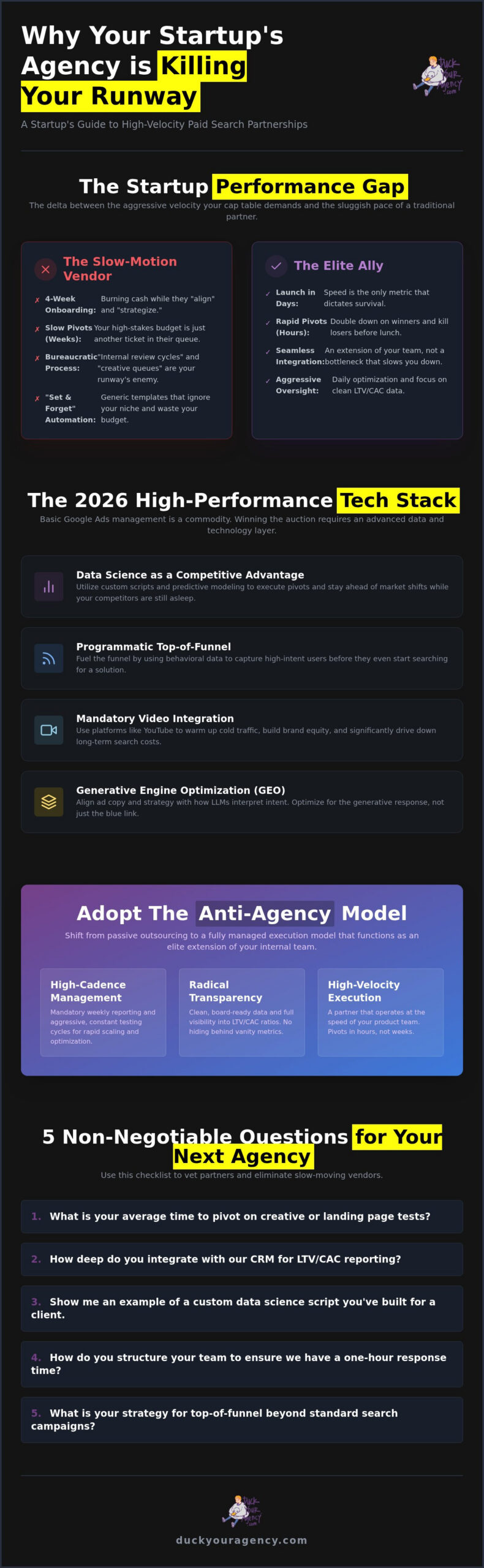
Your VC expects 10x growth. Your agency expects a four week onboarding phase. This is the Startup Performance Gap. It’s the delta between the aggressive velocity your cap table demands and the sluggish, bureaucratic pace of a traditional partner. For a high growth company, time isn’t just money; it’s survival. Every day your ads underperform is a day you’re burning cash without a return. Most generalist agencies don’t get this. They’re built for stability, not the high stakes volatility of a scaling business.

The digital advertising landscape is littered with the remains of startups that trusted “onboarding phases.” Let’s be clear: a month long setup process is usually just a paid excuse for agency laziness. They’re using your retainer to train a Junior Account Manager on your niche. While they “align” and “strategize,” your competitors are eating your market share. You don’t need a partner that needs a map; you need one that already knows the terrain. A specialized paid search agency for startups understands that a pivot needs to happen in hours, not weeks.

Traditional agencies favor high spend stability. They want clients who spend the same amount every month with minimal changes. Startups are the opposite. You need to double spend on a winning creative today and kill a failing landing page by lunch. When you’re handled by a junior who manages forty other accounts, your “high stakes” budget is just another ticket in their queue. That’s a death sentence for your runway.

The “Set and Forget” Trap

Automated bidding is a powerful tool, but without human oversight, it’s a lean budget killer. Generalist agencies love automation because it lets them ignore your account. They apply generic templates that ignore the nuances of your specific niche. In a high burn environment, you need daily optimization. If your agency isn’t looking at your LTV/CAC ratios every single day, they aren’t managing your spend. They’re just watching it disappear. CLEAN data and aggressive oversight are the only ways to beat the “set and forget” mediocrity that plagues the industry.

Bureaucracy vs. Velocity

If your agency takes three days to respond to an email, they’re already too slow. Your internal product team moves in sprints; your marketing partner should do the same. You need a one hour pivot, not a scheduled meeting for next Tuesday. Identifying a slow moving agency is easy if you know the red flags. During the first call, ask about their average time to launch a new creative. If the answer involves “internal review cycles” or “creative queues,” run. You need a paid search agency for startups that functions as an elite extension of your team, not a bottleneck that slows you down.

The 2026 Startup Tech Stack: Beyond Basic Google Ads Management

In 2026, the auction is an arms race. If your agency is still manually tweaking bids on “best SaaS platform,” you’ve already lost. Basic management is a commodity. Performance now requires a heavy Data Science layer to outmaneuver the competition. A modern paid search agency for startups must integrate programmatic advertising to fuel the top-of-funnel. This isn’t about spray and pray. It’s about using behavioral data to capture intent before a user ever hits the search bar.

Integrating video ads, specifically YouTube, into your search funnel is mandatory. It builds the brand equity needed to drive down search costs later. If you aren’t using video to warm up audiences, you’re paying a premium for cold traffic. Most agencies ignore this because it’s hard to track. We don’t. We focus on LTV-based bidding because ROAS is a vanity metric for companies that want to stay small. Scaling requires knowing exactly what a customer is worth over twelve months, not just twelve minutes.

Generative Engine Optimization (GEO) in Paid Search

AI-driven results are fundamentally changing how ads are placed. Generative Engine Optimization is the critical bridge between traditional PPC and AI-led search. Users are moving toward conversational queries. Your ad copy needs to reflect this shift. If your headlines don’t align with how LLMs interpret intent, your visibility will vanish. You need a partner that understands how to optimize for the generative response, not just the blue link.

Data Science as a Competitive Advantage

Off-the-shelf Google Ads features are for amateurs. To dominate, you need custom scripts that execute pivots while your competitors are still sleeping. Predictive modeling is the only way to stay ahead of the burn. It allows you to identify high-value cohorts and double down before the market reacts. This level of Data Science Execution is what separates the unicorns from the casualties. If you want to stop wasting runway on best effort management, our growth marketing consultants can deploy these technical layers immediately. Execution is everything. Data without it is just expensive noise.

Vetting Your Partner: 5 Non-Negotiable Questions for a Startup PPC Agency

Stop asking about “culture fit” and start asking about technical velocity. Most vetting processes are too soft; they focus on price tags rather than performance ceilings. When you’re selecting a paid search agency for startups, you need to interrogate their ability to move at your speed. If they can’t handle the volatility of a high-growth environment, they’ll just bleed your runway dry. Use these five non-negotiable questions to filter out the dead weight before you sign a retainer.

  • “What is your average pivot time for a new creative or campaign direction?” If the answer is longer than 24 hours, they’re too slow for 2026.
  • “How do you integrate our CRM data into the ad auction in real-time?” Manual CSV uploads are for amateurs. You need automated API pipelines to feed the algorithm clean data.
  • “Can you show us a case study where you lowered CPA by at least 40% in 90 days?” Proof of aggressive optimization is the only credential that matters.
  • “Who is actually pushing the buttons on our account daily?” Demand an elite expert, not a junior intern who is learning on your dime.
  • “What is your strategy for GEO and AI search disruption?” If they don’t have a plan for conversational queries, they’re already obsolete.

The Transparency Test

Account ownership is non-negotiable. Never let an agency “own” your ad accounts or hide your data behind proprietary dashboards. This is a common tactic used to mask underperformance and make firing them difficult. You need full, direct access to the raw numbers. Watch out for “Blended ROAS” as a primary KPI. It’s often a mask for failing search campaigns being propped up by organic traffic or branded spend. If you spot artificial inflation in their performance reports, terminate the relationship immediately. Clean data is the only way to make informed decisions for your board.

The Strategy-Execution Alignment

Consulting is fluff without the managed services to back it up. Your agency lead must understand your unit economics, not just “keywords” and “bidding.” If they can’t speak fluently about your LTV/CAC ratios, they’ll never scale your business effectively. Most marketing failures happen because of the Strategy-Execution Gap. You need a partner that can translate high-level growth goals into tactical, daily wins. Don’t settle for a “strategic partner” who can’t execute at the speed of your product team. Speed and precision are the only things that determine who wins the auction.
Paid Search Agency for Startups: Why Speed is Your Only KPI in 2026

Scaling Velocity: How to Manage Your Agency for Aggressive Growth

Monthly reports are a cemetery for startup dreams. If you’re only looking at performance once every thirty days, you’re already dead. When you hire a paid search agency for startups, you aren’t paying for a dashboard; you’re paying for velocity. A high-performance partner operates on a weekly cadence. You need to know what happened last Tuesday so you can win next Wednesday. This isn’t just about looking at numbers; it’s about an Aggressive Testing framework. You should be rotating creatives, landing pages, and bidding strategies constantly. If your agency isn’t breaking things to find what works, they’re just collecting a fee. Optimization isn’t a one-time event. It’s a daily ritual.

The Feedback Loop

Your agency shouldn’t operate in a vacuum. They need your sales feedback and lead quality data in real-time. If the leads are garbage, tell them at 10 AM, not at the end of the month. Setting “Flash Alerts” is mandatory. If your CPA exceeds a specific threshold, someone needs to be notified immediately. This requires a shared Slack channel. Email is too slow. A high-speed communication channel ensures that pivots happen in minutes. If you want to stop the bleed, you need to tighten the loop. Execution speed is your only real defense against a rising CAC. A paid search agency for startups that hides behind a ticketing system is an agency that is killing your runway.

Integrated Growth Strategies

Paid search is the tip of the spear, but it doesn’t work alone. It should feed your retargeting engines across programmatic and video channels. Use search data to identify high-intent users, then follow them with precision. This is how you balance “Capture” (Search) with “Creation” (Demand Gen). You need to verify your partner’s Programmatic Advertising Performance to ensure they aren’t just wasting impressions on low-value traffic. Integrated growth means every dollar spent on search makes your video ads smarter and your programmatic placements more efficient.

Knowing when to push for more budget versus when to optimize is a technical science. If your CAC is below your target and your volume is low, spend more. If your CPA is spiking, cut the fat. Most agencies will just tell you to spend more because they get a percentage of spend. We don’t. Our Fully Managed Digital Marketing services focus on aggressive efficiency. We treat your runway like it’s our own. Stop letting slow agencies kill your growth. Start moving at startup speed.

Duck Your Agency: The Anti-Agency Built for Startup Scale

Most agencies are built to survive on your retainer. We’re built to scale your business. We are the elite, specialized ally you need when the stakes are high and the runway is short. As a paid search agency for startups, we’ve stripped away the traditional bureaucracy and replaced it with raw execution. No junior account managers. No fluff. Only experts who understand that your runway is a finite resource. We don’t just manage accounts; we bridge the gap between where you are and where your cap table demands you to be.

We focus on Fully Managed Digital Marketing because you have a product to build. You shouldn’t be wasting your time worrying about bid adjustments or keyword match types. We deploy a technical data science layer to ensure your customer acquisition is both aggressive and efficient. This approach provides the clean, actionable data that satisfies founders and VCs alike. We treat your ad spend with the same urgency you do, focusing on lowering CPA and maximizing LTV from day one. Execution is our only priority.

The Recruitment Advantage

We’re the only partner confident enough to help you hire our replacement. Our Digital Marketing Recruitment services are designed to help you build an internal team that eventually takes the reins. We don’t want to be a permanent crutch; we want to be the engine that gets you to the next stage. By helping you source top-tier talent, we ensure you eventually own your marketing machine. This is the ultimate “Rebel Expert” move. We manage your ads today to get immediate results while recruiting your team for tomorrow. It’s about building a sustainable, high-performing marketing infrastructure that stays within your company.

Ready to Scale?

If you’re tired of slow-motion vendors and “set and forget” mediocrity, it’s time to pivot. We provide a no-nonsense commitment to your ROI. Stop letting passive management kill your growth. You can see why Fully Managed Google Ads are the only way to avoid the traps that drain startup budgets. We don’t do “best efforts.” We do high-velocity execution that scales at startup speed.

Your runway is ticking. Every day you spend waiting for an agency “review cycle” is a day you’re losing market share. Stop playing defense with your marketing. If you’re a high-growth startup ready for an aggressive, data-backed partner that acts as an extension of your internal team, let’s talk. No excuses. No fluff. Just performance that moves as fast as you do.

Stop Burning Runway and Start Dominating the Auction

The auction doesn’t care about your “strategic alignment” meetings or your agency’s thirty day onboarding plan. In 2026, the only thing that matters is velocity. You’ve seen the cost of the Startup Performance Gap. You know that basic management is a commodity and that a data science layer is the only way to beat the competition. Choosing the right paid search agency for startups is the difference between a successful Series B and a quiet liquidation. It’s time to demand more than just “best efforts.”

We provide the specialized startup growth framework and data-science backed optimization needed to scale aggressively. Our model is unique because we actually help you build for the future with recruitment support for internal scaling. We execute while you build, then we help you hire the team that takes over. It’s transparent. It’s aggressive. It’s effective. Stop wasting your runway and scale with a partner that moves at startup speed. Your market share is waiting. Go get it.

Frequently Asked Questions

How much should a startup spend on paid search per month?

Startups should spend enough to generate statistically significant data quickly, often starting with a budget that allows for at least 50 to 100 conversions per month. If you’re spending less than what’s required to test your unit economics, you’re just gambling. The exact figure depends on your industry’s CPCs and your growth targets. Don’t look for a “safe” number; look for the number that proves your model works.

Is Google Ads better than Meta Ads for early-stage startups?

Google Ads is generally better for capturing existing high-intent demand, while Meta Ads excels at generating new demand through visual storytelling. For most early-stage startups, search is the priority because it targets users actively looking for a solution. However, a balanced strategy often uses search to capture and social to scale. Start where the intent is highest to protect your runway and prove product-market fit.

What is the typical onboarding time for a high-velocity paid search agency?

A high-velocity paid search agency for startups should be fully operational within 48 to 72 hours. If an agency asks for three or four weeks to “onboard,” they’re wasting your time and capital. Rapid execution is the only way to stay ahead of your burn rate. You need a partner that arrives with a proven framework ready to deploy, not one that needs a month to learn your business.

How do I know if my current agency is underperforming?

You know they’re underperforming if your CAC is stagnant or rising while your pivot speed is measured in weeks rather than hours. Another red flag is a lack of technical depth, such as failing to integrate CRM data or ignoring LTV-based bidding. If they’re hiding behind “brand awareness” metrics and can’t show a direct impact on your bottom line, it’s time to fire them and move on.

Can a paid search agency help with my Series B fundraising data?

Yes, an elite agency provides the clean, granular data required to prove your unit economics to VCs. We focus on delivering precise LTV/CAC ratios and cohort analysis that demonstrates a scalable growth engine. This data is critical for Series B rounds where investors demand proof of efficiency. A partner that understands the venture landscape acts as a technical extension of your leadership team during the fundraising process.

What is GEO and should my startup care about it yet?

Generative Engine Optimization (GEO) is the process of optimizing your presence for AI-driven search results and LLMs. Your startup needs to care about it immediately because conversational queries are replacing traditional keyword searches. If your ads and content don’t align with how AI interprets intent, you’ll lose visibility as search engines evolve. It’s the critical bridge to maintaining market share in an AI-first digital landscape.

Why do most startups fail at paid search in their first six months?

Most startups fail because they treat paid search like a “set and forget” channel rather than a high-velocity experiment. They often waste spend on low-intent keywords or fail to optimize their landing pages for conversion. Without a technical data science layer and aggressive daily oversight, lean budgets get eaten by the auction. Failure usually stems from a lack of speed in testing and a refusal to kill underperforming campaigns quickly.

Should I hire an agency or an in-house PPC manager first?

You should hire a specialized paid search agency for startups first to establish a winning framework and find product-market fit. Agencies bring a breadth of cross-industry data and technical tools that a single hire can’t match. Once the channel is proven and profitable, you can use our recruitment services to hire an internal lead who inherits a high-performing machine. This approach minimizes risk and maximizes early-stage growth velocity.
  Category: Uncategorized
  Comments: Comments Off on Paid Search Agency for Startups: Why Speed is Your Only KPI in 2026

Your latest 40-page slide deck from a marketing strategy consulting agency is likely just expensive fan fiction. It looks brilliant in the boardroom, but it fails the moment it hits the real world of programmatic auctions and shifting search algorithms. You’ve probably already felt the sting of paying for a “strategic roadmap” that provides zero actionable insight, leaving your team to stare at disconnected data silos while your budget evaporates. It’s the classic strategy-execution gap, and in 2026, it is a terminal condition for growth.

We agree that high-level thinking is useless if your consultants don’t understand the technical reality of paid search or data science. This article will expose the expensive myths of traditional consulting and show you how to build a marketing strategy that actually scales revenue. You will learn how to lower your CPA through data-driven optimization and create a measurable bridge between business goals and ad spend. We are moving past the fluff. We are diving into the managed services and technical execution required to turn a plan into a profit engine.

Key Takeaways

  • Stop settling for creative fluff and learn why a modern marketing strategy consulting agency must prioritize technical data science over subjective roadmaps.
  • Identify the “Slide Deck Trap” and why separating strategic theory from tactical execution is a recipe for wasted budget.
  • Discover the critical difference between vanity reporting and actionable data science that actually informs your programmatic and search auctions.
  • Learn the specific “In-the-Weeds” test to verify if your strategist can actually navigate a Google Ads auction before you sign the contract.
  • Transition from passive consulting to a managed growth model that bridges the gap between business goals and real-world ad spend.

What is a Marketing Strategy Consulting Agency in 2026?

In 2026, a marketing strategy consulting agency isn’t a group of suits selling “vibes” and mood boards. It’s a technical partner that bridges the gap between high-level business goals and the gritty reality of media buying. The foundational Marketing strategy has evolved. It’s no longer just about positioning; it’s about building data-driven growth models that survive contact with the market. Performance strategy is the new standard. If your consultant focuses on brand awareness without a clear path to conversion, they’re just an expensive distraction.

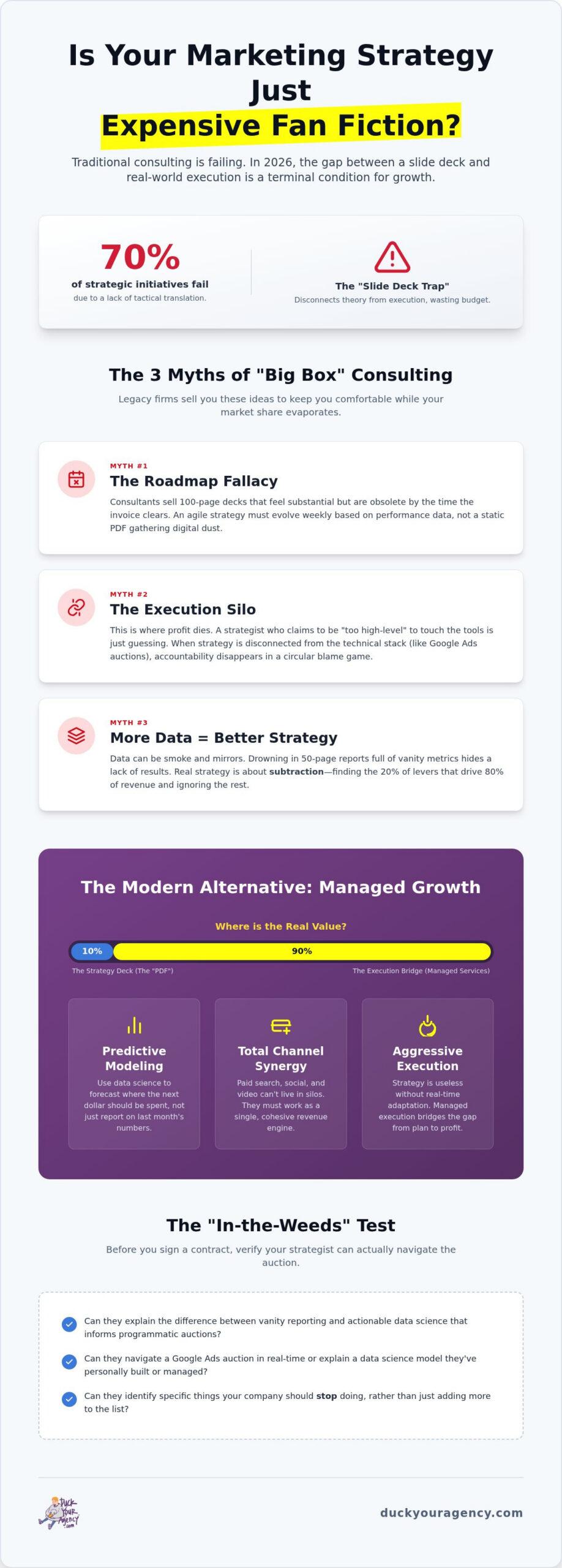
The role of a marketing strategy consulting agency has shifted from creative ideation to technical architecture. Research suggests that roughly 70% of strategic initiatives fail because they lack a tactical translation layer. They look brilliant in a boardroom but collapse the moment they hit the programmatic auction. You don’t need more “ideas.” You need a performance strategy agency that understands how to turn a business objective into a profitable search campaign.

The Core Components of a Modern Strategy

Real strategy requires predictive modeling, not just looking at what happened last month in GA4. Modern agencies use data science to forecast where the next dollar should go. This involves total channel synergy. Your paid search, programmatic video, and YouTube ads can’t live in silos. They must work as a single, cohesive engine. The strategy deck is only 10% of the value. The other 90% is the execution bridge that turns theory into revenue through managed services. Without that bridge, you’re just buying a very expensive PDF.

Why Traditional “Big Box” Consulting is Obsolete

Speed is the primary KPI in a generative AI economy. If your consultant takes three months to deliver a roadmap, the market has already moved. Traditional “Big Box” firms often employ smart people who have never actually managed a $1M monthly ad spend. They understand the theory but lack the technical scars. They sell “Set and Forget” models that are the death of modern ROAS. You need aggressive, managed execution that adapts in real-time. If they can’t navigate a Google Ads auction or explain a data science model, they shouldn’t be touchng your strategy.

The industry is addicted to safety. Traditional firms sell you a sense of control through massive documentation, but documentation doesn’t buy media. Most legacy firms operate on a model that prioritizes billable hours over actual performance. If your marketing strategy consulting agency spends more time on font choices in a slide deck than on your actual ROAS, you’ve already lost. These agencies sell three specific myths that keep you comfortable while your competitors eat your market share.

Myth 1: The Roadmap Fallacy

Roadmaps are the biggest trap in the game. Consultants love 100-page decks because they feel substantial. In 2026, an annual roadmap is outdated by the time the invoice clears. Elite programs like Strategic Marketing for Competitive Advantage teach the principles, but the application must be lightning fast. An agile strategy is a living document that evolves based on weekly performance data rather than a static PDF gathering digital dust. If you aren’t pivoting based on real-time signals, you aren’t strategizing; you’re just following a script.

Myth 2: The Execution Silo

The “Execution Silo” is where profit goes to die. Consultants often claim they are “too high-level” to touch the tools. This is a massive red flag. When strategy is disconnected from the technical stack, friction is inevitable. This gap is exactly why fully managed Google Ads management is non-negotiable for scaling revenue. Without eyes on the auction, the strategist is just guessing. Accountability dies in the silo. When the strategy looks “perfect” but revenue is stagnant, the strategist blames the execution team. It’s a circular blame game that costs you millions.

Myth 3: More Data Equals Better Strategy

Data is the new smoke and mirrors. Most agencies drown you in 50-page reports to hide a lack of results. They confuse noise with signal. This data hoarding leads to inflated CPAs because you’re optimizing for vanity metrics instead of bottom-line growth. Real strategy is about subtraction. It’s about finding the 20% of levers that drive 80% of the revenue and ignoring the rest. If your consultant can’t identify what to stop doing, they aren’t a strategist. They’re a librarian.

Stop buying fan fiction and start building a performance engine. You might want to look into how a fully managed approach eliminates these myths entirely by aligning strategy with technical reality.

Strategic Theory vs. Performance Reality: The Data Gap

Most consultants are historians. They hand you a 50-page report detailing why you missed your targets last month. That’s an autopsy, not a strategy. A real marketing strategy consulting agency doesn’t just look at the past; it builds a predictive model for the future. Most traditional firms provide data without execution because it’s safe. It’s easy to bill for. But it doesn’t move the needle. If your strategist isn’t willing to get their hands dirty in the technical stack, they’re just selling you a very expensive rearview mirror.

You must learn to spot vanity metrics before they drain your budget. Consultants love “Engagement Rates” and “Impressions” because these numbers always go up if you spend enough money. They are the smoke screen for underperformance. Real performance reality is measured in CPA, LTV, and incremental ROAS. If your data doesn’t provide a direct line to these outcomes, it is a distraction. Actionable data science identifies the specific levers that drive revenue. It tells you exactly where the friction is in your funnel and how to fix it through managed execution.

The “Noise” Problem in Marketing Analytics

In the world of modern growth, data without execution is just noise. Most businesses suffer from “Death by Dashboard.” You have GA4, CRM data, and ad platform metrics all telling different stories in disconnected silos. This fragmentation creates a massive strategy gap. You need a Single Source of Truth that informs your media buying in real-time. We are shifting from retroactive reporting to predictive performance. If your strategy doesn’t forecast revenue based on specific spend levels across search and programmatic, you’re just gambling with your budget.

Programmatic Strategy: The Untapped Lever

Programmatic is the most misunderstood lever in the strategist’s toolkit. Most consultants treat it as an afterthought or “cheap reach.” In reality, it’s the fuel for your entire funnel. A truly unified strategy creates synergy between YouTube video ads and bottom-funnel search. When a prospect sees a high-impact programmatic ad, their search behavior changes. We use advanced data science to find “lookalike” audiences that actually convert, moving beyond the basic interest-based targeting that fails in 2026. This isn’t about buying more impressions; it’s about using technical execution to capture intent before your competitors even know the lead exists. Before committing to any programmatic partner, use a structured framework like the one outlined in this Programmatic Advertising Agency Brooklyn performance vetting checklist to ensure your budget is protected from ad fraud and black-box reporting.

The Strategy-Execution Gap: Why Most Marketing Strategy Consulting Agencies Fail in 2026

How to Audit a Marketing Strategy Partner (Before You Hire Them)

Before you sign a high-ticket retainer, you need to strip away the agency’s polish. A marketing strategy consulting agency lives or dies by its technical competence, not its pitch deck. Start your audit by asking for their “Loss Leader.” Every agency has a strategy that crashed and burned. If they claim a 100% success rate, they’re either lying or playing it so safe they’ll never deliver a breakthrough. You want the partner who can explain exactly why a campaign failed and how they salvaged the data to pivot. This is the difference between a theorist and a practitioner who understands the volatility of 2026 markets.

Next, apply the “In-the-Weeds” test. Force the lead strategist to open a live ad account. Ask them to navigate a Google Ads auction or explain the logic behind a specific bidding script. If they try to hand you off to a junior account manager, end the meeting. You cannot build a winning strategy if you don’t understand the mechanics of the platform. You need to know if they provide fully managed execution or if they’re just going to lob suggestions over the fence for your team to figure out. If you’ve been searching for Digital Marketing Consulting NYC and keep landing on agencies that prioritize their zip code over your ROAS, this audit process is exactly how you cut through the noise.

The Accountability Audit

Demand “Before and After” data that focuses on bottom-line metrics like CPA and incremental ROAS. Don’t settle for vanity reports or “brand lift” surveys. You need a “Tough Love” partner who will tell you your landing page is trash or your product-market fit is lagging. If they’re “Yes-Men,” they’re just there to collect a check. Run from any firm that doesn’t prioritize AI search optimization as a core pillar. In 2026, if they aren’t leveraging AI for real-time bid adjustments and predictive modeling, they’re effectively obsolete.

The Talent Gap: Strategy vs. Staffing

The best strategy in the world is useless if your internal team lacks the technical chops to maintain it. A legitimate strategic partner should offer digital marketing recruitment services to help you scale. They shouldn’t try to make you dependent on their hours forever. Instead, they should help you source and vet the high-performing internal talent needed to sustain growth. This transition is how you move from a consultant-led model to a sustainable, revenue-generating machine that you actually own.

If you’re tired of “advisors” who are afraid to touch the tools, see how our fully managed digital marketing approach eliminates the friction between strategy and technical execution.

Duck Your Agency: The Managed Growth Alternative

Most firms sell you a roadmap and then run for the hills. We don’t. Duck Your Agency was built to dismantle the traditional marketing strategy consulting agency model. We are the Rebel Experts who have no patience for the bureaucracy that slows down growth. While traditional firms are busy polishing slides for a quarterly review that will be obsolete by next Tuesday, we are in the ad accounts, optimizing bids, and testing new data science models to capture intent. We reject the “advisor” role because advice without action is just a waste of your capital. It is time to stop playing defense and start scaling with a partner who has skin in the game.

Our approach is built on three non-negotiable pillars that most agencies ignore:

  • Managed Execution: We don’t just tell you what to do; we do it for you through fully managed search, programmatic, and video.
  • Technical Authority: We bridge the gap between high-level data science and the gritty reality of the Google Ads auction.
  • Speed as a KPI: We move at the pace of the market, not the pace of a consultant’s billing cycle.

The Fully Managed Advantage

We bridge the gap between high-level theory and technical reality. This isn’t about giving you a list of tasks for your overworked team. It’s about providing fully managed advertising services that actually lower your acquisition costs while scaling volume. We are the Anti-Agency for brands that value speed. In a market where programmatic shifts happen daily, waiting for a consultant’s approval is a death sentence. We move fast, break the status quo, and scale your revenue through aggressive, data-driven optimization. If your current marketing strategy consulting agency isn’t touching the tools, they aren’t helping you grow.

Building Your Internal Powerhouse

We know you don’t want to be tethered to an external partner forever. Most agencies try to create dependency. We do the opposite. Our specialized digital marketing recruitment services stop the revolving door of junior talent. We source, vet, and train top-tier experts who understand the technical reality of growth. We want to scale your revenue so high that you eventually need a dedicated internal powerhouse to sustain it. We train our replacements because our goal is your long-term independence, not a perpetual retainer.

Stagnant strategies are for our competitors. If you want aggressive scaling, you need a partner who understands both the math and the media. It is time to stop buying into the slide deck trap and start building a performance engine that works. Stop paying for slides. Start paying for growth.

Stop Buying Slides. Start Scaling Revenue.

The era of the bloated, theoretical roadmap is dead. If your current marketing strategy consulting agency can’t navigate a live auction or bridge the gap between data science and media buying, they’re just dead weight in your budget. You’ve seen the myths: the slide deck trap, the execution silo, and the noise of vanity metrics. Real growth requires a partner that doesn’t just advise but executes with technical authority. It’s about moving from retroactive autopsies to predictive performance models that actually win in a high-volatility market.

You deserve a model that prioritizes Fully Managed Performance and Advanced Data Science Integration. Don’t settle for yes-men who hide behind 50-page reports while your CPA climbs. It’s time to pivot toward a system that includes Specialized Marketing Recruitment to build your internal powerhouse for the long haul. You have the business goals; we have the technical engine to hit them. Stop playing defense against the underperformers and start taking your market share with aggressive, managed execution.

Ditch the fluff. Scale your ROAS with Duck Your Agency. Let’s turn your stagnant strategy into an aggressive, revenue-generating machine today. You’ve got the vision. We have the tools to make it a reality.

Frequently Asked Questions

What is the difference between a marketing agency and a strategy consulting agency?

A standard agency usually focuses on tactical output like writing blogs or managing basic social posts. A marketing strategy consulting agency identifies the “why” and “how” behind your total spend, aligning business goals with technical market opportunities. The problem in 2026 is that traditional consulting stops at the slide deck. You need a partner that bridges this gap by offering both high-level architecture and the technical managed services required to execute it.

How much does a marketing strategy consulting agency typically cost?

Costs vary based on your scale, but you should avoid any firm that bills solely for “research hours” or slide deck production. Look for performance-aligned structures or flat-fee managed services that prioritize tangible outcomes over activity. Your investment should always be measured against incremental ROAS. If the consulting fee doesn’t have a clear, data-backed path to paying for itself through lower CPAs and increased volume, it is just a vanity expense.

Can a strategy consultant help lower my Google Ads CPA?

Only if they actually understand the technical mechanics of the auction. A strategist who refuses to touch the ad account is just guessing with your budget. Real CPA reduction comes from aligning your first-party data with advanced bidding scripts and aggressive creative testing. By integrating data science models, a consultant can identify waste in your current spend and divert those dollars to high-intent auctions that actually convert.

What should be included in a 2026 marketing strategy roadmap?

Forget the 50-page PDF that gathers dust. A 2026 roadmap must be an agile document focusing on technical architecture and channel synergy. It should include predictive performance modeling, a clear data science integration plan, and a tactical execution bridge for programmatic and search. Most importantly, it needs a talent gap analysis. If your strategy doesn’t address who will physically manage the technical tools, it isn’t a roadmap; it is a wish list.

How long does it take to see results from a new marketing strategy?

You should see directional signals within the first 30 days if the execution bridge is built correctly. While long-term brand equity takes time, performance-driven strategies focus on the immediate optimization of your current spend. By fixing data silos and technical errors in your search or programmatic accounts, you can often find “low-hanging fruit” revenue almost instantly. Significant scaling usually requires 90 days of consistent, data-driven pivoting to hit peak efficiency.

Why do most marketing strategies fail to scale?

Most fail because they are built in a technical vacuum. A consultant designs a “perfect” plan that ignores the actual limitations of the ad platforms or your internal talent gap. When the strategy hits the real world, the execution team cannot translate those high-level goals into tactical bids. This disconnect creates friction, inflated CPAs, and stagnant growth. Scaling requires a unified approach where strategy and managed execution live under one roof.

Do I need a fractional CMO or a strategy consulting agency?

A fractional CMO provides leadership and internal alignment, while a strategy consulting agency typically offers deeper technical expertise and execution resources. If you have a team but no direction, hire the CMO. If you have goals but lack the data science models and managed services to hit them, the agency is the better bet. Ideally, you want a partner that provides both strategic leadership and the tactical muscle to execute.

How does data science improve marketing strategy consulting?

Data science moves the needle from retroactive reporting to predictive performance. Instead of asking what happened last month, we use models to forecast what will happen if you shift budget between search and programmatic. It allows for advanced audience modeling and real-time bid adjustments based on signal rather than noise. This technical layer ensures your marketing strategy consulting agency is making decisions based on math, not just “best practices” or gut feelings.

  Category: Uncategorized
  Comments: Comments Off on The Strategy-Execution Gap: Why Most Marketing Strategy Consulting Agencies Fail in 2026

In 2026, a marketing strategy without a direct line to execution is a liability. You have likely spent thousands on 50-page slide decks that gather digital dust while your CPA remains stagnant and your growth stays flat. If you are looking for a Fractional CMO NYC, you don’t need another advisor to tell you what is wrong; you need a partner who can actually fix it. Most consultants act like high-priced secretaries for your problems, offering “vision” while leaving the messy work of data science and programmatic execution to underperforming agencies. It is time to stop paying for pretty pictures and start investing in measurable performance.

We know the frustration of being the smartest person in the room regarding your own marketing. You deserve a scalable growth framework that doesn’t require constant hand-holding. This guide will show you how to bridge the gap between strategic vision and actual ROI by leveraging advanced analytics and a “no-nonsense” execution model. We will explore why the traditional advisory model is failing mid-market companies and how to build a high-performing internal team that delivers lowered acquisition costs. It is time to burn the slide decks and start scaling.

Key Takeaways

  • Stop paying for strategy that never leaves the slide deck. Learn why 70% of marketing plans fail due to a lack of execution and how to ensure your roadmap actually drives revenue.
  • Discover why your next Fractional CMO NYC must be a technologist. In 2026, high-performance growth requires a leader who weaponizes data science and programmatic advertising.
  • Ditch the hourly retainer trap that incentivizes slow work and “meeting culture.” We expose the Managed Growth model that prioritizes accountability and tangible ROI over billable hours.
  • Master our no-nonsense vetting framework to audit a leader’s technical stack. Demand a proven track record of lowering CPA rather than just inflating vanity metrics and traffic numbers.
  • Bridge the execution gap with a full-stack engine. Learn how elite leadership combined with managed execution creates a scalable growth framework that doesn’t require constant hand-holding.

The Fractional Marketing Trap: Why Strategic Hires Fail to Scale

Hiring a Chief Marketing Officer (CMO) on a fractional basis is often pitched as a shortcut to enterprise-level growth without the enterprise-level salary. In theory, you are getting a high-level strategic partner. In reality, most businesses hiring a Fractional CMO NYC fall directly into the “Consultancy Curse.” This is the point where high-priced advice meets zero implementation capability. You don’t need a part-time employee to sit in on your Zoom calls. You need an architect who actually knows how to swing a hammer.

The “Consultancy Curse” is a documented failure. Industry data suggests that roughly 70% of strategic plans collect digital dust because there is no infrastructure to support them. Traditional consultants deliver a Strategy Deck, which is essentially a 50-page PDF of “shoulds” and “coulds.” What you actually need is a Growth Framework—a living, breathing system of data science, programmatic triggers, and measurable feedback loops. Developing this technical infrastructure is critical, and Design Data Concepts provides the custom website design and organic SEO services that help build a stable foundation for growth. If your leadership hire isn’t bringing an engine to drive, they are just another passenger in your burning car.

To better understand the core requirements of this role before you sign a retainer, watch this helpful breakdown:

The Cost of Implementation Inertia

Hiring a leader without an execution team creates a massive MANAGEMENT BOTTLENECK. In lean organizations, you often end up “managing the manager.” You spend your week explaining your internal politics to a consultant who has no power to change them. This is implementation inertia. The hidden cost isn’t just the retainer; it is the opportunity cost of three months spent talking instead of scaling. You must transition from “What should we do?” to “How fast can we ship?” If your Fractional CMO NYC doesn’t have a direct line to execution, you are just paying for a very expensive to-do list.

Why Traditional NYC Firms Are Failing in 2026

The “Set and Forget” mentality is dead. High-competition markets like New York demand aggressive, real-time optimization. Many firms claiming to be the Best Digital Marketing Agency NYC are failing because their leadership lacks technical depth. In 2026, “Strategy” is often used as a euphemism for “We don’t know how to code” or “We don’t understand your data science models.” If your strategist cannot audit a programmatic bid strategy or a Python-based attribution model, they aren’t leading your growth. They are guessing with your capital. Stop hiring advisors. Start hiring outcomes.

Bridging the Execution Gap: Why Your CMO Needs a Data Science Arsenal

Strategy without data science is a hallucination. In the high-stakes environment of a Fractional CMO NYC, “gut feelings” are for amateurs. While a growing number of organizations are turning to fractional CMOs to save on executive overhead, they often forget that a leader without a technical arsenal is just a cheerleader. You don’t need a cheerleader. You need a data-driven sniper who can navigate the complexities of 2026 marketing. If your strategist isn’t deep in the weeds of your attribution models, they aren’t managing your growth. They are managing your decline.

Vanity metrics like “impressions” or “engagement” are useless if they don’t map to your bottom line. True business insights come from a fully managed approach to technical channels where every dollar is tracked, analyzed, and optimized. A “Fully Managed” model is the only way to survive in 2026. Traditional agencies love to hide behind “Strategy Only” contracts because it limits their liability. We reject that. If your leadership is not accountable for the technical execution of your programmatic and video ads, you are left with a massive execution gap. This gap is where your ROI goes to die.

Data Science vs. Intuition-Based Marketing

Executive decision-making has evolved. We have moved past the era of “I think this creative works” into the era of “The model shows this creative converts.” Predictive modeling is no longer a luxury; it’s the primary tool for lowering Customer Acquisition Cost (CAC) before a single dollar is spent. In 2026, data science transforms programmatic bidding by shifting from reactive audience targeting to high-velocity predictive modeling that captures intent in the milliseconds before a bid is even placed. If your current leadership lacks this technical edge, it might be time to evaluate a managed growth partner who prioritizes data over decks.

The Programmatic Advantage

A modern Fractional CMO NYC must understand the technical plumbing of video and display ads. Programmatic is no longer just “buying banners.” It is a complex ecosystem of real-time bidding, first-party data integration, and cross-device tracking. If your CMO doesn’t know how a DSP (Demand Side Platform) interacts with your CRM, they are flying blind. They cannot lead a team they do not understand.

Duck Your Agency integrates execution directly into the strategic layer. We don’t just tell you to run YouTube ads; we build the data models that power them. This technical depth is why traditional search models are failing. You can explore this further by looking at our AI Paid Search Agency NYC insights. Stop guessing. Start executing with a technologist at the helm.

Strategic Consultant vs. Growth Partner: The ROI of Real Accountability

Most marketplaces for a Fractional CMO NYC are nothing more than glorified body shops. They sell you a “body in a seat” and call it leadership. This model is fundamentally broken because it places all the risk on your shoulders. While some industry reports suggest an average revenue growth rate of 29% for companies using fractional leadership, that number is a pipe dream if your consultant is incentivized by hourly retainers. Hourly billing is the enemy of performance. It creates a “meeting culture” where slow work is rewarded and “Strategy” becomes a recurring line item that never resolves into revenue.

We take an “Anti-Agency” stance. We prioritize speed and tangible outcomes over the traditional bureaucracy of monthly check-ins and vanity reports. You don’t need more meetings; you need more margin. Real accountability means having skin in the game regarding your ROAS and CAC, not just your billable hours. If your leadership isn’t willing to tie their success to your bottom line, they aren’t a partner. They are a line item.

Eliminating the Middleman in Marketing Strategy

The traditional pipeline is a game of telephone. You hire a CMO, they hire an agency, and the agency hires a junior executioner. By the time your strategic intent reaches the ad spend optimization level, it is diluted beyond recognition. We eliminate the middleman. By combining executive leadership with Digital Marketing Analytics and Data Science, we create a direct line between the boardroom and the bidding floor. Accountability must be baked into your contract, not just a handshake over coffee. Speed is your only competitive advantage in 2026. Don’t let a middleman slow you down.

Building Internal Teams That Last

A true growth partner doesn’t want to be your permanent crutch. Part of strategic leadership is using Digital Marketing Recruitment Services to build an internal culture that can eventually sustain itself. We de-risk the transition from fractional to full-time leadership by vetting candidates who actually understand the technical stack we have built. It isn’t just about “Recruit or Execute.” In 2026, you need a partner who can do both simultaneously to ensure your growth doesn’t flatline the moment the consultant leaves the building. We build the engine, then we find the driver.

Fractional CMO NYC: Why Strategy Without Execution is a Liability in 2026

The No-B.S. Framework for Vetting Fractional Marketing Leadership

Hiring a Fractional CMO NYC shouldn’t feel like a blind date. Most “vetted” marketplaces just verify that a candidate has a pulse and a LinkedIn premium account. That is not vetting; that is a directory. In 2026, you need a rigorous audit of technical capabilities and psychological fit. If they cannot explain how they will lower your CPA within the first 90 days, they are just another line item on your balance sheet. Use this framework to separate the performers from the pretenders.

  • Step 1: Audit their technical stack. Do they actually understand programmatic bidding and AI-driven search? If they can’t talk about DSPs or data science models, they aren’t ready for 2026.
  • Step 2: Demand a track record of lowering CPA. Traffic is a vanity metric. Revenue is the only reality. Ask for specific examples of cost-per-acquisition reduction.
  • Step 3: Test their “tough love.” A real partner will tell you if your product-market fit is a mess. If they agree with everything you say, they are a yes-man, not a leader.
  • Step 4: Evaluate their execution team. Ask exactly who is pushing the buttons. If the answer is “a junior intern” or “we’ll hire an agency,” walk away.
  • Step 5: Check for data transparency. You must own your accounts and your data models. Never let a consultant hold your historical data hostage in their proprietary “black box.”

The CPA Litmus Test

During an interview, a competent leader should define their target ROAS as the gross revenue generated from ad spend divided by the total cost of that spend, adjusted for your specific net margin requirements to maintain a maximum allowable CPA. If they start talking about “Brand Awareness” without tying it to a performance metric, it is a massive red flag. Awareness doesn’t pay the bills; conversions do. For those in the ecommerce space, this lack of accountability is exactly why your Shopify marketing agency NYC is costing you sales instead of generating them. Demand math, not myths.

Vetting for AI Readiness

A modern Fractional CMO NYC must be a master of Generative Engine Optimization (GEO). They should be able to explain how they are optimizing your content to appear in AI-driven search results, not just traditional blue links. There is a fundamental difference between “using AI” to write blog posts and building an AI-driven strategy that leverages predictive modeling. Ask them how AI Search Optimization will impact your 2026 traffic. If they look confused, they are already obsolete.

The “Anti-Agency” Interview Questions

To expose a consultant who is just hunting for a retainer, ask these three questions. First, “How do you handle the technical implementation of your data science models?” Second, “Can you show me a live dashboard where I own the underlying infrastructure?” Third, “What was the last failed experiment you ran, and how fast did you pivot?” Spot a “Set and Forget” mentality early. You should hire for speed of learning and technical agility over thirty years of “industry experience” that no longer applies to the modern web. Start building your high-performance growth engine today with a partner who prioritizes execution over slide decks.

Scaling at Speed: The Duck Your Agency Managed Execution Model

Marketplaces for a Fractional CMO NYC are built on a flawed premise: that you can hire a brain without a body and expect it to run. We represent the elite alternative to these “body shop” directories. Duck Your Agency doesn’t just provide a part-time executive; we provide a high-performance engine. Our fractional leaders operate with a full-stack execution team at their disposal, ensuring that every strategic pivot is immediately translated into ad spend optimization and technical implementation. We aren’t just consultants; we are the architects and the builders of your growth framework.

Our Performance-First Philosophy

We practice “tough love” because your bottom line depends on it. We reject the traditional agency model of endless status calls and bloated account management teams. Instead, we focus on speed as the ultimate KPI. Our data science models are designed to identify high-intent audiences and predict ROI before the first dollar is spent. For example, by integrating predictive modeling directly into programmatic bidding, we eliminate the waste typical of “Set and Forget” campaigns. We don’t care about making you feel good; we care about making you more money.

Ready to Stop Guessing?

Basic automation and generic strategy are the hallmarks of the underperformers. In 2026, you cannot afford to guess with your marketing capital. You need a Fractional CMO NYC who understands that strategy is a liability without a direct line to execution. It is time to move beyond the slide deck and start investing in a scalable growth framework that delivers results. If you are ready to stop managing the manager and start scaling at speed, we are ready to build. Request a strategic growth audit today and see how we bridge the gap between vision and ROI.

Stop Paying for Potential. Start Buying Performance.

The era of the high-priced advisor is dead. In 2026, if your Fractional CMO NYC isn’t weaponizing data science and managing the execution layer, they are just an expensive bottleneck. You’ve seen why strategy is a liability without a direct line to the bidding floor. You need more than a roadmap; you need the engine and the driver to reach your revenue goals. Real growth requires a technologist who understands that brand awareness is a byproduct of performance, not a replacement for it.

Duck Your Agency bridges this gap by combining executive leadership with technical mastery. We’ve managed over $100M in programmatic ad spend and utilize proprietary data science models designed specifically for aggressive CPA reduction. When you are ready to scale, we deploy our recruitment network of the top 1% of marketing talent to build your internal culture while our managed execution team handles the technical heavy lifting. It’s time to stop managing consultants and start hitting your KPIs.

Scale your growth with an execution-first partner

Your growth shouldn’t be a guessing game. Burn the slide decks and start investing in the measurable ROI your business deserves. Let’s get to work.

Frequently Asked Questions

What is a Fractional CMO and how does it differ from a consultant?

A Fractional CMO is an embedded executive leader who owns your marketing outcomes, while a consultant is merely an advisor who delivers a plan and leaves. Consultants trade in “shoulds” and “coulds” through slide decks. A Fractional CMO NYC takes accountability for the execution, manages your team or agencies, and is responsible for hitting specific revenue targets. They are a part of your leadership team, not just a temporary voice in your ear.

How much does a Fractional CMO cost compared to a full-time hire in 2026?

Hiring a fractional leader is typically 50 to 70 percent less expensive than a full-time executive. In 2026, the average annual cost for a full-time CMO is $656,815 when including benefits and bonuses. Fractional retainers for mid-market companies generally range from $15,000 to $25,000 per month. This allows you to access elite, technical leadership without the massive overhead of a permanent C-suite salary.

Can a Fractional CMO manage my existing marketing agency?

Yes, but their primary job is to audit them, not just supervise them. A Fractional CMO NYC must hold your current agencies accountable for hard performance metrics like CPA and ROAS. If your agency is hiding behind vanity metrics, the CMO should have the technical depth to expose those inefficiencies. They serve as your internal advocate to ensure your external partners are actually delivering a measurable return on your spend.

How many hours a week does a Fractional CMO typically work?

Most fractional leaders dedicate between 5 and 20 hours per week to your business. The focus isn’t on the quantity of hours but the velocity of the results they produce. You are paying for high-impact decision-making and the implementation of advanced data science models. In a results-oriented model, a leader who fixes your attribution in five hours is more valuable than one who sits in meetings for forty.

Is a Fractional CMO better for startups or established mid-market firms?

They are critical for both, though the objectives change. Startups need them to build a growth engine from zero and establish a scalable framework. Mid-market firms typically hire them to disrupt stagnant growth or fix a broken agency model. If your internal team has hit a ceiling or your acquisition costs are spiraling, a fractional leader provides the specialized expertise needed to optimize your technical stack.

What technical skills should a modern Fractional CMO possess?

They must be technologists who understand the plumbing of 2026 marketing. This includes programmatic advertising, predictive data science models, and Generative Engine Optimization (GEO). According to a 2026 Adobe survey, 78 percent of CMOs report that data integration is their biggest obstacle to AI adoption. Your hire must know how to solve these technical bottlenecks, not just talk about “brand vision” in a vacuum.

How do I measure the ROI of a Fractional Marketing Leader?

Measure success through the reduction of Customer Acquisition Cost (CAC) and the acceleration of your sales pipeline. Ignore soft metrics like “brand sentiment” or “engagement rates.” A true partner provides a data-driven growth framework that shows exactly how each dollar of ad spend converts into revenue. If the ROI isn’t visible in your bank account within the first 90 days, your leadership hire is failing.

What happens if we need to transition to a full-time CMO later?

A high-performance partner should make themselves obsolete by building an internal team that can sustain your growth. They use their recruitment services to find and vet a full-time successor who understands the technical stack already in place. This ensures a seamless transition where your momentum actually increases. You get the elite strategy now and a hand-picked internal leader when the time is right for a permanent hire.

  Category: Uncategorized
  Comments: Comments Off on Fractional CMO NYC: Why Strategy Without Execution is a Liability in 2026