
 Your Underperforming Digital Marketing Agency



STOP. If you’re still running your 2024 PPC playbook, you’re essentially burning cash to stay warm. With traditional search volume predicted to drop by 25% by the end of this year, sticking to the status quo isn’t just lazy; it’s professional negligence. Your b2b paid search strategy 2026 requires a total pivot from keyword-chasing to a data-feeding game where the most aggressive CRM-to-Ad loop wins. If you’re paying a $6.29 average CPC for leads that never close, you’re just funding Google’s transition to AI while your own pipeline starves.
You already know the “black box” of Smart Bidding is failing you. You’ve watched your Cost Per Acquisition climb while lead quality plummets, leaving you with a CRM full of junk. This article promises to hand you the high-performance frameworks needed to survive the AI shift and reclaim your ROI. We’ll explore how to dominate Generative Engine Ads, leverage CRM-led data science to find high-value accounts, and finally align your marketing spend with actual sales outcomes. It’s time to stop being a victim of the algorithm and start being the one who controls it.
Key Takeaways
- Stop chasing dead keywords; shift to an intent-driven data strategy to combat the 25% drop in traditional search volume.
- Secure your brand’s presence in AI-powered answer engines by mastering Generative Engine Optimization (GEO) before your competitors do.
- Implement a b2b paid search strategy 2026 that uses CRM-led data science to feed the “black box” with high-value offline conversion signals.
- Eliminate budget waste by applying the 95/5 rule to target only the 5% of B2B stakeholders currently in an active buying window.
- Abandon the “set and forget” agency model in favor of fully managed growth marketing that scales with your actual revenue, not just clicks.
The 2026 B2B Paid Search Landscape: Why 2025 Tactics Are Failing
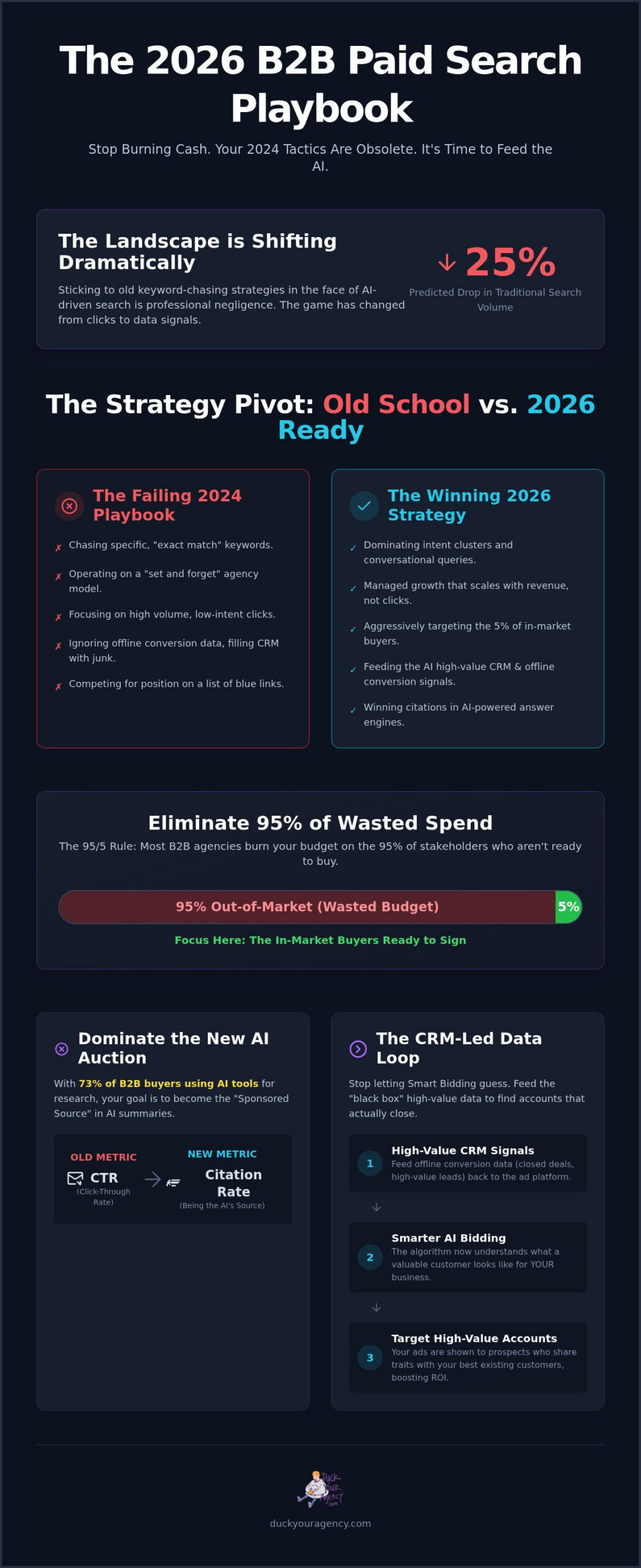
The “exact match” keyword is dead. Google buried it years ago, but in 2026, the corpse is finally cold. If your current b2b paid search strategy 2026 relies on bidding for specific terms and hoping for the best, you’re essentially donating your budget to Alphabet’s bottom line. The game has shifted from keyword hoarding to signal dominance. Traditional search volume has plummeted by 25% as users flock to AI answer engines, leaving traditional PPC managers scratching their heads while their CPAs explode.
Rising costs aren’t just about competition. They’re a penalty for mediocrity. While the foundations of paid search were built on simple auctions, the 2026 landscape is an arms race of data science. You aren’t just competing against other brands. You’re competing against the “black box” of AI bidding that will happily spend your money on low-intent clicks if you don’t give it a better reason not to. Winning now requires Intent, Signal, and Speed. Anything less is just expensive noise.
The Intent Revolution: From Keywords to Clusters
Buyers have gone conversational. They don’t search for “B2B accounting software” anymore. They ask their AI agents to find “enterprise-grade tools with SOC2 compliance and native HubSpot integration for a 200-person team.” These queries break traditional ad groups. Because 73% of B2B buyers now use AI tools like ChatGPT and Perplexity for research, the touchpoints have multiplied. You’re no longer reaching one person; you’re influencing a committee of 13 internal stakeholders. If you aren’t mapping your ads to clusters of intent across these 12+ touchpoints, you’re invisible.
The Cost of Mediocrity in a High-KD Market
Average B2B CPCs have reached $6.29, and SaaS terms have surged 29% year-over-year. This is the price of following the herd. Most agencies still operate on a “set and forget” model that ignores the 95/5 rule. They waste 95% of your budget on the “out-of-market” crowd instead of aggressively capturing the 5% of buyers actually ready to sign. STOP chasing volume. In 2026, a high-performance b2b paid search strategy 2026 prioritizes value-based demand capture over vanity metrics. If your agency isn’t talking about CRM-led signals and offline conversion loops, they’re the ones bleeding you dry.
Generative Engine Ads (GEA): Dominating the New AI Auction
Traditional PPC is a dinosaur. If you’re still obsessing over your position in a list of ten blue links, you’ve already lost. In 2026, the real battle happens inside the AI summary. Generative Engine Ads (GEA) have replaced the standard auction for the most valuable B2B queries. Since 73% of B2B buyers now use AI tools like ChatGPT and Perplexity for their research, your b2b paid search strategy 2026 must evolve to win the citation, not just the click. You aren’t just buying traffic anymore; you’re buying authority.
We’re moving from Click-Through Rate (CTR) to Citation Rate. It doesn’t matter if a prospect clicks through to your landing page if the AI has already summarized your value proposition and solved their problem. You need to be the “Sponsored Source” that the AI credits for its recommendations. This requires a radical shift in how you craft ad copy. It’s no longer about catchy headlines designed for humans; it’s about providing authoritative “data nuggets” that AI models can easily ingest and repeat. If the machine can’t parse your value, it won’t mention you.
Bidding for Citations: The New Ad Units
Securing a slot in a Gemini Overview or a Perplexity response is the new gold standard. To win here, your technical schema is your most important ad asset. AI models don’t guess; they scrape for structured data that confirms your authority. If your site isn’t feeding the machine exactly what it wants, you won’t be cited, regardless of your bid. You must write ad copy as a single, punchy sentence optimized for extraction. Think of it as “bidding for truth.” If you can’t be the expert the AI relies on, you’re just an unnecessary expense.
Perplexity and Beyond: Diversifying Away from Google
Google Gemini is just one player in a fragmented field. Perplexity and other conversational “answer engines” are where high-intent B2B researchers live now. These users aren’t browsing; they’re solving complex procurement problems. Diversifying your spend into these networks is no longer a “nice to have” experiment. Attribution is undeniably harder in this cookieless, generative world, but the ROI for early adopters is massive. You’re capturing demand at the exact moment of synthesis, before a buyer even thinks about visiting a traditional search engine.
If this sounds like a lot to manage while also running your core business, you might need fully managed Google Ads management to bridge the gap between 2025’s tactics and 2026’s reality. Stop letting your budget bleed on outdated auctions and start dominating the AI-led future.
CRM-Led Data Science: Feeding the Machine for ROI
Smart Bidding is a calculator, not a crystal ball. If you’re still optimizing for “form fills” in your b2b paid search strategy 2026, you’re training Google’s AI to find you more garbage. Most agencies celebrate a low Cost Per Lead (CPL) while the sales team drowns in junk. In 2026, the machine needs revenue signals, not vanity metrics. If you aren’t feeding the algorithm actual CRM outcomes, you’re just gambling with your budget and hoping the house doesn’t win.
The “Offline Conversion” loop is the only way to survive. By the time a prospect moves from a “Marketing Qualified Lead” to a “Sales Accepted Lead,” your ad platform should already know. This creates a feedback loop that forces the AI to hunt for high-LTV accounts instead of accidental clicks. This is the core of a modern b2b paid search strategy 2026: moving from Cost Per Acquisition (CPA) to Cost Per Value (CPV). You stop paying for people who might buy and start bidding for people who will.
The Data-Driven Bidding Framework
Implementing a CRM-to-Google Ads API isn’t optional anymore. You need real-time feedback to tell the algorithm which leads are actually worth the spend. This is where Duck Your Agency bridges the gap between data and execution. We don’t just look at dashboards; we scrub the “noise” from your data set. If you feed the AI learning errors like bot traffic or low-intent queries, it’ll scale those mistakes. Precision is your only defense against a bleeding budget.
Predictive Modeling for B2B Scale
Data science in 2026 growth marketing means building custom propensity models. You should know which accounts are likely to convert before they ever hit your landing page. Most GA4 setups are lying to you because they’re misconfigured or overwhelmed by the 12+ touchpoints in a 2026 buyer journey. We fix the tracking and then layer on predictive analytics to guide your budget allocation. It’s about finding the 5% of buyers in their window and hitting them with surgical accuracy while the competition is still chasing broad match keywords.
The 95/5 Rule: Capturing In-Market Demand Without the Waste
Stop trying to sell to everyone. It’s a waste of breath and budget. In any given quarter, only 5% of your target market is actually in a “buying window.” The other 95% aren’t just uninterested; they’re effectively immune to your sales pitch. If your b2b paid search strategy 2026 treats these two groups as a single monolith, you’re subsidizing Google’s revenue at the expense of your own. You don’t use high-CPC search terms for “awareness.” That’s what programmatic video is for. You use search to capture the 5% who are ready to sign today.
Most agencies target the wrong 95% because it’s easier to show “traffic growth” on a report. We don’t care about traffic. We care about revenue. To win, you need to pivot to Account-Based Bidding (ABB). This is the aggressive evolution of ABM. It’s about ensuring your ads follow the entire committee, which now averages 13 internal stakeholders, across every device they own. You need to be everywhere they are, but only when they show “in-market” intent signals. Anything else is just vanity.
Account-Based Bidding (ABB) Tactics
ABB works by layering LinkedIn intent data directly onto your Google Search campaigns. If a CFO at a Tier-1 account is researching your competitors on LinkedIn, your search ads should be waiting for them the second they hit Google. We use programmatic video to “warm up” the other 95% at a fraction of the cost of search. This builds the brand authority needed so that when they finally enter that 5% buying window, you’re the only logical choice. It’s surgical, not scattergun. You customize ad creative for specific industry verticals to increase relevance without losing the scale required to move the needle.
The Strategy-Execution Gap
High-level marketing strategy consulting agencies often fail because they can’t translate a pretty slide deck into a winning bid. They talk about “synergy” while your ROAS hits the floor. Aligning your b2b paid search strategy 2026 with your actual sales cycle requires a “Rebel Expert” approach. You need to be aggressive where it counts and invisible where it doesn’t. Stop playing it safe with “industry standard” tactics that were designed for a market that no longer exists. If your bidding isn’t as sharp as your strategy, you’re just a loud amateur.
Ready to stop the bleeding and start winning? Audit your bidding strategy today and see where your cash is actually going.
Scaling Your 2026 Strategy: Managed Growth vs. Traditional Agencies
The “Set and Forget” agency model didn’t just die; it was murdered by complacency. In a landscape where traditional search volume is dropping by 25% and AI answer engines are rewriting the rules, a passive partner is a financial anchor. Most agencies still operate on a 2022 mindset. They collect their percentage of spend while your ROI evaporates. Transitioning to a high-performance b2b paid search strategy 2026 requires a partner who treats your budget like their own capital, not a recurring revenue stream.
Winning in 2026 demands fully managed Google Ads management that prioritizes data science over simple bid adjustments. You need a partner who can bridge the gap between your CRM signals and the ad auction in real-time. If you prefer to build that capability in-house, you still need elite talent. That is why our recruitment service exists. We help firms scale internal teams with specialists who actually understand how to execute a modern b2b paid search strategy 2026 without the typical agency fluff.
The Accountability Crisis
Standard agency contracts are often designed to hide underperformance. They bury hidden fees in “proprietary tech” and use inflated ROAS numbers that include branded search and existing customers. This is professional deception. TRANSPARENCY is the only KPI that matters in 2026. You must audit your current partner for “AI-washing.” Many claim to use advanced machine learning when they’re actually just letting Google’s default settings run wild with your cash. If they can’t explain the logic behind their data-feeding loop, they don’t have one.
Your 2026 Growth Roadmap
Moving from legacy PPC to managed growth isn’t a slow transition; it’s a hard pivot. The first 90 days of a high-performance audit should expose every leak in your funnel, from junk lead signals to wasted spend on the “out-of-market” 95%. We don’t do “check-in” calls to talk about clicks. We do strategy sessions to talk about revenue. It is time to stop playing defense against rising CPCs and start playing offense against your competitors. Duck Your Agency and see what real growth looks like.
Stop Playing Defense and Start Dominating the 2026 Auction
The 2026 auction doesn’t care about your historical performance or your “best practices” from two years ago. It only cares about the quality of the signals you feed it. To win, you must abandon the keyword-first mindset and embrace a b2b paid search strategy 2026 built on CRM-led data science and surgical demand capture. Whether you’re dominating Generative Engine Ads or leveraging the 95/5 rule to starve your competitors of high-intent leads, the goal remains the same: PROFITABLE revenue, not vanity clicks.
Traditional agencies will keep selling you “transparency” while hiding behind automated reports and inflated ROAS. Don’t let them. You need an aggressive, data-science-led approach that bridges the gap between your sales floor and the ad auction. We offer specialized B2B recruitment services for those building internal powerhouses and no-nonsense performance marketing for those who want results without the bureaucracy. STOP funding Google’s growth and start prioritizing your own.
Stop bleeding cash and start scaling with a fully managed B2B paid search strategy.
The future of B2B search is here. It’s time to decide if you’re going to lead the charge or be the one paying for everyone else’s success. Let’s get to work.
Frequently Asked Questions
What is the most effective B2B paid search channel in 2026?
Google Search remains the dominant force for demand capture, but it no longer works in a vacuum. The most effective approach is an omnichannel loop where LinkedIn identifies intent and Google Ads closes the deal. By 2026, the real “channel” is the data science loop between your CRM and the ad platforms. If you aren’t visible where buyers conduct research, like Perplexity or YouTube, you’re leaving the door open for more aggressive competitors.
How much should a B2B company spend on paid search in 2026?
Your budget must align with your Customer Lifetime Value (LTV) rather than arbitrary industry averages. If the average B2B CPC is $6.29, a small monthly budget won’t provide enough data for AI bidding models to learn. You need to spend enough to generate statistically significant conversion signals. Stop looking at what your competitors spend and start calculating the maximum you can pay to acquire a high-value account while remaining profitable.
How do AI Overviews affect my Google Ads performance?
AI Overviews reduce traditional click-through rates by answering queries directly on the search results page. This forces a shift in your b2b paid search strategy 2026 from chasing clicks to winning citations. While top-of-funnel traffic may drop, the intent of users who do click is significantly higher. You must optimize your ad assets to be the “Sponsored Source” that the AI relies on, or you’ll become invisible in the new generative landscape.
Can I target specific companies with Google Ads in 2026?
Yes, you can target specific accounts using Customer Match and sophisticated Account-Based Bidding (ABB). By syncing your CRM or target account list, you ensure your ads only appear for stakeholders at those specific firms. This prevents budget waste on out-of-market users and allows for hyper-relevant ad creative. In 2026, precision is the only way to combat rising costs. If you aren’t layering firmographic data onto your campaigns, you’re just spraying and praying.
What is the average ROAS for B2B paid search in 2026?
ROAS is a vanity metric that often hides the truth about your performance. Many agencies inflate this number by including branded search and existing customers. Instead of chasing a generic 4x ROAS, you should focus on your LTV:CAC ratio. A high-performance campaign might show a lower immediate ROAS but a much higher long-term value. Because the B2B journey now involves 13+ stakeholders, single-session attribution is effectively dead.
How do I integrate my CRM with Google Ads for better bidding?
Integration requires connecting your CRM to Google Ads via the API to pass offline conversion signals back to the auction. This tells the bidding algorithm which “leads” actually turned into revenue and which were just junk form fills. Without this loop, the AI optimizes for volume instead of value. It’s the difference between a campaign that looks good in a meeting and one that actually scales your bottom line.
What is Generative Engine Optimization (GEO) in paid search?
GEO is the process of structuring your ad copy and technical schema so AI models like Gemini or Perplexity cite you as a trusted source. In paid search, this means bidding for “Sponsored Source” slots and providing the authoritative data nuggets that AI agents look for. It is the 2026 version of SEO, where the “user” is an AI looking for the most credible answer to a complex procurement question.
Why is my B2B CPA increasing every year?
Your CPA is rising because you’re likely chasing the same broad keywords as everyone else while traditional search volume drops by 25%. This increased competition for fewer clicks drives up prices. Additionally, your b2b paid search strategy 2026 might be feeding poor data into Smart Bidding, forcing the algorithm to bid higher for low-quality traffic. To lower your CPA, you must stop targeting the 95% of the market that isn’t buying.