 Your Underperforming Digital Marketing Agency



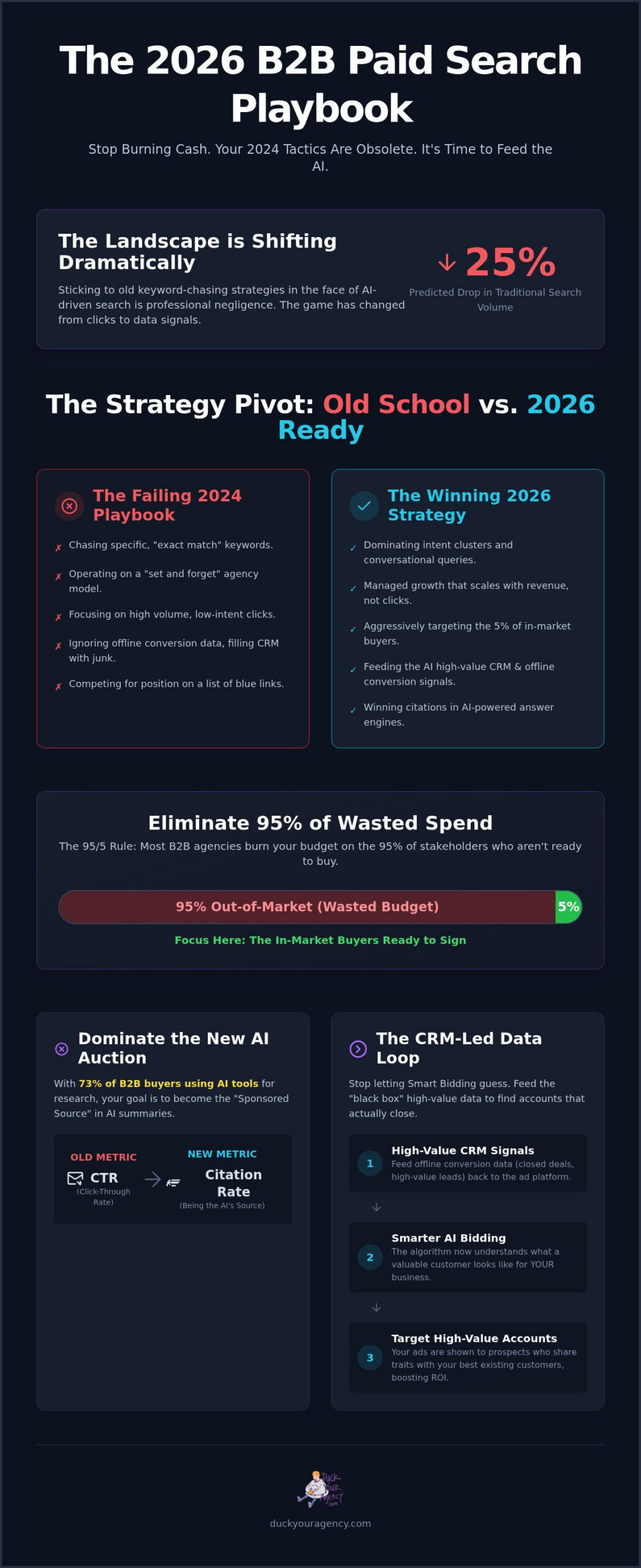
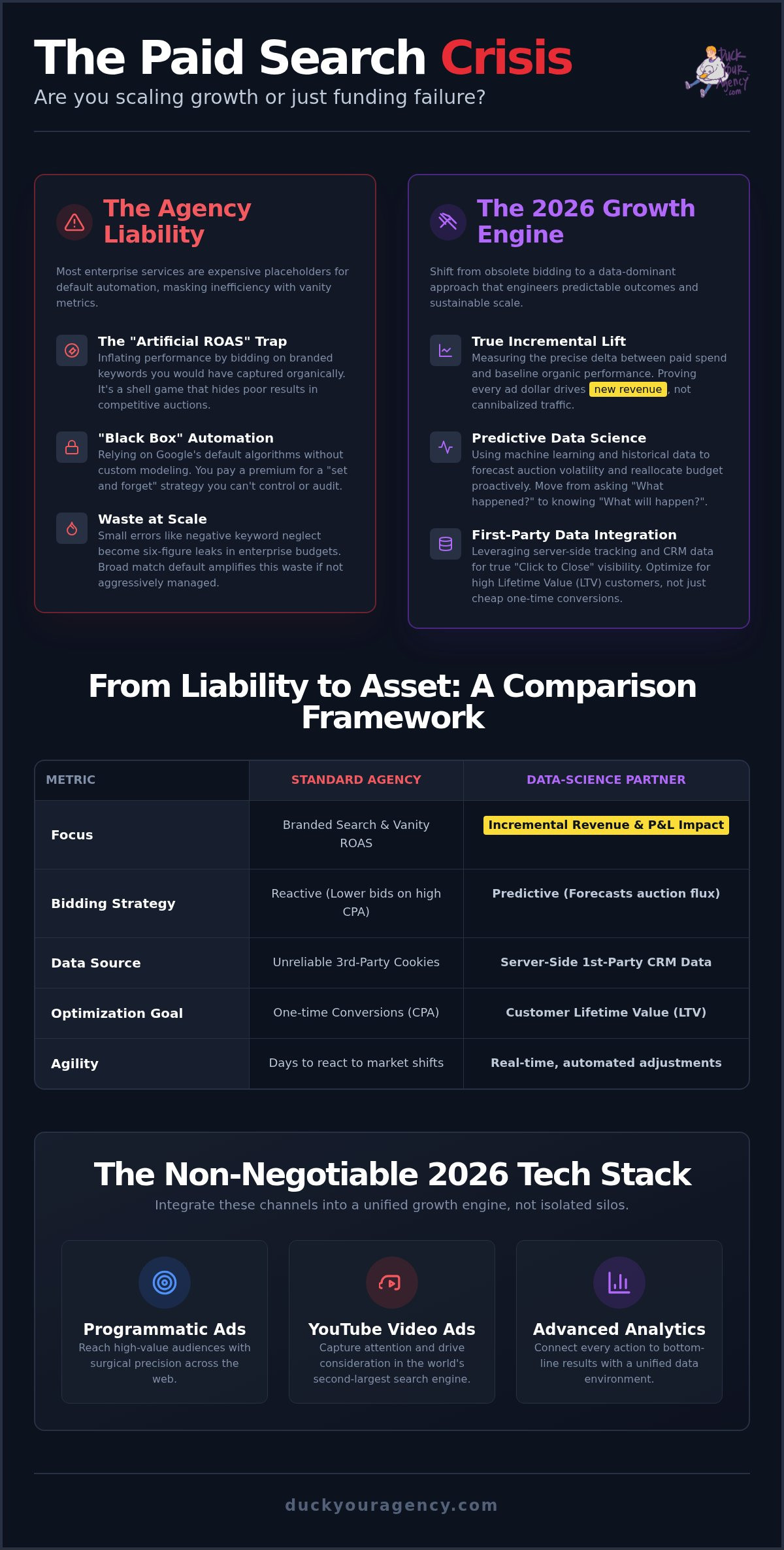
Most enterprise paid search services are just expensive placeholders for Google’s default automation. You’re likely paying a premium for an agency to “manage” campaigns that are actually run by black-box algorithms you can’t control. It’s time to stop funding mediocrity. If your partner relies on artificial ROAS inflation and takes days to react to a market shift, they’re a liability. In 2026, the gap between standard management and data science is the difference between scaling and burning cash.
You know the frustration of clean data being a myth and internal talent gaps widening. We agree that surface-level reporting is a waste of your time and your budget. This article promises to show you how to deploy enterprise-level strategies that prioritize data science over basic bidding to dominate the 2026 market. We will preview how to achieve a lower CPA at scale and secure a partner that acts as an elite extension of your team. It’s time for total transparency and aggressive performance.
Key Takeaways
- Expose the “Artificial ROAS” trap and learn how mediocre agencies use branded search to mask massive inefficiencies in your high-spend campaigns.
- Shift from obsolete keyword bidding to predictive data science models that leverage first-party data to dominate high-competition auctions in 2026.
- Audit your current enterprise paid search services to ensure your partner acts as an agile, high-performance extension of your team rather than a slow-moving liability.
- Master the non-negotiable 2026 tech stack by integrating programmatic, YouTube video ads, and advanced analytics into a unified growth engine.
- Bridge the “Strategy-Execution Gap” by moving past traditional agency retainers and stagnant in-house models toward a results-only managed growth framework.
The Enterprise Paid Search Crisis: Why Most Large-Scale Campaigns Fail
Enterprise paid search services are currently facing a crisis of terminal mediocrity. Most agencies have retreated into a comfortable “set and forget” coma, allowing black-box automation to dictate your strategy while they collect a percentage of spend. If you are managing a budget north of $1M, this passivity is a death sentence. You aren’t paying for an elite partner; you’re paying for a glorified babysitter. The real cost isn’t just the fee. It’s the hidden friction of bloated tech stacks that don’t communicate, leaving your data fragmented and your strategy blind.
To better understand the specific challenges facing large-scale accounts, watch this helpful video:
The Branded Search Illusion
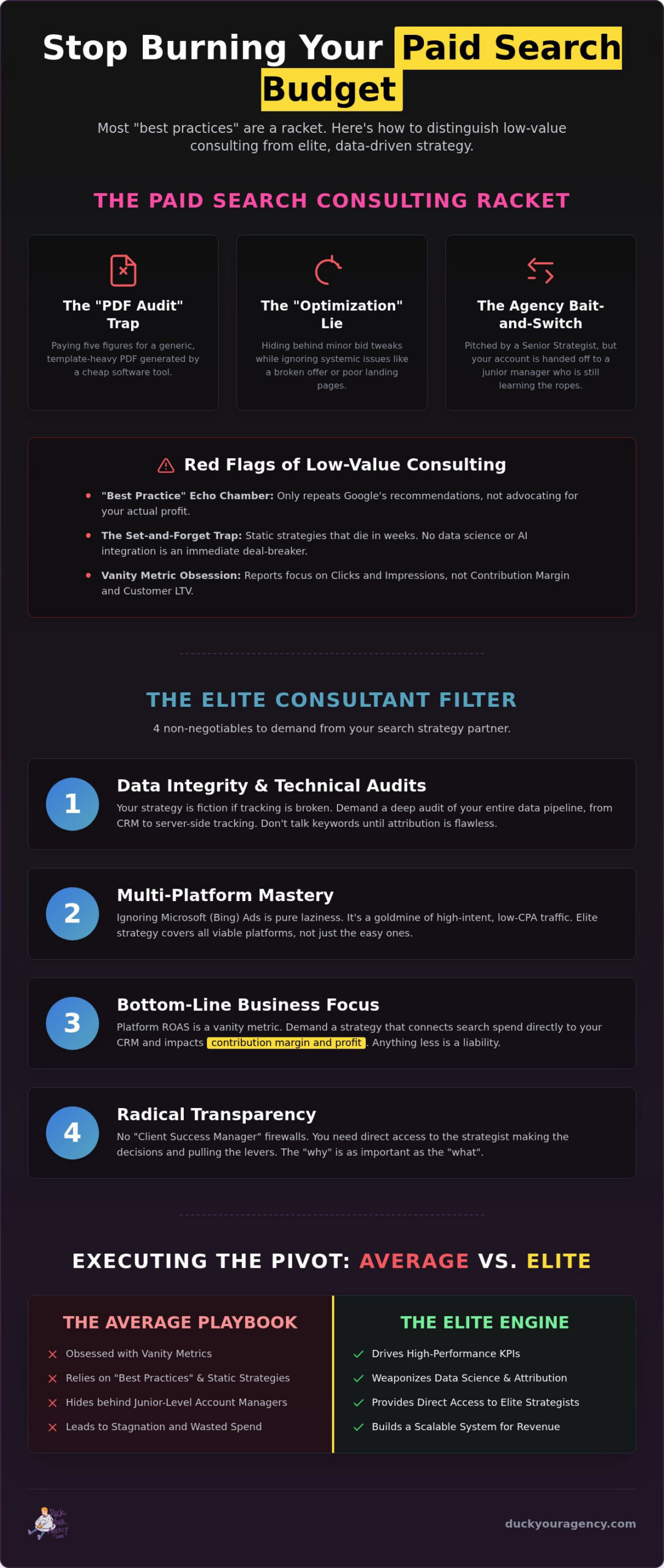
Agencies love branded search because it makes them look like geniuses. They call it “Artificial ROAS.” By cannibalizing traffic you would have captured anyway through organic search, they mask abysmal performance in cold-traffic auctions. It’s a shell game. In 2026, a competent Search engine marketing (SEM) strategy requires calculating Incremental Lift to prove that paid spend is actually driving new revenue. If your agency can’t show you the delta between your branded ad spend and your baseline organic performance, they’re just taking credit for your brand’s existing reputation. Stop celebrating vanity metrics that don’t move the bottom line.
Waste at Scale: The $100k Leak
When you operate at scale, small errors become massive financial leaks. Identifying negative keyword neglect is the first step in auditing your enterprise paid search services. Many accounts are bleeding six figures annually because no one bothered to prune the search terms report. With broad match now being the mandatory default, the danger has shifted from “not enough reach” to “too much garbage.” Spend efficiency in high-competition markets is the surgical application of capital to high-intent signals while aggressively excluding low-value queries. If your reports are stuffed with “Agency Fluff” like high CTRs on irrelevant terms, you’re being played. Demand data that connects to the P&L, not just the dashboard.
The Data Science Advantage: Engineering Enterprise Growth in 2026
Bidding on keywords is a relic. If your strategy is still “buy the click and pray,” you’re already behind. In 2026, the auction is an AI-driven battlefield where human intuition goes to die. Elite enterprise paid search services don’t just bid; they engineer outcomes using predictive math. This isn’t about being “data-driven.” Everyone says that. This is about being data-dominant. An academic study on keyword effectiveness proves that traditional methods fail to capture the complex intent signals of modern users.
To actually scale, you must integrate Marketing Analytics Agency NYC principles that bridge the gap between raw numbers and aggressive execution. Data without action is just noise. You need models that identify high-value “whale” customers before they even touch your landing page. This is where precision meets profit.
Predictive Modeling vs. Reactive Bidding
Reactive bidding is a race to the bottom. You see a spike in CPA, so you lower the bid. That’s amateur hour. Predictive modeling uses your historical data to forecast auction volatility before it happens. Machine learning allows for real-time budget reallocation across campaigns based on probability, not history. We move from asking “What happened?” to knowing “What will happen next?” and positioning your capital accordingly. It’s about total control. If your agency isn’t forecasting the next 30 days of auction flux, they’re just guessing with your money.
First-Party Data Integration
The cookie is dead. If you’re still relying on browser-based tracking, your data is 40% fiction. Server-side tracking is the only way forward. By syncing your CRM directly to Google Ads, you get true “Click to Close” visibility. This allows our data science models to optimize for Lifetime Value (LTV) rather than just a one-time conversion. We don’t want every click. We want the clicks that turn into long-term revenue. We identify the signals that lead to high-retention clients and feed those back into the algorithm. If you’re ready to stop funding mediocre results, our fully managed digital marketing ensures your data stack is actually built for growth.
Agency vs. In-House vs. The Anti-Agency: A Comparison Framework
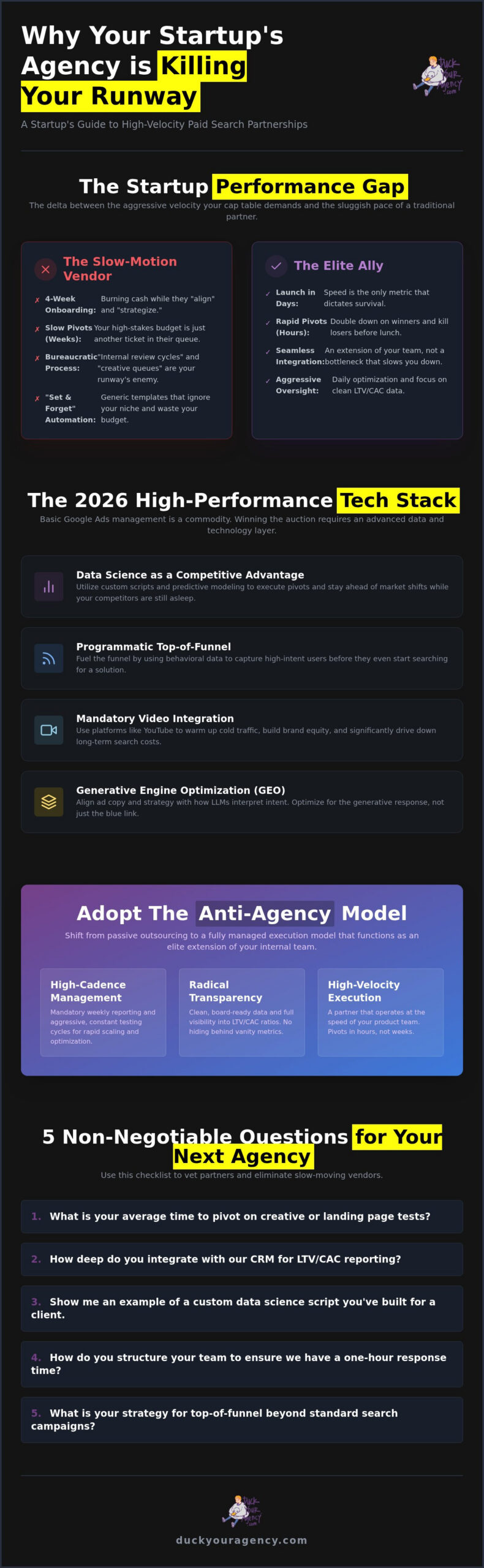
The traditional agency retainer model is designed to protect the agency, not your profit. They want long-term stability and predictable billing. You want aggressive growth and lower CPAs. These goals are fundamentally at odds. Most enterprise paid search services operate on a percentage of spend, which creates a perverse incentive to keep your costs high even when efficiency drops. It’s a system built for mediocrity. If your monthly check-in feels more like a polite social hour than a high-stakes strategy session, you’re funding your own stagnation.
In-house teams aren’t always the solution either. While they have deep product knowledge, they often suffer from “platform myopia.” Without the pressure of managing multiple high-spend accounts across diverse industries, internal teams lose their edge. They stop testing. They stop questioning the defaults. They become comfortable with the status quo while the Paid Search Association standards for elite performance continue to evolve. You need a partner that brings external specialized pressure to keep your strategy sharp.
The Recruitment Hybrid Model
We bridge the internal talent gap through our digital marketing recruitment services. You shouldn’t have to choose between a disconnected agency and a stagnant internal team. We help you hire elite talent to manage the day-to-day while we provide the high-level data science and strategy. This hybrid approach ensures your internal team remains elite and accountable. Our “Anti-Agency” methodology focuses on performance-based relationships that actually scale. We don’t hide behind bureaucracy. We value speed and tangible outcomes above all else.
Evaluating Enterprise Service Providers
Don’t sign another contract without demanding a data science audit. If a provider can’t explain how they use predictive modeling to beat the auction, they’re just guessing with your budget. Ask them how they handle server-side tracking or how they integrate CRM data for LTV optimization. If they give you a blank stare or a “standard” enterprise pitch, walk away. You should also demand a fully managed google ads management audit to see exactly where your current spend is leaking. Red flags include long-term lock-in contracts without performance clauses and reports that prioritize vanity metrics over actual incremental lift. Demand a partner that acts as an elite extension of your team, not a vendor that just checks boxes.
If you think a Google Ads login constitutes a tech stack, you’ve already lost the auction. In 2026, enterprise paid search services require a diversified arsenal that extends far beyond a single platform. You need to leverage Microsoft Advertising, programmatic display, and YouTube video as a unified machine. The foundation must be led by AI Paid Search Agency NYC strategies that prioritize proprietary data science over the platform’s “auto-apply” traps. Most automation tools provided by Google are designed to maximize their revenue, not your profit. You need tools that act as guardrails, not just accelerators for burning your budget.
Programmatic and Video Integration
YouTube is no longer just a “top of funnel” play. It is a performance engine. Scaling YouTube video ads alongside search creates a compounding effect that captures intent at every stage of the buyer journey. In high-competition markets, programmatic advertising provides the reach necessary to dominate the digital landscape where your competitors are blind. The danger here is transparency. You must implement strict protocols to eliminate programmatic ad waste. If your agency can’t show you exactly which domains and apps are eating your spend, they’re hiding their own incompetence. Demand total visibility into every placement.
Attribution and Measurement
Last-click attribution is a fantasy for amateurs. It ignores the reality of complex enterprise sales cycles that span multiple devices and weeks of consideration. You must move to data-driven models that value every touchpoint. Cross-device tracking is non-negotiable if you want to understand how a mobile video view leads to a desktop conversion. A seamless GA4 and BigQuery integration is the only way to process the massive datasets required for predictive enterprise search. Without this unified data layer, your attribution is just a series of educated guesses. Stop guessing and start measuring what actually drives revenue.
Your tech stack should be an elite extension of your team, not a source of confusion. If your current setup feels fragmented and slow, it’s time to switch to fully managed digital marketing that actually integrates your data for scale.
Execution Over Fluff: Partnering with Duck Your Agency
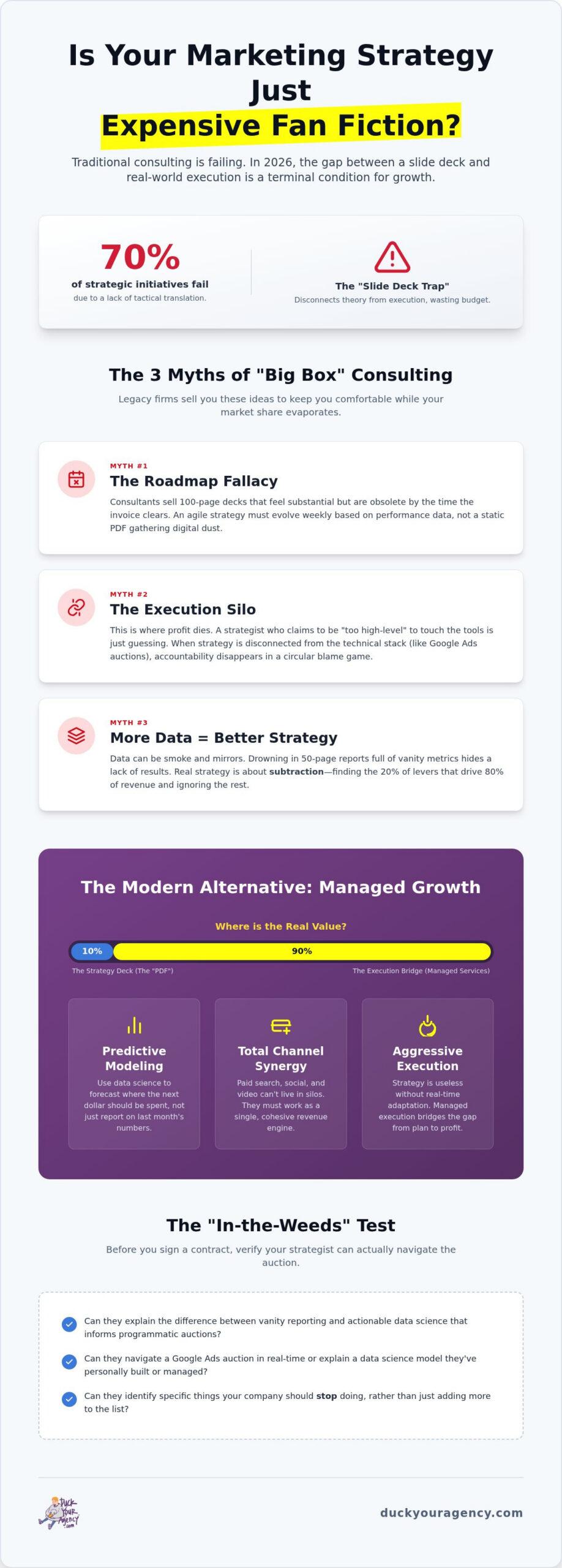
Most agencies are great at selling a vision but abysmal at delivering a result. They hide behind 50-page slide decks while your enterprise paid search services bleed cash in real-time. We’ve seen the “Strategy-Execution Gap” destroy multi-million dollar budgets. It happens because the people writing the strategy aren’t the ones pulling the levers in the account. At Duck Your Agency, we’ve killed the bureaucracy. Our promise is simple: straight talk, zero fluff, and high-performance metrics that actually reflect your P&L. We don’t do “polite” reporting. We do managed growth marketing that wins.
The Anti-Agency Audit
We start by gutting your current account. Our Anti-Agency Audit isn’t a “best practices” checklist. It’s a search-and-destroy mission for inefficiency. We hunt for hidden fees, inflated ROAS from branded cannibalization, and massive keyword opportunities your current provider is too lazy to pursue. By auditing your enterprise paid search services, we identify immediate “quick wins” that reduce waste and generate the capital needed to fund aggressive, long-term growth. Transitioning an enterprise account shouldn’t feel like a heart transplant. We move with speed and precision, ensuring you don’t lose a single day of momentum while we clean up the mess left by your previous agency.
Scaling Beyond Search
Search dominance doesn’t happen in a vacuum. To win in 2026, you must integrate content strategy and growth marketing directly into your search funnel. We leverage marketing strategy consulting agency insights to ensure every search click lands on an experience built for conversion. We don’t just buy traffic; we engineer demand. Our focus is on lowering your customer acquisition costs while simultaneously scaling your volume. It’s about being the most efficient player in the most expensive auctions, identifying those high-value “whale” customers we discussed earlier, and converting them at a lower CPA.
You’ve spent enough time funding agency mediocrity. It’s time to partner with an elite extension of your team that values performance over politeness. We offer fully managed digital marketing for brands that are tired of excuses and ready for scale. Stop settling for average. Scale with Duck Your Agency.
Stop Funding Failure and Start Dominating the Auction
The era of passive account management is over. If your enterprise paid search services aren’t built on predictive data science and cross-channel integration, you’re essentially handing your market share to competitors who aren’t afraid to evolve. We’ve shown that “Artificial ROAS” is a trap and that a hybrid recruitment model is the only way to keep your internal team from stagnating in 2026. You don’t need another polite vendor; you need an elite ally that prioritizes execution over slide decks.
Duck Your Agency provides the disruptive, performance-first approach required to win in high-competition markets. Whether it’s through data-science led optimization or our unique recruitment services to build your internal powerhouse, we bridge the gap between strategy and actual revenue. It’s time to stop accepting “industry average” and start demanding aggressive growth. Your budget deserves better than mediocrity.
Get a Performance Audit: Stop Paying for Mediocrity
The path to market dominance starts with a single decision to reject the status quo. We’re ready to help you build the high-performance engine your brand needs to thrive.
Frequently Asked Questions
What is the difference between standard PPC and enterprise paid search services?
Enterprise services focus on high-volume data science and predictive modeling rather than simple keyword bidding. While standard PPC is often a reactive process, enterprise management requires a unified data layer to handle millions in monthly spend. It’s about precision at scale. You aren’t just buying clicks; you’re engineering a full-funnel growth engine that integrates search, programmatic, and video. Standard agencies can’t handle that complexity.
How much should an enterprise company spend on paid search management?
Management fees shouldn’t be a flat tax on your growth. Instead of focusing on a specific dollar amount, you should look for a model that aligns incentives with your profit. Traditional agencies often charge a percentage of spend, which rewards waste. An elite partner focuses on lowering your CPA and scaling volume. You’re paying for specialized expertise and data science models that prevent the massive leaks common in large accounts.
Can you help us build an internal team while managing our current search ads?
Yes, we offer digital marketing recruitment services to bridge your internal talent gap. We manage your campaigns as a high-performance extension of your team while simultaneously helping you hire and train elite internal talent. This hybrid model ensures you don’t stagnate. We provide the external specialized pressure and advanced data science models while your internal powerhouse handles the day-to-day product nuances and brand alignment.
How do enterprise paid search services handle multi-channel attribution?
We move beyond last-click fantasy to data-driven models that value every touchpoint. In complex enterprise sales cycles, cross-device tracking is non-negotiable. We integrate GA4 with BigQuery to process massive datasets, ensuring you see how a YouTube video view influences a Bing search conversion weeks later. This unified data layer removes the guesswork, allowing for real-time budget reallocation across your entire tech stack to maximize efficiency.
What role does data science play in enterprise Google Ads management?
Data science is the engine of modern enterprise paid search services. We use predictive modeling to forecast auction volatility and identify high-value “whale” customers before they click. This goes beyond basic automation. By leveraging first-party data and server-side tracking, we build custom bidding models that optimize for Lifetime Value (LTV) rather than just one-time conversions. It’s about dominating the auction through mathematical superiority, not just higher bids.
How do you handle the transition from a traditional agency to an “anti-agency” model?
The transition begins with a surgical audit to identify immediate leaks and artificial ROAS. We don’t believe in long-term lock-in contracts without performance clauses. We gut your current setup, remove the “Agency Fluff,” and implement strict transparency protocols. The goal is to move fast, securing quick wins that fund your long-term strategy while ensuring you don’t lose a single day of momentum during the account handoff.
Is programmatic advertising necessary for enterprise-level search success?
Programmatic is essential for scaling reach in high-competition markets where search alone is tapped out. It allows you to dominate the digital landscape by capturing intent signals across millions of domains. However, you must implement rigorous transparency protocols to avoid ad waste. When integrated with search and video, programmatic becomes a performance engine that feeds your search funnel with high-intent audience signals, lowering your overall customer acquisition costs.
How do you prevent “artificial ROAS” in enterprise reporting?
We prevent “Artificial ROAS” by calculating Incremental Lift for every campaign. If an agency is just cannibalizing branded traffic you would have captured organically, they’re hiding their own inefficiency. We demand data that connects directly to your P&L. By separating branded performance from cold-traffic acquisition, we ensure your enterprise paid search services are actually driving new revenue rather than just taking credit for your existing brand equity.