
 Your Underperforming Digital Marketing Agency



What if your viral video is actually a massive liability? Most agencies will tell you that a million views is a win. If your bank account isn’t moving, it’s just expensive noise. You’ve been burned by high customer acquisition costs and creative that looks like a Super Bowl ad but performs like a local car wash commercial. It’s time to stop the bleeding. If you want to scale, you need to master direct response video advertising and ignore the “reach” metrics that agencies use to hide their underperformance.
You’re right to be skeptical of the vanity metric hype. We agree that likes and shares don’t pay the bills. This guide promises to show you how to engineer high-conversion campaigns that prioritize psychology over production value. We’re going to dive into the data-driven tactics that lower your CPA and provide clear ROI visibility. You’ll learn the exact framework for predictable scaling through video ads that actually SELL. No fluff. No excuses. Just PERFORMANCE.
Key Takeaways
- Stop burning cash on “pretty” production that wins awards but loses money. Learn why the brand awareness trap is killing your margins and how to avoid it.
- Weaponize the 3-second rule to win the battle for the thumb-stop. We’ll show you how to engineer direct response video advertising as a self-contained sales funnel.
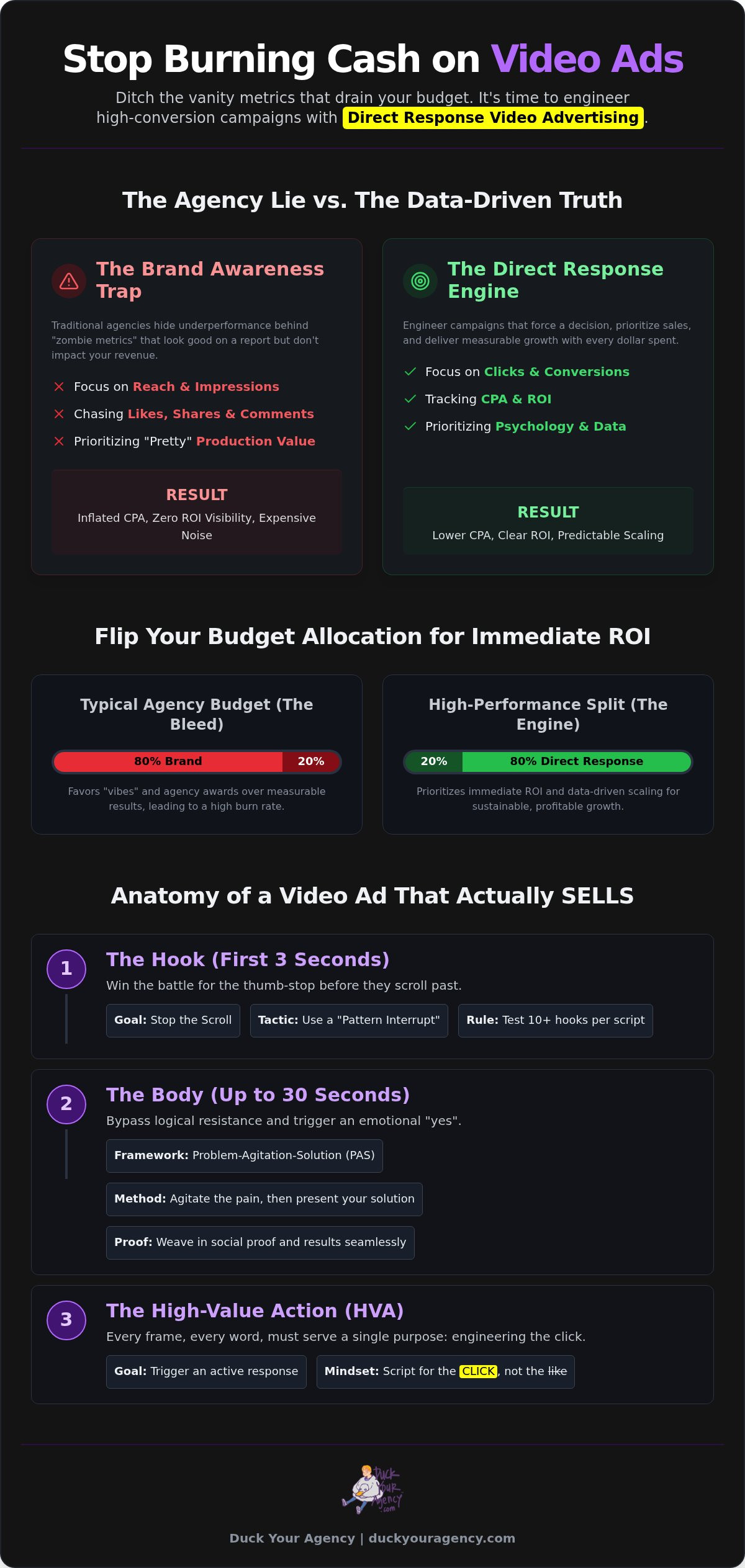
- Flip your budget allocation. Prioritize an 80/20 split that favors immediate ROI and measurable growth over vanity metrics and agency ego.
- Script for the High-Value Action (HVA). Use data-mined pain points to create creative that actually triggers a click instead of just a “like.”
- Embrace the math. Discover how data science and predictive analytics turn creative guesswork into a scalable, high-performance engine.
Why Most Video Advertising Is a Waste of Your Budget
Your current video budget is likely a bonfire. It looks expensive. It sounds professional. It’s winning exactly zero sales. Traditional video is a relic of a time when “eyeballs” were the only currency. In 2026, eyeballs are cheap. Actions are expensive. If you aren’t using direct response video advertising, you’re just funding a creative agency’s award reel. Your current CPA is likely inflated by 40% or more because your strategy prioritizes “vibes” over volume. Pretty production that fails to trigger a click is just a vanity project with a high price tag.
While the legacy of broadcast media was built on these passive metrics, examining the evolution of these formats can reveal much about modern viewer engagement; learn more about The Late Desk to explore how late-night programming has changed over the years.
The Agency Lie: Reach vs. Revenue
Agencies love “Reach” because it’s a metric they can’t lose. They’ll present a report showing 1 million views and wait for a round of applause. If your revenue hasn’t moved, those 1 million views are a total failure. Traditional agencies hide underperformance behind “engagement” and “brand lift.” These are nebulous terms designed to mask a lack of accountability. There’s a brutal efficiency gap in modern media buying. Most “pretty” production is designed to be liked, not to trigger a high-value action. We don’t care if they like you. We care if they buy from you. High production value often creates a psychological barrier that makes an ad feel like an ad. Direct response strips that away to focus on the SELL.
Vanity Metrics: The Silent Profit Killer
Stop looking at “zombie metrics.” Likes, shares, and comments are the ghosts of a dead campaign. A viewer is just someone who didn’t scroll fast enough. A prospect is someone who clicked. Your profitability dies in the gap between “impressions” and “intent.” If you’re still tracking brand sentiment while your customer acquisition cost climbs, you’re losing the war. Identify the rot in your reports:
- Average watch time that doesn’t correlate with CTR.
- Total impressions served to non-converting demographics.
- Social engagement that stops at the platform instead of hitting your site.
The psychological difference between a viewer and a prospect is intent. Direct response video advertising forces that intent. It moves the needle from passive consumption to active response. In 2026, the market is too crowded for “maybe later.” You need “right now.” Stop paying for views that don’t pay you back.
The market has shifted. Consumers are blind to traditional “brand” spots. They’ve seen it all. They want solutions, not stories. The shift from passive viewership to active response isn’t a trend; it’s a survival requirement for growth-stage companies. If your video doesn’t have a clear, data-backed reason to exist, delete it. Every frame must serve the conversion. Every second must justify its cost. This is the difference between a marketing expense and a growth investment. Efficiency isn’t a suggestion. It’s the only way to scale.
The Anatomy of Direct Response Video: Engineering the Click
Stop treating your video ads like mini-movies. Direct response video advertising isn’t entertainment; it’s a self-contained sales funnel engineered for a single outcome. If your creative doesn’t function as an automated closer, it’s a liability. Every frame must move the prospect closer to a transaction. You aren’t just competing with other brands. You’re competing with a dopamine-fueled scroll. If you don’t win the battle for the thumb-stop in the first 3 seconds, your budget is dead before the first line of dialogue. This is high-stakes psychology, not an art project.
The Hook: Stopping the Scroll in 2026
Visual hooks usually outperform verbal hooks on high-volume programmatic platforms. People see before they hear. Use the “Pattern Interrupt” technique to break the user’s hypnotic scrolling state. Show something unexpected, jarring, or deeply relatable within the first 500 milliseconds. A data science approach requires testing at least 10 hooks for every one body script. If you’re struggling to identify which visual triggers actually lower your CPA, fully managed digital marketing can help you iterate with surgical precision. Don’t guess what works. Let the data tell you which hook wins.
The Body: Building Irresistible Desire
The Problem-Agitation-Solution (PAS) framework is your best weapon. Don’t just show the product. Agitate the pain. Make the viewer feel the cost of their current problem. Once the tension is high, present your solution as the only logical exit. Integrate social proof seamlessly. Don’t stop the narrative for a testimonial; weave results and authority directly into the script. You have roughly 30 seconds to bypass logical resistance and trigger an emotional “yes.” Handling objections in real-time is critical. If they’re thinking about the price or the setup time, address it before they can scroll away.
The CTA: Making the Action Inevitable
The “One Goal” rule is non-negotiable. Multiple CTAs kill your conversion rate by creating choice paralysis. If you want them to buy, tell them to buy. If you want a lead, ask for the lead. Use visual cues like arrows or on-screen buttons to guide the eye. Verbal commands must be direct and urgent. The Specific Offer is the heart of direct response video advertising; without a clear, time-sensitive reason to act, you’re just begging for attention. Make the click feel like the only natural next step. RESULTS. SCALE. NO EXCUSES.
Direct Response vs. Brand Awareness: Choosing Efficiency Over Ego
Brand awareness is the favorite hiding spot for mediocre marketers. It’s a “black box” where budgets go to die under the guise of long-term value. While your competitors are chasing awards for “storytelling,” you should be chasing revenue. The fundamental difference is simple: direct response video advertising pays for its own existence. Brand ads are a gamble on future memory. DR is an investment in immediate action. For growth-stage companies, especially those scaling beyond the initial Series A hype, ego is an expense you can’t afford. You need cash flow, not just compliments.
We advocate for a brutal 80/20 split. Allocate 80% of your video budget to high-intent direct response and leave 20% for experimental brand play. Why? Because brand equity is a byproduct of successful sales. If 10,000 people buy your product through a DR ad, you’ve just built brand awareness for free. You don’t need a “maybe later” strategy when you have a “definitely now” engine. This creates a feedback loop. Every dollar spent on DR returns data that tells you exactly how to scale the next ten dollars. Brand ads just return “sentiment,” which doesn’t pay the payroll.
The ROAS Reality Check
Direct Response offers immediate attribution. You know exactly which creative triggered which sale. This cash flow is the fuel for predictable scaling. Brand awareness, conversely, is often a statistical nightmare of unprovable correlations. When you hit a major growth milestone, you need certainties. You need to know that for every $1 in, $4 comes out. If you can’t track it, you can’t scale it. Efficiency isn’t just about saving money; it’s about moving faster than the competition can think. Stop guessing and start measuring.
Platform Selection: Where DR Dominates
Not all platforms are created equal. Meta is great for social proof, and YouTube is the king of intent, but programmatic video is the secret weapon for aggressive scaling. Programmatic allows for surgical precision across the open web, reaching prospects where they are most likely to convert, not just where they scroll. Matching your creative to user intent is the difference between a nuisance and a solution.
- YouTube: High intent, perfect for Problem-Agitation-Solution scripts.
- Meta: High engagement, ideal for visual “Pattern Interrupts.”
- Programmatic: High scale, the foundation for direct response video advertising at a global level. If you’re operating in the B2B space, a precision-guided B2B programmatic advertising strategy is essential to ensure your ads reach actual decision-makers instead of bots and low-level employees.
Stop buying “vibes.” Start buying outcomes. If the platform doesn’t support clear ROI visibility, it doesn’t deserve your budget. Your growth depends on data science, not creative guesswork.
How to Build a Direct Response Video Campaign That Actually Scales
Scaling is a math problem, not a creative one. If you’re still relying on “gut feelings” to increase your budget, you’re gambling with your capital. Direct response video advertising requires a repeatable architecture that survives high-volume spend. It starts with data mining. You don’t guess what hurts your customer; you look at the support tickets, the churn reasons, and the competitor complaints. You find the specific friction and you weaponize it. Once the pain point is identified, every subsequent step must be a clinical execution of that data.
The Scripting Blueprint for 2026
Write for the ear. Corporate jargon is a signal to the brain to tune out immediately. Use natural, aggressive language that mirrors how your customers actually talk. The “First 5 Words” test is your ultimate filter. If those words don’t identify the problem and promise a solution, the viewer is gone. Integrate your offer early and often. Waiting until the end of a 60-second video to reveal the CTA is a rookie mistake that kills your ROI. If you want high-scale performance, you need a fully managed digital marketing partner who knows how to script for the click.
The Testing Framework: Creative vs. Audience
Creative is 10x more important than targeting. In a world of automated bidding, the creative IS the targeting. Use Dynamic Creative Optimization (DCO) to let the algorithms find the winning combinations of hooks, bodies, and CTAs. A “scaling signal” isn’t just a high click-through rate. It’s a stable CPA over a 72-hour period at 3x your normal daily spend. Don’t fall in love with your creative; fall in love with the numbers.
- Step 1: Mine data for the core pain point. Ignore the “ideal persona” fluff.
- Step 2: Script for the HVA. Every word must pay for itself.
- Step 3: Run rapid-fire tests to identify the “Winner’s Circle.”
- Step 4: Track the real path to purchase with multi-touch attribution. Last-click is a lie.
- Step 5: Scale spend only when CPA thresholds are met. No exceptions.
Scale is about discipline. You must have the stomach to kill underperforming creative without mercy. Move the winners into the high-budget tier and start the next round of testing immediately. This isn’t a “set it and forget it” strategy. It’s a constant cycle of optimization. If you aren’t testing at least five new hooks every week, you aren’t scaling; you’re just waiting for your frequency to burn out. RESULTS. DATA. GROWTH. This is the only path to the top.
Beyond the Creative: Data-Driven Optimization for Video Ads
Creative is only 50% of the win. The other half is cold, hard data science. If you’ve engineered the perfect thumb-stop but your attribution model is broken, you’re still flying blind. High-scale direct response video advertising requires more than just a talented editor; it requires predictive analytics to forecast performance before you burn a single dollar. Most agencies stop at the “upload” button. We start at the data layer. Scaling isn’t about hope. It’s about using quantitative models to identify which creative variants will survive a 10x increase in spend.
Duck Your Agency exists to kill the inefficiencies that plague the programmatic video space. Traditional models are slow, bloated, and terrified of accountability. We use advanced marketing analytics to bridge the gap between current underperformance and aggressive growth goals. If you aren’t looking at the math behind the movement, you aren’t running a campaign. You’re running a charity for ad platforms. Real scale happens when you stop guessing and start optimizing based on statistical significance.
Attribution: Tracking the Un-trackable
Last-click attribution is a lie that keeps you small. Video often acts as the catalyst that triggers a search or a direct visit days later. If you only credit the last touchpoint, you’ll mistakenly kill your most profitable video ads. Data science allows us to identify the hidden value in “view-through” conversions, giving you a transparent view of your real ROI. You need to see the entire path to purchase to understand how direct response video advertising is actually moving the needle. Stop making decisions based on incomplete data. Start by reviewing The Brutal Truth: A Digital Marketing Efficiency Audit to see where your tracking is leaking profit.
Scaling Without the Hype
Managing a 7-figure monthly video spend requires a technical infrastructure that most internal teams simply don’t possess. It’s not just about the ads; it’s about the server-side tracking, the API integrations, and the real-time bid optimization. You need an elite filter when hiring for your growth team. If they can’t explain the delta between probabilistic and deterministic modeling, they shouldn’t be touching your budget. Predictable scaling is the result of managed advertising that prioritizes speed and tangible outcomes over “brand feel.”
The status quo is designed to protect the underperformers. We’re here to protect your margins. Scaling requires a partner who treats your capital with the same aggression you do. If your current agency is hiding behind “reach” and “engagement” while your CPA climbs, it’s time to cut the cord. Stop settling for average. Scale your video ads with Duck Your Agency.
Stop Playing Safe and Start Scaling
The era of “vibes-based” marketing is dead. You now have the blueprint to move beyond the brand awareness trap and engineer videos that function as automated sales engines. Success in direct response video advertising isn’t about winning creative awards; it’s about winning the battle for profitable customer acquisition. Remember: the hook wins the attention, but the data science wins the scale. If you’re still tracking likes while your competitors are tracking leads, you’re just funding someone else’s growth. Efficiency is the only metric that matters.
We’ve managed over $100M in ad spend with a singular focus on data science-led optimization and no-nonsense ROI reporting. We don’t hide behind nebulous “reach” metrics because we know that reach doesn’t pay the bills. It’s time to demand more from your media buying and move toward a model that prioritizes your bottom line over agency ego. Stop leaking cash. Get a fully managed direct response strategy that scales. You have the tools, the framework, and the data. Now, get out there and dominate your market.
Direct Response Video: Your Questions Answered
Is direct response video advertising better than brand awareness ads?
Direct response is better for growth; brand awareness is better for award ceremonies. If you want cash flow, choose direct response video advertising. Brand ads are a gamble on future memory. DR is a transaction in real time. Growth-stage companies need certain ROI, not just recognition. We prioritize revenue over “vibes” every single time.
How much should I spend on a direct response video campaign?
Your spend should be dictated by your CPA goals and the cost of acquiring statistical significance. Don’t throw random numbers at the wall. Calculate the volume needed to prove a creative winner and fund it aggressively. Scale only when the math confirms the margin. Performance dictates the budget, not the other way around.
What is the ideal length for a direct response video ad in 2026?
The ideal length is exactly as long as it takes to convert. In 2026, successful ads usually fall between 15 and 60 seconds. However, the first 3 seconds are the only frames that determine your success. If the hook fails, the rest of the video is irrelevant. Focus on the thumb-stop first, and the duration second.
Can direct response video work for B2B companies?
B2B companies often see massive success with DR because decision-makers are still people with problems to solve. Replace your boring PDF lead magnets with high-intent video funnels that agitate a specific business pain. It’s faster, more trackable, and far more persuasive than a whitepaper. People buy from people, even in the enterprise space. To maximize your reach within target accounts, pair your video strategy with a data-driven B2B programmatic advertising strategy that hunts down the full buying committee.
How do I track the ROI of my video advertising campaigns?
Track ROI through multi-touch attribution and server-side tracking. Last-click is a relic that misses the influence of video views. You need a data science approach to see the full journey from the first impression to the final click. If your agency can’t show you the view-through impact, they’re hiding your real performance from you.
What makes a video ad ‘direct response’ versus ‘traditional’?
The defining factor is the “Ask.” Traditional ads are passive; they want you to remember a logo or feel a certain way. Direct response video advertising is active; it demands a specific, immediate action. If there isn’t a clear, time-sensitive offer and a direct command to act, it’s just a brand ad in disguise.
How often should I refresh my video ad creative?
Refresh your creative the moment your CPA exceeds your target threshold. Creative fatigue is real and it’s fast. Don’t wait for a monthly meeting to make a change. Use real-time analytics to identify when a hook is dying and swap it for a fresh test immediately. Constant iteration is the only way to maintain scale.
Do I need high production value for successful DR videos?
Glossy production is often a distraction. High production value can actually lower trust by making the content look like a “commercial.” Authenticity wins. A lo-fi video shot on a phone that hits a deep psychological trigger will outperform a $50k studio shoot every single time. Focus on the script, not the camera lens.