Category: Uncategorized


Your paid search budget is likely being incinerated by "best practices" that haven’t worked since 2019. Most paid search consulting services are little more than expensive babysitting for an algorithm that’s already failing you. You’re watching your CPA climb while your "senior" account manager sends over reports filled with vanity metrics and "optimization" fluff. It’s frustrating to know your internal team lacks the data science muscle to break the plateau while your agency hides behind a lack of transparency. Agency fatigue is real, and it’s usually caused by paying for elite expertise but receiving junior-level execution.

We agree that the status quo is broken and you’re right to be skeptical of the next "game-changing" tactic. This guide is your no-nonsense roadmap to stop the bleeding and start building a high-performance search engine backed by data science and elite strategy. This is about more than just bid adjustments; it’s about building a scalable system that drives predictable revenue. We’ll explore how to move past basic management into advanced attribution and real ROI. You’ll learn exactly what it takes to scale ROAS, whether through elite managed services or a strategic plan for internal team growth.

Key Takeaways

  • Stop falling for the “PDF audit” trap. Elite search strategy demands a foundation of technical data integrity and platform mastery across both Google and Bing Ads.
  • Learn to distinguish between “renting” paid search consulting services for rapid strategic pivots and “buying” fully managed growth for long-term market dominance.
  • Weaponize your data. Move beyond basic analytics to custom data science models and multi-touch attribution that expose exactly where your funnel is leaking revenue.
  • Execute a 30-day pivot. Replace junior-level vanity metrics with high-performance KPIs that command respect in the C-suite and prove undeniable ROI.

The Paid Search Consulting Racket: Why Most Strategies Fail

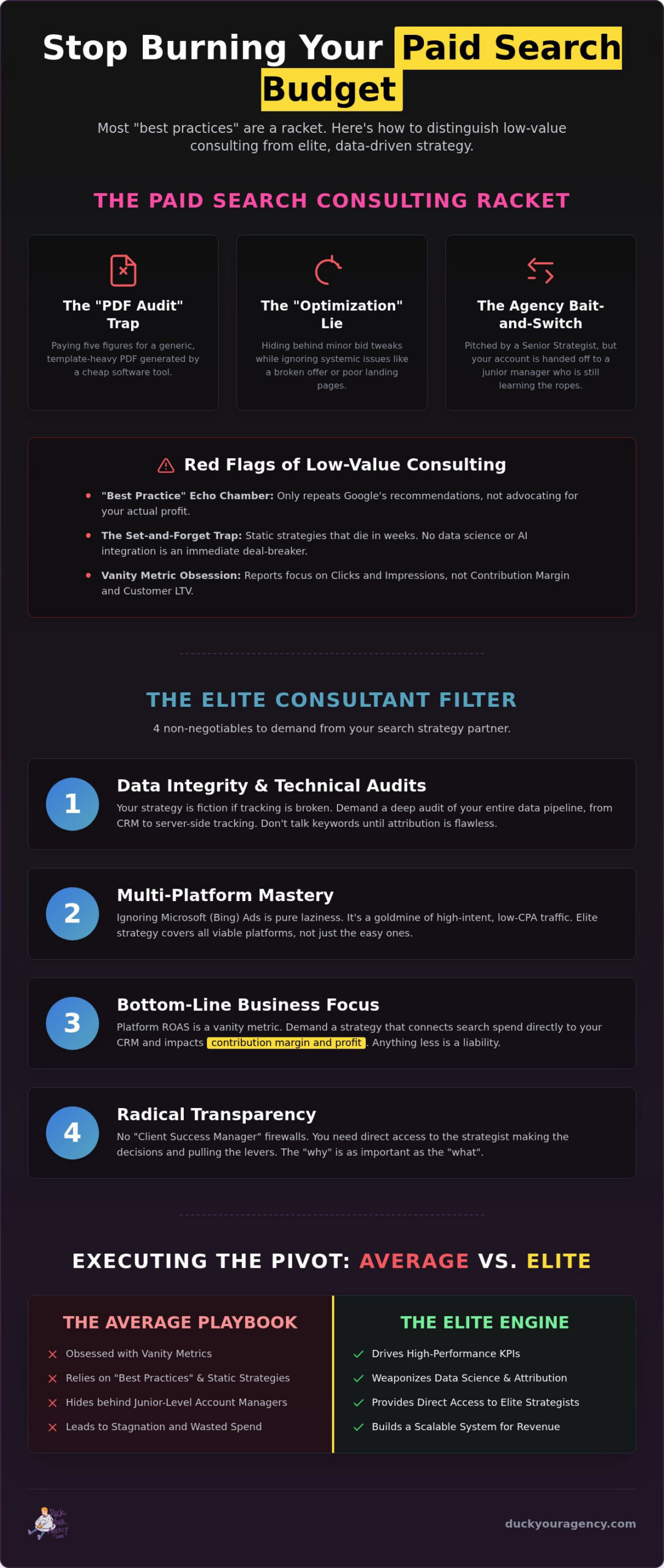
Most paid search consulting services are a racket. You pay five figures for a "strategic audit" that is really just a generic PDF generated by a software tool you could have licensed for $99. It’s a template-heavy scam designed to make you feel like you’re getting "elite" advice while the consultant spends twenty minutes looking at your account. True consulting isn’t a checklist. It’s the high-stakes fusion of strategy, technical infrastructure, and elite talent acquisition. If your consultant isn’t interrogating your unit economics or auditing your data pipeline, they aren’t consulting. They’re just reading a dashboard you already have access to.

Stop falling for the "Optimization" Lie. Small bid tweaks and keyword additions won’t save a broken business model or a landing page that converts like a sieve. Low-tier consultants love to hide behind these minor adjustments because they’re easy to report and even easier to fake. They ignore the systemic issues leaking your cash because fixing an offer is harder than changing a bid. Understanding What is Pay-Per-Click (PPC)? at a foundational level is a start, but winning in 2026 requires weaponizing that data against sophisticated competitors who are already using machine learning to eat your lunch.

Then there’s the agency bait-and-switch. You’ve felt it. The "Senior Strategy Lead" pitches you with world-class case studies and a brilliant vision. The moment the ink dries on the contract, your account is handed off to a junior manager who is still learning where the buttons are. This isn’t just annoying; it’s a liability. Average performance in a high-competition landscape is a slow death for your ROAS. Every dollar spent on "average" is a dollar your competitors are using to scale.

Consulting vs. Management: Knowing the Difference

Think of consulting as the architectural blueprint for your search engine. It defines the "why" and the "how" of your entire growth trajectory. Management is the daily high-performance maintenance. You wouldn’t hire a mechanic to design a Formula 1 car from scratch. You shouldn’t expect a tactical manager to fix a fundamental strategic flaw. You need the blueprint before you hire the mechanics to turn the wrenches.

The Red Flags of Low-Value PPC Consulting

  • The "Best Practice" Echo Chamber: If they only talk about "Quality Score" or "Google’s recommendations," they are a mouthpiece for the platforms, not an advocate for your profit.
  • The Set-and-Forget Trap: Static strategies die in weeks. In an AI-driven market, a lack of data science integration is an immediate deal-breaker.
  • Vanity Metric Obsession: If the reports focus on impressions and clicks rather than contribution margin and LTV, they are hiding a lack of real results.

The Consultant Filter: 4 Non-Negotiables for Your Search Strategy

Most consultants are just glorified button-pushers with better titles. You need a filter that separates the pretenders from the elite. Elite paid search consulting services start with data integrity. If your tracking is broken, your strategy is fiction. We don’t care about your keywords until we know your attribution model isn’t double-counting conversions or ignoring the dark funnel. A deep technical audit must go beyond the surface to interrogate your entire data pipeline. If they aren’t looking at your server-side tracking, they aren’t looking deep enough.

Building a strong search engine marketing strategy requires platform mastery that extends beyond Google. Microsoft Advertising is often the forgotten goldmine of high-intent, low-CPA traffic. A consultant who ignores Bing is lazy and leaving your money on the table for competitors to scoop up. Your search spend must also talk to your CRM. We want bottom-line profit, not just platform ROAS. If your consultant can’t explain how their search strategy impacts your contribution margin, they are a liability to your balance sheet.

Transparency is the final hurdle. You deserve direct access to the strategists making the decisions. We have zero patience for "Client Success Managers" who act as human firewalls. These middle-managers exist to soften the blow of underperformance, not to drive growth. You need the person pulling the levers to be the same person explaining the "why" behind every dollar spent. If you’re tired of the agency dance, it’s time for a straight-talking partner who treats your capital like their own.

The Seniority Trap: Who is Actually Touching Your Account?

Big agencies are factories. They sell you on the partner and give you the intern. It’s a betrayal of your budget. Direct access to the strategist is the only way to achieve Google Ads management for scale. If you aren’t talking to the person actually pulling the levers, you’re just playing a game of telephone with your capital. Demand accountability. Ask who is actually inside your account every day. If the answer is a "junior associate," walk away.

Strategic Alignment with Growth Goals

Stop chasing traffic. Start capturing revenue. High-performance paid search consulting services understand your specific unit economics. They know your LTV and your CAC limits. They also know that paid search doesn’t live in a vacuum. It needs the support of aggressive growth marketing to convert at scale. We move past "Traffic Generation" and focus on "Revenue Capture." We align every bid with your actual business goals, ensuring that every click is a calculated investment in your growth.

Build, Buy, or Rent: Navigating the Search Management Landscape

The choice between in-house and agency is a false binary. Smart companies don’t just pick a side; they select a delivery model based on their current growth stage. You have three real options: build, buy, or rent. Most businesses struggle because they choose the wrong model for their current velocity. They hire a full-time manager when they really need a strategic architect, or they hire an agency when they need an internal powerhouse.

Paid search consulting services represent the "Rent" model. You aren’t hiring a permanent fixture; you’re renting a high-performance brain to architect your strategy. This is the move when you need a rapid pivot or a professional audit of a team that’s currently incinerating capital. It’s the strategy layer that ensures your execution actually has a chance of success. It provides the elite perspective required to break through performance plateaus without the long-term commitment of a full-time executive salary.

If you want total hands-off growth, you "Buy" the results through Fully Managed Digital Marketing. This is for the executive who wants accountability without the operational headache of managing daily bid adjustments. You hold the partner to the revenue goals while they handle the technical heavy lifting. Finally, the "Build" model uses Digital Marketing Recruitment Services to place elite talent directly into your internal team. The best partners offer a hybrid path. They might start by consulting to fix the mess, move to managed services to scale the wins, and eventually help you recruit the talent to take it all in-house as you mature.

The Recruitment Edge: Building Your Internal Powerhouse

HR departments are notoriously bad at hiring for technical marketing roles. They look for "years of experience" and "culture fit" but wouldn’t know a broken tracking pixel if it hit them. They can’t vet for platform mastery or data science capabilities. A consulting partner acts as the ultimate technical filter. We know the difference between a practitioner who can scale a seven-figure budget and a theorist who just talks about "best practices." Using specialized recruitment services ensures you don’t waste six months on a hire who lacks the technical chops to actually perform.
In a competitive hiring landscape, improving job application engagement for media agencies is often the key to securing the industry’s most sought-after practitioners.

Managed Services: When Speed Trumps Everything

There are times when internal hiring is too slow. If you need to dominate a new market or launch complex programmatic plays next week, you need an elite managed service. This model allows for immediate scaling without the overhead of onboarding and training. You gain instant access to specialized expertise that an internal generalist simply cannot match. It’s about maintaining agility. You get the benefit of an entire data science team and senior strategists without the long-term liability of a massive internal payroll. It’s the fastest way to move from plateaued to profitable.
1 Paid Search Consulting Services: The No-Nonsense Guide to Scaling ROAS

The Data Science Edge: Why Your Search Strategy is Leaking Cash

Standard reporting is for losers. If your paid search consulting services are still relying on out-of-the-box Google Analytics 4 settings, you are flying blind. Most "experts" brag about basic conversion tracking, but basic tracking is the bare minimum. It is the floor, not the ceiling. To win in 2026, you need custom data science models that bridge the gap between platform clicks and actual bank deposits. These models don’t just count leads; they calculate the probability of lifetime value based on complex, cross-channel touchpoints. They turn raw data into a weaponized growth engine.

You cannot view search in a vacuum. Integrating programmatic advertising and video ads into your holistic data picture is non-negotiable. If you ignore these channels, you are ignoring the top-of-funnel influence that drives your branded search volume. Predictive modeling allows us to stop reacting to yesterday’s failures. We use historical data to forecast where your next profitable lead will come from and shift budgets before the competition even wakes up. This isn’t just "optimization." It’s financial foresight applied to your marketing spend.

Attribution: The Difference Between Guessing and Scaling

Standard attribution models are designed to make the platforms look good, not your business. They artificially inflate ROAS by over-crediting easy, bottom-of-funnel wins while hiding massive waste in mid-funnel campaigns. Proper digital marketing analytics identifies these leaks where your cash is evaporating into low-intent traffic. Multi-touch attribution is the only way to track true incrementality. It reveals which keywords actually move the needle and which ones are just along for the ride. Stop guessing and start scaling with advanced data science and analytics that prove real ROI.

AI and Automation: Friend or Foe?

AI is a tool, not a strategy. Google’s "Auto-Applied Recommendations" are frequently a tax on the uninformed. They prioritize platform revenue over your contribution margin. Elite consultants use AI search engines and sophisticated ad placements to gain a technical edge, but they never abdicate control to the algorithm. The sweet spot for ROI is human oversight paired with machine execution. Machines handle the micro-bidding at a scale humans can’t touch; humans handle the high-level strategy and psychological triggers that actually drive conversions. If you aren’t managing the machine, the machine is managing your budget into the ground.

Executing the Pivot: Average to Elite Search Results

Elite performance doesn’t take six months to manifest. If your paid search consulting services can’t show a meaningful pivot in 30 days, they are stalling. A high-impact engagement starts by cutting the waste and realigning your spend with reality immediately. We don’t care about "projected" growth in the distant future. We care about the 30-day turnaround where we stop the bleeding and start the scaling. This is the moment you stop being a passive participant in the auction and start being the dominant force.

Marketing managers love platform ROAS. The C-suite loves EBITDA. To bridge the gap between your current state and your growth goals, you must set KPIs that actually impact the balance sheet. We focus on contribution margin and CAC-to-LTV ratios. These are the numbers that matter. They prove you aren’t just buying traffic; you’re buying profit. The final call is choosing a partner who values your results more than their monthly retainer. You need a strategist who is willing to tell you your offer is broken if the data proves it.

The Roadmap to ROAS Dominance

  • Phase 1: The Infrastructure Audit. We interrogate your tracking, data pipeline, and tech stack. If the foundation is cracked, we fix it before spending another dollar.
  • Phase 2: The Strategic Overhaul. We rebuild your account architecture. This includes a total refresh of bidding strategies, keyword selection, and creative assets to ensure every click has a purpose.
  • Phase 3: The Scaling Phase. Once the core is profitable, we expand. We integrate programmatic, video ads, and new market expansion to maximize your reach and revenue.

Ready to Stop Bleeding Cash?

Settling for "average" is the fastest way to lose market share to competitors who are more aggressive and better informed. "Good enough" is a slow death for your margins. You deserve the camaraderie of high performance. Partnering with a rebel expert means choosing transparency over bureaucracy and results over excuses. It is time to stop the "optimization" fluff and start building a high-performance engine. Get a straight-talking strategy audit from Duck Your Agency and see what real accountability looks like.

The Final Pivot: From Search Victim to Market Leader

You’ve seen the racket. High-performance growth isn’t about minor bid tweaks or generic PDF audits. It requires elite paid search consulting services that integrate custom data science models and provide a clear roadmap for either managed growth or internal team building. You now know how to filter for transparency and platform mastery. Stop playing the agency game of telephone and demand direct access to the strategists who actually pull the levers. It’s about building a system that drives predictable revenue, not just vanity clicks.

It’s time to choose a partner who values your results more than your monthly retainer. Whether you need elite data science integration to fix your attribution or specialized recruitment for internal teams to build your own powerhouse, the path to ROAS dominance is clear. You don’t have to settle for "junior" account managers and opaque reporting. We offer direct strategy access with no middlemen to slow you down. Stop settling for average. Get a high-performance strategy audit now.

Your growth engine is waiting. Let’s build it together and leave the underperformers in the dust.

Frequently Asked Questions

What is the difference between PPC management and paid search consulting?

Management is the mechanic; consulting is the engineer. PPC management focuses on the day-to-day execution like bid adjustments and ad copy tweaks. Paid search consulting services provide the architectural blueprint, infrastructure audit, and talent strategy needed to scale. Consulting fixes the fundamental flaws in your business model that no amount of daily "optimization" can touch.

How much do paid search consulting services typically cost?

Fees for high-level consulting depend on the complexity of your data pipeline and the scale of your spend. You aren’t paying for "hours" or a junior account manager’s learning curve. You are investing in elite strategic oversight that prevents capital incineration. The cost of "average" performance is always higher than the fee for expert intervention.

How long does it take to see results from a search consulting engagement?

Expect a measurable strategic pivot within the first 30 days of an engagement. While total market dominance takes time, identifying and plugging budget leaks happens almost immediately. Elite consultants focus on high-impact wins first, ensuring your infrastructure is sound before pushing for aggressive scale in the following quarters.

Do I need a consultant if I already have an in-house marketing team?

Internal teams often suffer from "plateau fatigue" or a lack of specialized data science tools. A consultant provides the outsider’s perspective and technical muscle your team might lack. They act as a strategic layer that helps your internal staff execute at a higher level or identifies when you need to upgrade your talent through recruitment.

Can a paid search consultant help with Bing Ads as well as Google Ads?

Platform mastery across both Google Ads and Bing Ads is non-negotiable. Microsoft Advertising often yields higher intent and lower CPAs for specific industries. A consultant who only looks at Google is ignoring a massive chunk of the market. We treat Bing as a core component of a holistic search engine marketing strategy.

What data science models are most effective for optimizing paid search?

Predictive LTV models and custom attribution frameworks are the most effective tools for 2026. These models move beyond basic conversion counting to forecast the actual profit potential of every click. By integrating server-side data, these models reveal the true incrementality of your search spend across the entire funnel.

How does recruitment fit into a paid search consulting strategy?

Recruitment is the "Build" phase of your scaling roadmap. High-performance paid search consulting services identify the exact technical skill sets your organization needs to sustain growth. Specialized recruitment ensures you hire practitioners who can actually manage the machine we’ve built, rather than theorists who just talk about best practices.

Is multi-touch attribution really necessary for my business?

Last-click attribution is a fantasy that rewards easy wins and hides systemic waste. Multi-touch attribution is essential because it exposes the top-of-funnel influence of video ads and programmatic plays. Without it, you’ll likely over-invest in branded search while starving the discovery campaigns that actually drive new customer acquisition.
  Category: Uncategorized
  Comments: Comments Off on 1 Paid Search Consulting Services: The No-Nonsense Guide to Scaling ROAS

Paid Search Consulting Services: The No-Nonsense Guide to Scaling ROAS

Your paid search budget is likely being incinerated by “best practices” that haven’t worked since 2019. Most paid search consulting services are little more than expensive babysitting for an algorithm that’s already failing you. You’re watching your CPA climb while your “senior” account manager sends over reports filled with vanity metrics and “optimization” fluff. It’s frustrating to know your internal team lacks the data science muscle to break the plateau while your agency hides behind a lack of transparency. Agency fatigue is real, and it’s usually caused by paying for elite expertise but receiving junior-level execution.

We agree that the status quo is broken and you’re right to be skeptical of the next “game-changing” tactic. This guide is your no-nonsense roadmap to stop the bleeding and start building a high-performance search engine backed by data science and elite strategy. This is about more than just bid adjustments; it’s about building a scalable system that drives predictable revenue. We’ll explore how to move past basic management into advanced attribution and real ROI. You’ll learn exactly what it takes to scale ROAS, whether through elite managed services or a strategic plan for internal team growth.

Key Takeaways

  • Stop falling for the “PDF audit” trap. Elite search strategy demands a foundation of technical data integrity and platform mastery across both Google and Bing Ads.
  • Learn to distinguish between “renting” paid search consulting services for rapid strategic pivots and “buying” fully managed growth for long-term market dominance.
  • Weaponize your data. Move beyond basic analytics to custom data science models and multi-touch attribution that expose exactly where your funnel is leaking revenue.
  • Execute a 30-day pivot. Replace junior-level vanity metrics with high-performance KPIs that command respect in the C-suite and prove undeniable ROI.

Table of Contents

The Paid Search Consulting Racket: Why Most Strategies Fail

Most paid search consulting services are a racket. You pay five figures for a “strategic audit” that is really just a generic PDF generated by a software tool you could have licensed for $99. It’s a template-heavy scam designed to make you feel like you’re getting “elite” advice while the consultant spends twenty minutes looking at your account. True consulting isn’t a checklist. It’s the high-stakes fusion of strategy, technical infrastructure, and elite talent acquisition. If your consultant isn’t interrogating your unit economics or auditing your data pipeline, they aren’t consulting. They’re just reading a dashboard you already have access to.

Stop falling for the “Optimization” Lie. Small bid tweaks and keyword additions won’t save a broken business model or a landing page that converts like a sieve. Low-tier consultants love to hide behind these minor adjustments because they’re easy to report and even easier to fake. They ignore the systemic issues leaking your cash because fixing an offer is harder than changing a bid. Understanding What is Pay-Per-Click (PPC)? at a foundational level is a start, but winning in 2026 requires weaponizing that data against sophisticated competitors who are already using machine learning to eat your lunch.

Then there’s the agency bait-and-switch. You’ve felt it. The “Senior Strategy Lead” pitches you with world-class case studies and a brilliant vision. The moment the ink dries on the contract, your account is handed off to a junior manager who is still learning where the buttons are. This isn’t just annoying; it’s a liability. Average performance in a high-competition landscape is a slow death for your ROAS. Every dollar spent on “average” is a dollar your competitors are using to scale.

Consulting vs. Management: Knowing the Difference

Think of consulting as the architectural blueprint for your search engine. It defines the “why” and the “how” of your entire growth trajectory. Management is the daily high-performance maintenance. You wouldn’t hire a mechanic to design a Formula 1 car from scratch. You shouldn’t expect a tactical manager to fix a fundamental strategic flaw. You need the blueprint before you hire the mechanics to turn the wrenches.

The Red Flags of Low-Value PPC Consulting

  • The “Best Practice” Echo Chamber: If they only talk about “Quality Score” or “Google’s recommendations,” they are a mouthpiece for the platforms, not an advocate for your profit.
  • The Set-and-Forget Trap: Static strategies die in weeks. In an AI-driven market, a lack of data science integration is an immediate deal-breaker.
  • Vanity Metric Obsession: If the reports focus on impressions and clicks rather than contribution margin and LTV, they are hiding a lack of real results.

The Consultant Filter: 4 Non-Negotiables for Your Search Strategy

Most consultants are just glorified button-pushers with better titles. You need a filter that separates the pretenders from the elite. Elite paid search consulting services start with data integrity. If your tracking is broken, your strategy is fiction. We don’t care about your keywords until we know your attribution model isn’t double-counting conversions or ignoring the dark funnel. A deep technical audit must go beyond the surface to interrogate your entire data pipeline. If they aren’t looking at your server-side tracking, they aren’t looking deep enough.

Building a strong search engine marketing strategy requires platform mastery that extends beyond Google. Microsoft Advertising is often the forgotten goldmine of high-intent, low-CPA traffic. A consultant who ignores Bing is lazy and leaving your money on the table for competitors to scoop up. Your search spend must also talk to your CRM. We want bottom-line profit, not just platform ROAS. If your consultant can’t explain how their search strategy impacts your contribution margin, they are a liability to your balance sheet.

Transparency is the final hurdle. You deserve direct access to the strategists making the decisions. We have zero patience for “Client Success Managers” who act as human firewalls. These middle-managers exist to soften the blow of underperformance, not to drive growth. You need the person pulling the levers to be the same person explaining the “why” behind every dollar spent. If you’re tired of the agency dance, it’s time for a straight-talking partner who treats your capital like their own.

The Seniority Trap: Who is Actually Touching Your Account?

Big agencies are factories. They sell you on the partner and give you the intern. It’s a betrayal of your budget. Direct access to the strategist is the only way to achieve Google Ads management for scale. If you aren’t talking to the person actually pulling the levers, you’re just playing a game of telephone with your capital. Demand accountability. Ask who is actually inside your account every day. If the answer is a “junior associate,” walk away.

Strategic Alignment with Growth Goals

Stop chasing traffic. Start capturing revenue. High-performance paid search consulting services understand your specific unit economics. They know your LTV and your CAC limits. They also know that paid search doesn’t live in a vacuum. It needs the support of aggressive growth marketing to convert at scale. We move past “Traffic Generation” and focus on “Revenue Capture.” We align every bid with your actual business goals, ensuring that every click is a calculated investment in your growth.

Build, Buy, or Rent: Navigating the Search Management Landscape

The choice between in-house and agency is a false binary. Smart companies don’t just pick a side; they select a delivery model based on their current growth stage. You have three real options: build, buy, or rent. Most businesses struggle because they choose the wrong model for their current velocity. They hire a full-time manager when they really need a strategic architect, or they hire an agency when they need an internal powerhouse.

Paid search consulting services represent the “Rent” model. You aren’t hiring a permanent fixture; you’re renting a high-performance brain to architect your strategy. This is the move when you need a rapid pivot or a professional audit of a team that’s currently incinerating capital. It’s the strategy layer that ensures your execution actually has a chance of success. It provides the elite perspective required to break through performance plateaus without the long-term commitment of a full-time executive salary.

If you want total hands-off growth, you “Buy” the results through Fully Managed Digital Marketing. This is for the executive who wants accountability without the operational headache of managing daily bid adjustments. You hold the partner to the revenue goals while they handle the technical heavy lifting. Finally, the “Build” model uses Digital Marketing Recruitment Services to place elite talent directly into your internal team. The best partners offer a hybrid path. They might start by consulting to fix the mess, move to managed services to scale the wins, and eventually help you recruit the talent to take it all in-house as you mature.

The Recruitment Edge: Building Your Internal Powerhouse

HR departments are notoriously bad at hiring for technical marketing roles. They look for “years of experience” and “culture fit” but wouldn’t know a broken tracking pixel if it hit them. They can’t vet for platform mastery or data science capabilities. A consulting partner acts as the ultimate technical filter. We know the difference between a practitioner who can scale a seven-figure budget and a theorist who just talks about “best practices.” Using specialized recruitment services ensures you don’t waste six months on a hire who lacks the technical chops to actually perform.

Managed Services: When Speed Trumps Everything

There are times when internal hiring is too slow. If you need to dominate a new market or launch complex programmatic plays next week, you need an elite managed service. This model allows for immediate scaling without the overhead of onboarding and training. You gain instant access to specialized expertise that an internal generalist simply cannot match. It’s about maintaining agility. You get the benefit of an entire data science team and senior strategists without the long-term liability of a massive internal payroll. It’s the fastest way to move from plateaued to profitable.


The Data Science Edge: Why Your Search Strategy is Leaking Cash

Standard reporting is for losers. If your paid search consulting services are still relying on out-of-the-box Google Analytics 4 settings, you are flying blind. Most “experts” brag about basic conversion tracking, but basic tracking is the bare minimum. It is the floor, not the ceiling. To win in 2026, you need custom data science models that bridge the gap between platform clicks and actual bank deposits. These models don’t just count leads; they calculate the probability of lifetime value based on complex, cross-channel touchpoints. They turn raw data into a weaponized growth engine.

You cannot view search in a vacuum. Integrating programmatic advertising and video ads into your holistic data picture is non-negotiable. If you ignore these channels, you are ignoring the top-of-funnel influence that drives your branded search volume. Predictive modeling allows us to stop reacting to yesterday’s failures. We use historical data to forecast where your next profitable lead will come from and shift budgets before the competition even wakes up. This isn’t just “optimization.” It’s financial foresight applied to your marketing spend.

Attribution: The Difference Between Guessing and Scaling

Standard attribution models are designed to make the platforms look good, not your business. They artificially inflate ROAS by over-crediting easy, bottom-of-funnel wins while hiding massive waste in mid-funnel campaigns. Proper digital marketing analytics identifies these leaks where your cash is evaporating into low-intent traffic. Multi-touch attribution is the only way to track true incrementality. It reveals which keywords actually move the needle and which ones are just along for the ride. Stop guessing and start scaling with advanced data science and analytics that prove real ROI.

AI and Automation: Friend or Foe?

AI is a tool, not a strategy. Google’s “Auto-Applied Recommendations” are frequently a tax on the uninformed. They prioritize platform revenue over your contribution margin. Elite consultants use AI search engines and sophisticated ad placements to gain a technical edge, but they never abdicate control to the algorithm. The sweet spot for ROI is human oversight paired with machine execution. Machines handle the micro-bidding at a scale humans can’t touch; humans handle the high-level strategy and psychological triggers that actually drive conversions. If you aren’t managing the machine, the machine is managing your budget into the ground.

Executing the Pivot: Average to Elite Search Results

Elite performance doesn’t take six months to manifest. If your paid search consulting services can’t show a meaningful pivot in 30 days, they are stalling. A high-impact engagement starts by cutting the waste and realigning your spend with reality immediately. We don’t care about “projected” growth in the distant future. We care about the 30-day turnaround where we stop the bleeding and start the scaling. This is the moment you stop being a passive participant in the auction and start being the dominant force.

Marketing managers love platform ROAS. The C-suite loves EBITDA. To bridge the gap between your current state and your growth goals, you must set KPIs that actually impact the balance sheet. We focus on contribution margin and CAC-to-LTV ratios. These are the numbers that matter. They prove you aren’t just buying traffic; you’re buying profit. The final call is choosing a partner who values your results more than their monthly retainer. You need a strategist who is willing to tell you your offer is broken if the data proves it.

The Roadmap to ROAS Dominance

  • Phase 1: The Infrastructure Audit. We interrogate your tracking, data pipeline, and tech stack. If the foundation is cracked, we fix it before spending another dollar.
  • Phase 2: The Strategic Overhaul. We rebuild your account architecture. This includes a total refresh of bidding strategies, keyword selection, and creative assets to ensure every click has a purpose.
  • Phase 3: The Scaling Phase. Once the core is profitable, we expand. We integrate programmatic, video ads, and new market expansion to maximize your reach and revenue.

Ready to Stop Bleeding Cash?

Settling for “average” is the fastest way to lose market share to competitors who are more aggressive and better informed. “Good enough” is a slow death for your margins. You deserve the camaraderie of high performance. Partnering with a rebel expert means choosing transparency over bureaucracy and results over excuses. It is time to stop the “optimization” fluff and start building a high-performance engine. Get a straight-talking strategy audit from Duck Your Agency and see what real accountability looks like.

The Final Pivot: From Search Victim to Market Leader

You’ve seen the racket. High-performance growth isn’t about minor bid tweaks or generic PDF audits. It requires elite paid search consulting services that integrate custom data science models and provide a clear roadmap for either managed growth or internal team building. You now know how to filter for transparency and platform mastery. Stop playing the agency game of telephone and demand direct access to the strategists who actually pull the levers. It’s about building a system that drives predictable revenue, not just vanity clicks.

It’s time to choose a partner who values your results more than your monthly retainer. Whether you need elite data science integration to fix your attribution or specialized recruitment for internal teams to build your own powerhouse, the path to ROAS dominance is clear. You don’t have to settle for “junior” account managers and opaque reporting. We offer direct strategy access with no middlemen to slow you down. Stop settling for average. Get a high-performance strategy audit now.

Your growth engine is waiting. Let’s build it together and leave the underperformers in the dust.

Frequently Asked Questions

What is the difference between PPC management and paid search consulting?

Management is the mechanic; consulting is the engineer. PPC management focuses on the day-to-day execution like bid adjustments and ad copy tweaks. Paid search consulting services provide the architectural blueprint, infrastructure audit, and talent strategy needed to scale. Consulting fixes the fundamental flaws in your business model that no amount of daily “optimization” can touch.

How much do paid search consulting services typically cost?

Fees for high-level consulting depend on the complexity of your data pipeline and the scale of your spend. You aren’t paying for “hours” or a junior account manager’s learning curve. You are investing in elite strategic oversight that prevents capital incineration. The cost of “average” performance is always higher than the fee for expert intervention.

How long does it take to see results from a search consulting engagement?

Expect a measurable strategic pivot within the first 30 days of an engagement. While total market dominance takes time, identifying and plugging budget leaks happens almost immediately. Elite consultants focus on high-impact wins first, ensuring your infrastructure is sound before pushing for aggressive scale in the following quarters.

Do I need a consultant if I already have an in-house marketing team?

Internal teams often suffer from “plateau fatigue” or a lack of specialized data science tools. A consultant provides the outsider’s perspective and technical muscle your team might lack. They act as a strategic layer that helps your internal staff execute at a higher level or identifies when you need to upgrade your talent through recruitment.

Can a paid search consultant help with Bing Ads as well as Google Ads?

Platform mastery across both Google Ads and Bing Ads is non-negotiable. Microsoft Advertising often yields higher intent and lower CPAs for specific industries. A consultant who only looks at Google is ignoring a massive chunk of the market. We treat Bing as a core component of a holistic search engine marketing strategy.

What data science models are most effective for optimizing paid search?

Predictive LTV models and custom attribution frameworks are the most effective tools for 2026. These models move beyond basic conversion counting to forecast the actual profit potential of every click. By integrating server-side data, these models reveal the true incrementality of your search spend across the entire funnel.

How does recruitment fit into a paid search consulting strategy?

Recruitment is the “Build” phase of your scaling roadmap. High-performance paid search consulting services identify the exact technical skill sets your organization needs to sustain growth. Specialized recruitment ensures you hire practitioners who can actually manage the machine we’ve built, rather than theorists who just talk about best practices.

Is multi-touch attribution really necessary for my business?

Last-click attribution is a fantasy that rewards easy wins and hides systemic waste. Multi-touch attribution is essential because it exposes the top-of-funnel influence of video ads and programmatic plays. Without it, you’ll likely over-invest in branded search while starving the discovery campaigns that actually drive new customer acquisition.


  Category: Uncategorized
  Comments: Comments Off on Paid Search Consulting Services: The No-Nonsense Guide to Scaling ROAS

Your current b2b programmatic advertising strategy is likely a black hole for your budget. Most agencies are happy to sell you "reach" while your ads serve to bots or low-level employees who lack signing authority. It’s a waste of capital. We know the frustration of high CPAs that result in zero pipeline impact. You’re tired of the lack of transparency in agency fees and the inability to reach the actual decision-makers within your target accounts. STOP. There’s a better way to play the game.

We agree that impressions are a vanity metric that won’t save your job. You need a precision-guided engine that actually hunts down the 11-stakeholder buying committee. This guide provides a no-nonsense framework for account-based programmatic that slashes wasted spend and utilizes data science to optimize every bid. We’ll show you how to navigate the 2026 landscape, from the evolving regulatory environment for AI and data to the mandatory shift toward first-party data. It’s time to build a strategy that delivers full-funnel attribution and proves real value to the CFO.

Key Takeaways

  • Stop burning cash on “reach” and start hunting pipeline by ditching the vanity-heavy impression trap.
  • Build a b2b programmatic advertising strategy that uses data science to bypass gatekeepers and hit all 11 stakeholders in the buying committee.
  • Integrate your CRM with your DSP to ensure your tech stack actually targets high-priority accounts instead of random bots.
  • Audit your media spend to expose hidden agency fees and implement multi-touch attribution that finally proves ROI to your CFO.
  • Scale your operations by choosing between elite managed services or recruiting an internal programmatic powerhouse to maintain total control.

The Brutal Reality: Why Most B2B Programmatic Strategies are a Dumpster Fire

Most B2B marketing leaders are being lied to. They think they have a functional b2b programmatic advertising strategy. What they actually have is a glorified donation to the Google and Trade Desk ecosystem. Programmatic, at its core, is the automated, data-driven hunt for business decision-makers. It should be a sniper rifle. Instead, most agencies use it like a confetti cannon. They celebrate "reach" while your pipeline is a desert. This is the Impression Trap. High reach often equals zero pipeline because you’re targeting everyone and influencing no one.

Research indicates that by 2026, 90% of B2B display budgets will flow through programmatic platforms. Yet, most of that capital is burned on bot traffic or low-level employees who couldn’t sign off on a lunch order, let alone a six-figure contract. Traditional agency models are built on this waste. They hide behind "platform fees" and "optimization" while pocketing a percentage of your total spend. They want you to spend more. They don’t care if it converts. It’s a conflict of interest that kills growth and keeps you stuck in a cycle of underperformance.

The Myth of Awareness vs. The Reality of Revenue

Stop paying for eyeballs that don’t have budget authority. Awareness doesn’t pay the bills; revenue does. If your primary metrics are CTR or CPM, you’ve already lost. These vanity metrics are the enemy of growth. They provide a false sense of security while your actual market share stagnates. You need to shift from "spray and pray" to account-level precision. Every dollar must be tied to an entity that can actually buy from you. If the data doesn’t show a direct path to a decision-maker, it’s just noise.

Stakeholder Infiltration: The New B2B Standard

The 11-stakeholder problem is real. You aren’t selling to a person; you’re selling to a committee. If your b2b programmatic advertising strategy only targets one "lead," you’re begging for a closed-lost status. You need to map the entire buying committee across the digital ecosystem, from LinkedIn to Connected TV. Most frequency caps are set too low, killing your conversion before the committee even knows you exist. You need to be omnipresent for the right people, not just visible to everyone.

In 2026, the buying committee is a shifting constellation of 11 diverse stakeholders, ranging from technical evaluators to financial gatekeepers, who must all reach a consensus before a single dollar moves.

The Architecture of a High-Performance B2B Programmatic Engine

A winning b2b programmatic advertising strategy isn’t built on hope. It’s built on a cold, hard tech stack that values precision over volume. If your DSP and CRM aren’t talking, you’re essentially flying blind. CRM integration isn’t a "nice to have" in 2026; it’s the only way to ensure your ads aren’t chasing ghosts. By feeding your first-party data directly into the engine, you create a feedback loop that trains the system to find more people who actually look like your best customers. Anything less is just guesswork.

Choosing a DSP That Doesn’t Suck

Generalist giants often fail in the B2B space because they’re built for consumer scale, not committee complexity. You need a platform with native CRM connectors and account-based targeting baked into its DNA. Be wary of the entry barriers. Google’s DV360 typically requires a $40,000 monthly spend just for basic access and support. The Trade Desk often demands a $1.5 million annual commitment for self-serve access. If you aren’t hitting those numbers, you’re likely stuck in a managed service black box with 15-20% fees. Always demand a "Transparency Test" to see exactly where every cent of your media spend goes. If you want to bypass the bureaucracy and deploy an elite stack immediately, consider fully managed programmatic advertising that prioritizes your pipeline over platform quotas.

Intent Data: The Fuel for the Engine

Intent data is the signal in the noise. Firmographics tell you who a company is. Technographics tell you what they use. Intent data tells you they are ready to buy right now. By layering these data points, you can identify "In-Market" signals before your competitors even know there’s a deal on the table. In the cookieless landscape of 2026, first-party data is your primary weapon. Use it to build predictive bid strategies that aggressively target accounts showing high-velocity engagement. This isn’t just advertising; it’s a data-driven infiltration of the buying committee.

Executing the Hunt: Advanced Targeting and ABM Strategies

Architecture is useless without execution. You’ve built the engine; now you have to point it at the right targets and pull the trigger. A ruthless b2b programmatic advertising strategy requires a five-step tactical framework that leaves no room for "brand awareness" fluff. We don’t care if they know your name. We care if they’re in your pipeline. The hunt begins with data and ends with a closed-won deal.

  • Step 1: Define your ICP. Use historical CRM data to identify the traits of your highest-LTV customers. Don’t guess. Let the math tell you who actually pays the bills.
  • Step 2: Align with Sales. If your target account list doesn’t match the Sales team’s high-priority targets, you’re just generating noise. Alignment is mandatory.
  • Step 3: Multi-Channel Deployment. Infiltrate the committee through Video, Display, and Native placements. Be everywhere they are, from industry news sites to YouTube.
  • Step 4: Scale with DCO. Use Dynamic Creative Optimization to swap headlines and imagery based on the viewer’s industry or job title. Personalization at scale is no longer optional.
  • Step 5: Execute Surround Sound. Hit all 11 stakeholders simultaneously. When the CFO, the CTO, and the end user all see your solution, the internal conversation shifts in your favor.

Account-Based Marketing (ABM) at Scale

Most marketers treat ABM like a manual, 1:1 labor of love. That doesn’t scale. You need to move to a 1:Many model that maintains surgical precision. While LinkedIn Ads are great for initial targeting, they are a walled garden with high costs. Programmatic allows you to bridge that gap, reaching those same professionals across the entire web for a fraction of the price. By syncing your CRM, you can automatically trigger high-intensity display ads the moment an account moves from "Discovery" to "Proposal" stage, ensuring your brand remains top-of-mind during the final decision.

Creative That Actually Converts B2B Buyers

Your B2C-style ads are being ignored. Professionals don’t click on flashy clickbait; they click on solutions to their specific problems. Direct response video is the sledgehammer of B2B programmatic. It forces engagement and qualifies the viewer in seconds. You must test your messaging by job function. The CEO wants to hear about market share. The End User wants to know if the software is going to make their Friday afternoon easier. If you use the same creative for both, you’re failing both. Elite execution means delivering the right message to the right stakeholder at the exact moment they’re looking for an exit from their current pain.

Killing the Waste: Diagnostics, Attribution, and Hidden Fee Audits

Your agency is likely skimming off the top. It’s the uncomfortable truth of the programmatic world. While you’re focused on the creative, they’re often hiding behind a "black box" of tech fees and markups. A sophisticated b2b programmatic advertising strategy requires you to be as good at accounting as you are at marketing. If you aren’t auditing your spend, you’re likely paying a 20% bot-tax and another 15% in hidden platform fees. This isn’t just "the cost of doing business." It’s a failure of leadership that drains your pipeline before it even has a chance to grow.

Performance diagnostics aren’t just about looking at a pretty dashboard. They’re about digging into the log-level data. Most agencies will show you a "blended" report that masks the 15-30% data discrepancies common when using multiple platforms. If they can’t show you exactly which domains your ads appeared on and the specific clearing price for those impressions, they’re hiding something. You need to eliminate the waste before you can scale the wins. Fraud detection isn’t a feature; it’s a necessity to ensure your capital is hunting humans, not algorithms.

Attribution: Tracking Every Cent

Last-click attribution is a lie. In a world where B2B sales cycles last 6 to 18 months and involve 11 stakeholders, the idea that the final click gets all the credit is absurd. You need Multi-Touch Attribution (MTA) that reconciles platform data with your CRM, your only true source of truth. Platform data is often inflated by "view-through" conversions, which are frequently a scam designed to make display ads look more effective than they are. Unless that view-through leads to a documented stage change in your CRM, it’s a vanity metric. Data science models are the only way to accurately map the long, winding path to a B2B conversion.

The No-Fluff Audit Checklist

Transparency is your best defense against incompetence and greed. Demand domain-level transparency and placement reports. If your ads are running on "made-for-advertising" sites, kill those placements immediately. Audit the agency markup on every dollar of media spend to ensure you aren’t overpaying for basic execution. A massive red flag is the presence of "unspecified tech fees" or "bundled platform charges" that aren’t tied to a specific, third-party vendor invoice. If your current partner can’t provide a line-item breakdown of every cent, it’s time to find one who values accountability. Stop funding their bureaucracy and start funding your growth with fully managed digital marketing that puts performance first.

Scaling Without the Agency Black Box: Results, Not Excuses

Scaling a b2b programmatic advertising strategy shouldn’t mean scaling your frustration. Most agencies want to sell you a permanent seat on their retainer boat. We want to build you a rocket ship. Whether you choose fully managed digital marketing or decide to bring the operation in-house, the goal remains the same: pipeline growth that survives CFO scrutiny. Traditional agencies thrive on your dependence. They create complexity to justify their existence. We prioritize ROI over retainers because we know that if we don’t deliver, we don’t deserve the business.

The Duck Your Agency Filter is simple. We hate bureaucracy. We prioritize data science and performance over "client service" fluff. If a campaign isn’t moving the needle on your 11-stakeholder buying committee, we kill it. No excuses. No "brand building" pivots when the numbers look bad. This aggressive stance is what separates a high-performance engine from a dumpster fire. We provide the elite execution speed you need to hit the ground running, but we also provide the exit ramp. We help you transition from managed campaigns to an internal powerhouse once you have the scale to justify it.

Managed Growth Marketing and Data Science

Leveraging fully managed programmatic is about hitting aggressive ROI targets without the six-month lead time of building a team. Our data science models kill the guesswork in media buying. We don’t "test" with your money. We optimize based on proven patterns that identify in-market intent before your competitors wake up. While other agencies are still explaining why your CTR is low, we are showing you how many target accounts moved into the proposal stage. Stop settling for average results and see how we manage programmatic.

Building Your Internal Elite Team

HR departments are notoriously bad at hiring digital marketing talent. They look for buzzwords and certifications. We look for performance DNA. If you want to scale internally, you need the top 1% of talent who understands the technical nuances of DSPs and attribution modeling. Our digital marketing recruitment services bridge this gap. We vet candidates using the same data-driven rigor we use for our own media buying. We don’t just find you a "manager." We find you a powerhouse that can own your b2b programmatic advertising strategy for the long haul. Hire the top 1% of digital marketing talent today.

Weaponize Your Data for 2026 Pipeline Growth

The days of hiding behind "brand awareness" are over. If your b2b programmatic advertising strategy isn’t actively hunting down your 11-stakeholder buying committee, it’s a liability. We’ve shown you how to audit hidden agency fees, integrate your CRM for real attribution, and use data science to bypass the open exchange sludge. You now have the framework to move from burning budget to building a precision-guided pipeline engine that CFOs actually respect.

The shift toward first-party data and curated supply paths in 2026 means there’s no room for "spray and pray" tactics. Whether you need transparency-first managed services to hit immediate ROI targets or elite recruitment to build your internal growth powerhouse, the path forward is unapologetically aggressive. Don’t let your competition dominate the digital landscape while you’re stuck in the impression trap. It’s time to demand accountability and see exactly where every cent of your media spend goes. Stop Wasting Budget: Get a Programmatic Efficiency Audit and start scaling with results, not excuses. You’ve got the blueprint; now go take the market.

Frequently Asked Questions

Is B2B programmatic advertising worth it for small budgets?

No. If you’re playing with pocket change, stay away. Programmatic requires enough data to feed the machine. Enterprise platforms like DV360 often require a practical threshold of $40,000 monthly spend for access and support. If you don’t have the budget to reach a critical mass of your buying committee, you’re just throwing money into a digital void.

How long does it take to see ROI from a B2B programmatic strategy?

Patience is a requirement, not a suggestion. B2B sales cycles typically range from 6 to 18 months. You might see engagement signals early, but real ROI, meaning closed-won revenue, takes time to manifest. A successful b2b programmatic advertising strategy is a marathon, not a sprint for quick wins.

What is the difference between programmatic and LinkedIn advertising?

LinkedIn is a high-priced walled garden; programmatic is the entire internet. LinkedIn ads often cost $5 to $10 per click. Programmatic allows you to reach those same decision-makers on news sites, apps, and Connected TV for a fraction of the cost. It’s about efficiency and omnipresence across the digital ecosystem.

Can I target specific companies with programmatic ads?

Absolutely. This is the foundation of account-based marketing. You can upload a list of high-priority domains and ensure your ads only serve to employees at those specific firms. It’s the digital equivalent of a sniper rifle, allowing you to bypass the general public and hit only the stakeholders who matter. This precision is the core of an elite b2b programmatic advertising strategy.

What are the typical hidden fees in programmatic ad buying?

Expect to lose 30% of your budget to the "ad tech tax" if you aren’t careful. Common culprits include DSP platform fees, which usually range from 7% to 20%, data segments, and hidden agency markups. If your partner won’t give you a transparent breakdown of the clearing price versus the billed price, they’re likely pocketing the difference.

How do I measure the success of an ABM programmatic campaign?

Stop looking at clicks. Measure success by account penetration and CRM stage velocity. Are your target accounts moving from "Cold" to "Qualified"? Is the sales team seeing an increase in revenue influenced by these accounts? Those are the only metrics that prove value to your CFO. Clicks are for amateurs.

What data is needed to start a B2B programmatic hunt?

You need a verified Ideal Customer Profile and a high-quality target account list. Don’t start without your CRM data. This first-party information is the only way to train data science models to recognize the behavior of your actual buyers. Garbage data in results in wasted spend out. Precision starts with your own records.

Do I need a specialized agency for programmatic video ads?

Yes, unless you enjoy burning cash. Programmatic video carries higher CPMs, often ranging from $10 to $30. A specialized partner understands how to optimize for completion rates and viewability without serving your ads to bots. Generalist agencies lack the technical depth to manage these high-stakes placements effectively.

Author:

Sergey Izbash (founder of Duck Your Agency)

With over 15 years of digital marketing experience, Sergey decided to create Duck Your Agency to bridge the gap between unhappy business owners (decision-makers) and digital marketing talent who wanted more flexibility and freedom to implement their ideas. Duck Your Agency is the first of its kind anti-marketing agency digital marketing agency. Since then, the results have been great – Duck Your Agency clients receive the full agency experience, with even more attention to their accounts, fewer human errors in their campaigns, at a more affordable price range.

  Category: Uncategorized
  Comments: Comments Off on B2B Programmatic Advertising Strategy: The No-Nonsense Guide to Pipeline Growth in 2026

Direct Response Video Advertising: A No-Fluff Guide to High Conversions

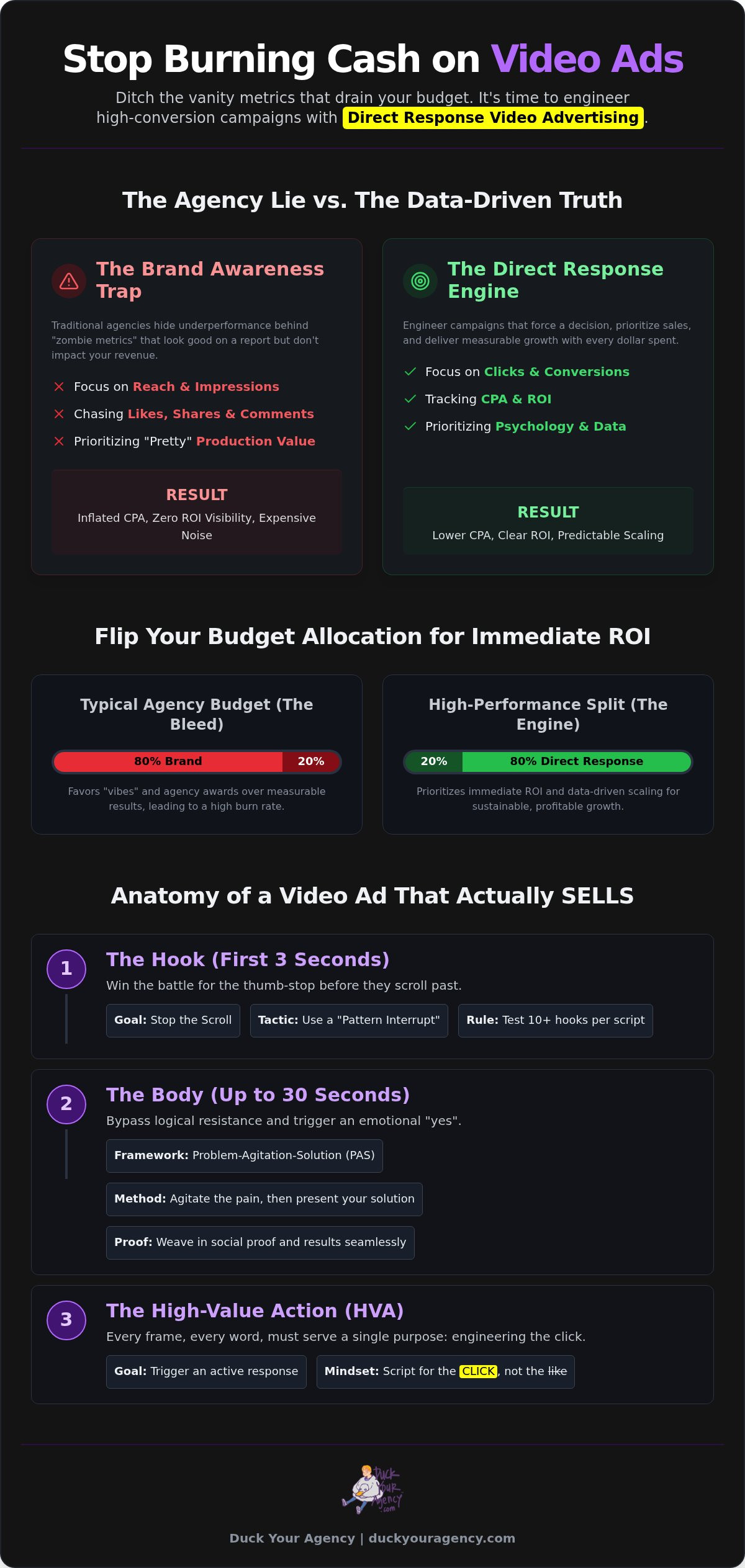
What if your viral video is actually a massive liability? Most agencies will tell you that a million views is a win. If your bank account isn’t moving, it’s just expensive noise. You’ve been burned by high customer acquisition costs and creative that looks like a Super Bowl ad but performs like a local car wash commercial. It’s time to stop the bleeding. If you want to scale, you need to master direct response video advertising and ignore the “reach” metrics that agencies use to hide their underperformance.

You’re right to be skeptical of the vanity metric hype. We agree that likes and shares don’t pay the bills. This guide promises to show you how to engineer high-conversion campaigns that prioritize psychology over production value. We’re going to dive into the data-driven tactics that lower your CPA and provide clear ROI visibility. You’ll learn the exact framework for predictable scaling through video ads that actually SELL. No fluff. No excuses. Just PERFORMANCE.

Key Takeaways

  • Stop burning cash on “pretty” production that wins awards but loses money. Learn why the brand awareness trap is killing your margins and how to avoid it.
  • Weaponize the 3-second rule to win the battle for the thumb-stop. We’ll show you how to engineer direct response video advertising as a self-contained sales funnel.
  • Flip your budget allocation. Prioritize an 80/20 split that favors immediate ROI and measurable growth over vanity metrics and agency ego.
  • Script for the High-Value Action (HVA). Use data-mined pain points to create creative that actually triggers a click instead of just a “like.”
  • Embrace the math. Discover how data science and predictive analytics turn creative guesswork into a scalable, high-performance engine.

Why Most Video Advertising Is a Waste of Your Budget

Your current video budget is likely a bonfire. It looks expensive. It sounds professional. It’s winning exactly zero sales. Traditional video is a relic of a time when “eyeballs” were the only currency. In 2026, eyeballs are cheap. Actions are expensive. If you aren’t using direct response video advertising, you’re just funding a creative agency’s award reel. Your current CPA is likely inflated by 40% or more because your strategy prioritizes “vibes” over volume. Pretty production that fails to trigger a click is just a vanity project with a high price tag.

While the legacy of broadcast media was built on these passive metrics, examining the evolution of these formats can reveal much about modern viewer engagement; learn more about The Late Desk to explore how late-night programming has changed over the years.

The Agency Lie: Reach vs. Revenue

Agencies love “Reach” because it’s a metric they can’t lose. They’ll present a report showing 1 million views and wait for a round of applause. If your revenue hasn’t moved, those 1 million views are a total failure. Traditional agencies hide underperformance behind “engagement” and “brand lift.” These are nebulous terms designed to mask a lack of accountability. There’s a brutal efficiency gap in modern media buying. Most “pretty” production is designed to be liked, not to trigger a high-value action. We don’t care if they like you. We care if they buy from you. High production value often creates a psychological barrier that makes an ad feel like an ad. Direct response strips that away to focus on the SELL.

Vanity Metrics: The Silent Profit Killer

Stop looking at “zombie metrics.” Likes, shares, and comments are the ghosts of a dead campaign. A viewer is just someone who didn’t scroll fast enough. A prospect is someone who clicked. Your profitability dies in the gap between “impressions” and “intent.” If you’re still tracking brand sentiment while your customer acquisition cost climbs, you’re losing the war. Identify the rot in your reports:

  • Average watch time that doesn’t correlate with CTR.
  • Total impressions served to non-converting demographics.
  • Social engagement that stops at the platform instead of hitting your site.

The psychological difference between a viewer and a prospect is intent. Direct response video advertising forces that intent. It moves the needle from passive consumption to active response. In 2026, the market is too crowded for “maybe later.” You need “right now.” Stop paying for views that don’t pay you back.

The market has shifted. Consumers are blind to traditional “brand” spots. They’ve seen it all. They want solutions, not stories. The shift from passive viewership to active response isn’t a trend; it’s a survival requirement for growth-stage companies. If your video doesn’t have a clear, data-backed reason to exist, delete it. Every frame must serve the conversion. Every second must justify its cost. This is the difference between a marketing expense and a growth investment. Efficiency isn’t a suggestion. It’s the only way to scale.

The Anatomy of Direct Response Video: Engineering the Click

Stop treating your video ads like mini-movies. Direct response video advertising isn’t entertainment; it’s a self-contained sales funnel engineered for a single outcome. If your creative doesn’t function as an automated closer, it’s a liability. Every frame must move the prospect closer to a transaction. You aren’t just competing with other brands. You’re competing with a dopamine-fueled scroll. If you don’t win the battle for the thumb-stop in the first 3 seconds, your budget is dead before the first line of dialogue. This is high-stakes psychology, not an art project.

The Hook: Stopping the Scroll in 2026

Visual hooks usually outperform verbal hooks on high-volume programmatic platforms. People see before they hear. Use the “Pattern Interrupt” technique to break the user’s hypnotic scrolling state. Show something unexpected, jarring, or deeply relatable within the first 500 milliseconds. A data science approach requires testing at least 10 hooks for every one body script. If you’re struggling to identify which visual triggers actually lower your CPA, fully managed digital marketing can help you iterate with surgical precision. Don’t guess what works. Let the data tell you which hook wins.

The Body: Building Irresistible Desire

The Problem-Agitation-Solution (PAS) framework is your best weapon. Don’t just show the product. Agitate the pain. Make the viewer feel the cost of their current problem. Once the tension is high, present your solution as the only logical exit. Integrate social proof seamlessly. Don’t stop the narrative for a testimonial; weave results and authority directly into the script. You have roughly 30 seconds to bypass logical resistance and trigger an emotional “yes.” Handling objections in real-time is critical. If they’re thinking about the price or the setup time, address it before they can scroll away.

The CTA: Making the Action Inevitable

The “One Goal” rule is non-negotiable. Multiple CTAs kill your conversion rate by creating choice paralysis. If you want them to buy, tell them to buy. If you want a lead, ask for the lead. Use visual cues like arrows or on-screen buttons to guide the eye. Verbal commands must be direct and urgent. The Specific Offer is the heart of direct response video advertising; without a clear, time-sensitive reason to act, you’re just begging for attention. Make the click feel like the only natural next step. RESULTS. SCALE. NO EXCUSES.

Direct Response vs. Brand Awareness: Choosing Efficiency Over Ego

Brand awareness is the favorite hiding spot for mediocre marketers. It’s a “black box” where budgets go to die under the guise of long-term value. While your competitors are chasing awards for “storytelling,” you should be chasing revenue. The fundamental difference is simple: direct response video advertising pays for its own existence. Brand ads are a gamble on future memory. DR is an investment in immediate action. For growth-stage companies, especially those scaling beyond the initial Series A hype, ego is an expense you can’t afford. You need cash flow, not just compliments.

We advocate for a brutal 80/20 split. Allocate 80% of your video budget to high-intent direct response and leave 20% for experimental brand play. Why? Because brand equity is a byproduct of successful sales. If 10,000 people buy your product through a DR ad, you’ve just built brand awareness for free. You don’t need a “maybe later” strategy when you have a “definitely now” engine. This creates a feedback loop. Every dollar spent on DR returns data that tells you exactly how to scale the next ten dollars. Brand ads just return “sentiment,” which doesn’t pay the payroll.

The ROAS Reality Check

Direct Response offers immediate attribution. You know exactly which creative triggered which sale. This cash flow is the fuel for predictable scaling. Brand awareness, conversely, is often a statistical nightmare of unprovable correlations. When you hit a major growth milestone, you need certainties. You need to know that for every $1 in, $4 comes out. If you can’t track it, you can’t scale it. Efficiency isn’t just about saving money; it’s about moving faster than the competition can think. Stop guessing and start measuring.

Platform Selection: Where DR Dominates

Not all platforms are created equal. Meta is great for social proof, and YouTube is the king of intent, but programmatic video is the secret weapon for aggressive scaling. Programmatic allows for surgical precision across the open web, reaching prospects where they are most likely to convert, not just where they scroll. Matching your creative to user intent is the difference between a nuisance and a solution.

  • YouTube: High intent, perfect for Problem-Agitation-Solution scripts.
  • Meta: High engagement, ideal for visual “Pattern Interrupts.”
  • Programmatic: High scale, the foundation for direct response video advertising at a global level. If you’re operating in the B2B space, a precision-guided B2B programmatic advertising strategy is essential to ensure your ads reach actual decision-makers instead of bots and low-level employees.

Stop buying “vibes.” Start buying outcomes. If the platform doesn’t support clear ROI visibility, it doesn’t deserve your budget. Your growth depends on data science, not creative guesswork.

Direct Response Video Advertising: A No-Fluff Guide to High Conversions

How to Build a Direct Response Video Campaign That Actually Scales

Scaling is a math problem, not a creative one. If you’re still relying on “gut feelings” to increase your budget, you’re gambling with your capital. Direct response video advertising requires a repeatable architecture that survives high-volume spend. It starts with data mining. You don’t guess what hurts your customer; you look at the support tickets, the churn reasons, and the competitor complaints. You find the specific friction and you weaponize it. Once the pain point is identified, every subsequent step must be a clinical execution of that data.

The Scripting Blueprint for 2026

Write for the ear. Corporate jargon is a signal to the brain to tune out immediately. Use natural, aggressive language that mirrors how your customers actually talk. The “First 5 Words” test is your ultimate filter. If those words don’t identify the problem and promise a solution, the viewer is gone. Integrate your offer early and often. Waiting until the end of a 60-second video to reveal the CTA is a rookie mistake that kills your ROI. If you want high-scale performance, you need a fully managed digital marketing partner who knows how to script for the click.

The Testing Framework: Creative vs. Audience

Creative is 10x more important than targeting. In a world of automated bidding, the creative IS the targeting. Use Dynamic Creative Optimization (DCO) to let the algorithms find the winning combinations of hooks, bodies, and CTAs. A “scaling signal” isn’t just a high click-through rate. It’s a stable CPA over a 72-hour period at 3x your normal daily spend. Don’t fall in love with your creative; fall in love with the numbers.

  • Step 1: Mine data for the core pain point. Ignore the “ideal persona” fluff.
  • Step 2: Script for the HVA. Every word must pay for itself.
  • Step 3: Run rapid-fire tests to identify the “Winner’s Circle.”
  • Step 4: Track the real path to purchase with multi-touch attribution. Last-click is a lie.
  • Step 5: Scale spend only when CPA thresholds are met. No exceptions.

Scale is about discipline. You must have the stomach to kill underperforming creative without mercy. Move the winners into the high-budget tier and start the next round of testing immediately. This isn’t a “set it and forget it” strategy. It’s a constant cycle of optimization. If you aren’t testing at least five new hooks every week, you aren’t scaling; you’re just waiting for your frequency to burn out. RESULTS. DATA. GROWTH. This is the only path to the top.

Beyond the Creative: Data-Driven Optimization for Video Ads

Creative is only 50% of the win. The other half is cold, hard data science. If you’ve engineered the perfect thumb-stop but your attribution model is broken, you’re still flying blind. High-scale direct response video advertising requires more than just a talented editor; it requires predictive analytics to forecast performance before you burn a single dollar. Most agencies stop at the “upload” button. We start at the data layer. Scaling isn’t about hope. It’s about using quantitative models to identify which creative variants will survive a 10x increase in spend.

Duck Your Agency exists to kill the inefficiencies that plague the programmatic video space. Traditional models are slow, bloated, and terrified of accountability. We use advanced marketing analytics to bridge the gap between current underperformance and aggressive growth goals. If you aren’t looking at the math behind the movement, you aren’t running a campaign. You’re running a charity for ad platforms. Real scale happens when you stop guessing and start optimizing based on statistical significance.

Attribution: Tracking the Un-trackable

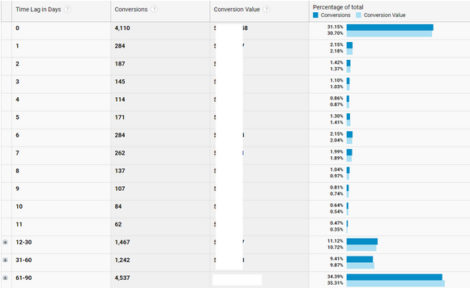
Last-click attribution is a lie that keeps you small. Video often acts as the catalyst that triggers a search or a direct visit days later. If you only credit the last touchpoint, you’ll mistakenly kill your most profitable video ads. Data science allows us to identify the hidden value in “view-through” conversions, giving you a transparent view of your real ROI. You need to see the entire path to purchase to understand how direct response video advertising is actually moving the needle. Stop making decisions based on incomplete data. Start by reviewing The Brutal Truth: A Digital Marketing Efficiency Audit to see where your tracking is leaking profit.

Scaling Without the Hype

Managing a 7-figure monthly video spend requires a technical infrastructure that most internal teams simply don’t possess. It’s not just about the ads; it’s about the server-side tracking, the API integrations, and the real-time bid optimization. You need an elite filter when hiring for your growth team. If they can’t explain the delta between probabilistic and deterministic modeling, they shouldn’t be touching your budget. Predictable scaling is the result of managed advertising that prioritizes speed and tangible outcomes over “brand feel.”

The status quo is designed to protect the underperformers. We’re here to protect your margins. Scaling requires a partner who treats your capital with the same aggression you do. If your current agency is hiding behind “reach” and “engagement” while your CPA climbs, it’s time to cut the cord. Stop settling for average. Scale your video ads with Duck Your Agency.

Stop Playing Safe and Start Scaling

The era of “vibes-based” marketing is dead. You now have the blueprint to move beyond the brand awareness trap and engineer videos that function as automated sales engines. Success in direct response video advertising isn’t about winning creative awards; it’s about winning the battle for profitable customer acquisition. Remember: the hook wins the attention, but the data science wins the scale. If you’re still tracking likes while your competitors are tracking leads, you’re just funding someone else’s growth. Efficiency is the only metric that matters.
We’ve managed over $100M in ad spend with a singular focus on data science-led optimization and no-nonsense ROI reporting. We don’t hide behind nebulous “reach” metrics because we know that reach doesn’t pay the bills. It’s time to demand more from your media buying and move toward a model that prioritizes your bottom line over agency ego. Stop leaking cash. Get a fully managed direct response strategy that scales. You have the tools, the framework, and the data. Now, get out there and dominate your market.

Direct Response Video: Your Questions Answered

Is direct response video advertising better than brand awareness ads?

Direct response is better for growth; brand awareness is better for award ceremonies. If you want cash flow, choose direct response video advertising. Brand ads are a gamble on future memory. DR is a transaction in real time. Growth-stage companies need certain ROI, not just recognition. We prioritize revenue over “vibes” every single time.

How much should I spend on a direct response video campaign?

Your spend should be dictated by your CPA goals and the cost of acquiring statistical significance. Don’t throw random numbers at the wall. Calculate the volume needed to prove a creative winner and fund it aggressively. Scale only when the math confirms the margin. Performance dictates the budget, not the other way around.

What is the ideal length for a direct response video ad in 2026?

The ideal length is exactly as long as it takes to convert. In 2026, successful ads usually fall between 15 and 60 seconds. However, the first 3 seconds are the only frames that determine your success. If the hook fails, the rest of the video is irrelevant. Focus on the thumb-stop first, and the duration second.

Can direct response video work for B2B companies?

B2B companies often see massive success with DR because decision-makers are still people with problems to solve. Replace your boring PDF lead magnets with high-intent video funnels that agitate a specific business pain. It’s faster, more trackable, and far more persuasive than a whitepaper. People buy from people, even in the enterprise space. To maximize your reach within target accounts, pair your video strategy with a data-driven B2B programmatic advertising strategy that hunts down the full buying committee.

How do I track the ROI of my video advertising campaigns?

Track ROI through multi-touch attribution and server-side tracking. Last-click is a relic that misses the influence of video views. You need a data science approach to see the full journey from the first impression to the final click. If your agency can’t show you the view-through impact, they’re hiding your real performance from you.

What makes a video ad ‘direct response’ versus ‘traditional’?

The defining factor is the “Ask.” Traditional ads are passive; they want you to remember a logo or feel a certain way. Direct response video advertising is active; it demands a specific, immediate action. If there isn’t a clear, time-sensitive offer and a direct command to act, it’s just a brand ad in disguise.

How often should I refresh my video ad creative?

Refresh your creative the moment your CPA exceeds your target threshold. Creative fatigue is real and it’s fast. Don’t wait for a monthly meeting to make a change. Use real-time analytics to identify when a hook is dying and swap it for a fresh test immediately. Constant iteration is the only way to maintain scale.

Do I need high production value for successful DR videos?

Glossy production is often a distraction. High production value can actually lower trust by making the content look like a “commercial.” Authenticity wins. A lo-fi video shot on a phone that hits a deep psychological trigger will outperform a $50k studio shoot every single time. Focus on the script, not the camera lens.

  Category: Uncategorized
  Comments: Comments Off on Direct Response Video Advertising: A No-Fluff Guide to High Conversions

Google Ads Management for Scale: Stop Bleeding Cash and Start Dominating

You double your Google Ads budget and your ROAS doesn’t double. It collapses. CPCs blow out, lead quality tanks, and your agency sends you a slide deck full of impressions and click-through rates instead of answers. Sound familiar?

Here’s the brutal truth most agencies won’t tell you: scaling Google Ads isn’t a budget adjustment. It’s an infrastructure overhaul. The strategies that got you to $10k per month will actively destroy you at $100k. Google Ads management for scale operates by completely different rules, and most internal teams and traditional agencies simply don’t have the data science muscle or the accountability frameworks to play that game.

You already know something is broken. You’ve felt the performance ceiling. This article is going to show you exactly why it happens, what elite-level scaling actually requires, and how to build the kind of paid search operation that grows revenue without torching your margins. We’re covering the data models, the talent gaps, and the structural decisions that separate campaigns that dominate at scale from the ones that quietly bleed cash while everyone pretends the numbers look fine.

Key Takeaways

  • Doubling your budget without restructuring your campaigns is a guaranteed way to collapse ROAS — google ads management for scale requires a full infrastructure overhaul, not a spend adjustment.
  • Campaign consolidation using modern audience-first frameworks consistently outperforms granular keyword-heavy structures at high spend levels, and most agencies are still building the wrong way.
  • The talent running your accounts matters more than the budget fueling them — junior account managers and generalist hires are actively costing you money at scale.
  • Clicks and impressions are the metrics agencies hide behind; multi-touch attribution and revenue-tied data models are what actually tell you where your money is working.
  • There is a structural difference between passive campaign management and aggressive growth execution — and only one of them survives contact with serious scale.

The Scaling Plateau: Why Your Google Ads Budget is Bleeding

Scaling for scale isn’t about spending more. It’s the deliberate transition from tactical testing, where you’re validating what works, to aggressive market dominance, where you’re weaponizing what you know. That distinction sounds simple. Most businesses get it catastrophically wrong.

The core problem is structural. Pay-per-click advertising operates on an auction model where increased demand directly inflates costs. Push more budget into a mature campaign and you’re not buying more of the same traffic; you’re buying progressively worse traffic at progressively higher prices. This is the Law of Diminishing Returns in its most expensive form. The accounts that survive it are the ones built to anticipate it, not react to it.

There’s a hard line between spending more and scaling profitably. Spending more means increasing budgets and hoping the algorithm figures it out. Scaling profitably means expanding your addressable audience, deepening your data feedback loops, and maintaining CPA discipline as volume grows. One of these is a strategy. The other is an invoice.

Symptoms of a Broken Scaling Strategy

You’ll recognize the warning signs if you’re honest about your numbers. Rising CPAs that consistently outpace revenue growth is the first red flag. Not a temporary spike during a competitive window, but a sustained upward trend that your team keeps explaining away. Ad fatigue compounds this fast. Campaigns built around low-hanging fruit audiences saturate quickly, and once that initial performance window closes, you’re left with inflated frequency, declining CTR, and a creative strategy that hasn’t evolved to meet it.

The trap that quietly destroys scaling ambitions? Over-reliance on branded search to prop up ROAS figures. Branded campaigns convert well because the user already wants you. That’s not paid search doing work; that’s brand equity doing work. Padding your account-level ROAS with branded volume while non-branded campaigns bleed is one of the most common ways agencies manufacture good-looking reports from bad performance.

The Infrastructure Gap

Here’s the uncomfortable truth about most accounts attempting serious scale: the architecture was never built for it. Granular campaign structures that performed well at lower spend levels become brittle and data-starved at high volume. Google’s smart bidding algorithms need consolidated, clean conversion signals to function. Fragment your data across too many campaigns and you’re essentially asking the machine to optimize blind.

Effective google ads management for scale runs on data feedback loops: real-time conversion data flowing back into bidding systems, audience signals refreshing continuously, and creative performance informing budget allocation decisions. Without those loops, budget waste isn’t a possibility. It’s a certainty.

Scaling infrastructure is the combination of tracking, talent, and tech working as a single, integrated system. Miss any one of those three and the whole thing leaks. Proper google ads management for scale demands all three operating at a level that most internal teams and traditional agencies simply aren’t resourced to deliver.

Structural Integrity: Building Campaigns That Don’t Break

Most accounts hitting a scaling wall aren’t suffering from a budget problem. They’re suffering from an architecture problem. The granular, keyword-heavy structures that felt like best practice at $10k per month become a liability at $100k. Too many campaigns, too little data per campaign, and Google’s smart bidding algorithms are essentially flying blind. The fix isn’t more granularity. It’s less.

The Hagakure method, sometimes called the Modern Search approach, consolidates campaigns into fewer, broader structures that funnel maximum conversion data into each bidding pool. Instead of fragmenting signals across dozens of tightly themed ad groups, you’re concentrating them. The algorithm gets what it needs to optimize. Your team gets a cleaner account to actually manage. Both outcomes matter at scale.

The other structural shift that separates scalable accounts from stagnant ones is the move from keyword-first to audience-first targeting. Keywords tell you what someone typed. Audiences tell you who they are, what they’ve done, and how likely they are to convert. At high spend levels, layering Customer Match lists, in-market segments, and remarketing audiences onto your campaigns isn’t optional. It’s the difference between buying traffic and buying intent.

Performance Max deserves its own conversation because the instinct to avoid it is understandable but often wrong. pMax consolidates inventory across Search, Display, YouTube, Gmail, and Maps under a single campaign. The control trade-off is real, but the reach isn’t available any other way. The non-negotiable safeguard: brand exclusions and negative keyword lists applied at the account level before pMax goes live. Without those guardrails, pMax will happily cannibalize your branded search traffic and make the numbers look spectacular while doing it.

Broad Match paired with Smart Bidding is the high-volume engine most accounts are afraid to run. That fear is legitimate when supervision is weak. With strong conversion data, tight audience signals, and an experienced team monitoring search term reports actively, Broad Match unlocks reach that exact and phrase match simply can’t access. The keyword isn’t the lever. The audience signal and the bidding model are the levers.

Advanced Bidding Strategies for Volume

Target CPA is a starting point, not a destination. At serious scale, value-based bidding via tROAS is the only model that reflects what conversions are actually worth. Not all leads are equal. Not all purchases carry the same margin. Feeding revenue values back into your bidding signals lets Google optimize for profit, not just volume. Seasonality Adjustments layer on top of this during aggressive growth windows, signaling expected conversion rate changes so the algorithm doesn’t overcorrect and throttle spend at exactly the wrong moment. Budget capping is where most teams quietly sabotage themselves. Hard daily caps interrupt Google’s learning cycles, create uneven delivery patterns, and suppress performance during high-intent windows. At scale, budgets should be set with headroom, with CPA and ROAS targets doing the actual work of controlling spend efficiency.

YouTube and Programmatic: The Scale Multipliers

Search captures demand. It doesn’t create it. Businesses serious about google ads management for scale eventually hit the ceiling of what existing search demand can deliver, and that ceiling arrives faster than most expect. YouTube video ads build top-of-funnel awareness that replenishes the search pipeline, and the downstream effect on Search CPAs is measurable: warmer audiences convert more efficiently and bid less competitively against themselves. Programmatic extends this logic outside the Google ecosystem entirely, capturing intent signals across third-party inventory that Search and pMax can’t touch. Running these channels in isolation is a mistake. The accounts that scale without margin collapse are the ones treating Search, YouTube, and Programmatic as a single, coordinated system, not three separate budget lines.

Building that kind of integrated infrastructure requires more than good campaign settings. It requires the right people running it. If you’re evaluating whether your current team or agency has the capability to execute at this level, explore what elite-level paid search management actually looks like before your next budget increase goes live.

The Talent Gap: Managed Services vs. Marketing Recruitment

Fix the campaign structure. Nail the bidding model. Build the attribution framework. None of it matters if the person running the account can’t execute at the level the strategy demands. This is the talent gap, and it’s the reason most scaling attempts collapse even when the technical foundations are solid.

The agency model has a dirty secret: your $50k per month account is being managed by someone earning $45k per year. Junior account managers get handed high-spend accounts because agencies are built to maximize margin, not maximize your results. They know the interface. They can pull reports. What they can’t do is diagnose why your tROAS target is suppressing volume during a high-intent window, or architect a data feedback loop that keeps smart bidding calibrated as spend scales. That gap costs you more than their salary ever will, which is why many brands in the Gulf prefer working with a dedicated performance marketing specialist like mohit.ae to ensure their budget is managed with senior-level expertise.

In-house isn’t automatically the answer either. Hiring a generalist “Digital Marketing Manager” to oversee serious google ads management for scale is a different version of the same problem. Generic resumes signal generic capability. High-spend paid search demands specialists who’ve operated at volume, made expensive mistakes on someone else’s budget, and built the pattern recognition that only comes from managing real complexity. If you’re unsure whether your current setup qualifies, a review of what genuine paid search consulting services actually deliver at scale will make the gap immediately obvious.

Why Your HR Department Can’t Hire for Growth

Standard recruitment processes aren’t designed to identify performance talent. HR screens for credentials and culture fit. Neither predicts whether someone can manage a $200k monthly paid search budget without bleeding margin. The top 1% of performance marketers don’t look different on paper. They think differently under pressure, they interrogate data instead of reporting it, and they hold themselves accountable to revenue outcomes rather than activity metrics. Identifying that requires a filter that most internal hiring processes simply don’t have.

Duck Your Agency’s recruitment service exists precisely because this problem is structural, not accidental. The process is built around performance-specific vetting: technical depth, analytical rigor, and a demonstrated track record of scaling accounts without destroying efficiency. Culture matters too, but a culture of accountability has to survive budget scaling, and that means hiring people who are uncomfortable with mediocre numbers, not people who are comfortable explaining them away.

The Managed Consulting Hybrid

There’s a decision point every scaling business hits: do you outsource execution or build internal capability? The honest answer is that the timing matters as much as the choice. Fully managed services offer speed-to-market that recruitment simply can’t match. When you need performance now, not in three months after onboarding, a managed execution model removes the lag entirely.

The smarter play for businesses with genuine long-term scaling ambitions is the hybrid: external consulting and managed execution running in parallel with a recruitment process that’s building toward internalization. This isn’t a gap-fill. It’s a deliberate transition that protects performance during the talent acquisition window while transferring institutional knowledge to an internal team that’ll own the accounts long-term.

What separates a real partner from a retainer-chasing agency is simple: one of them is invested in your growth beyond the contract, and the other is invested in renewing it. For google ads management for scale, that distinction is the difference between a team that builds your capability and one that quietly depends on you never developing it.

Data Science & Attribution: Scaling Beyond the Click

Clicks don’t pay salaries. Impressions don’t close deals. At serious spend levels, reporting on either is the equivalent of measuring how many times your sales team picked up the phone without asking whether anyone bought anything. Vanity metrics are the comfort food of underperforming agencies, and if your weekly report leads with CTR, you’re being managed by someone who’s optimizing for the report, not the revenue.

Effective google ads management for scale treats every dollar as a data point in a predictive model, not a line item in a spreadsheet. The question isn’t “how many clicks did we get?” It’s “which signals, channels, and audience intersections are generating the highest lifetime value, and how do we allocate the next dollar to compound that?” That’s a data science question. Most agencies aren’t equipped to answer it.

The Death of Last-Click Attribution

Last-click attribution is a lie your reporting has been telling you. It hands 100% of the conversion credit to the final touchpoint, which means YouTube, programmatic, and upper-funnel Search campaigns get zeroed out while branded search takes all the glory. The customer who watched your YouTube ad, retargeted through display, searched your brand name, and converted gets recorded as a branded search conversion. YouTube gets cut from the budget. The cycle repeats.

Data-Driven Attribution (DDA) distributes credit across every touchpoint that contributed to the conversion, weighted by actual influence. It’s not perfect, but it’s a fundamentally more honest picture of how your channels interact. Pair DDA with incrementality testing, which measures the actual revenue lift your campaigns generate against a control group that didn’t see the ads, and you’ve got the only metric that actually defines scaling success: did this spend create demand that wouldn’t have existed without it?

Marketing Analytics Dashboards

Executive dashboards built on platform-native data are a delayed, fragmented version of reality. The accounts that scale without margin collapse are running real-time truth dashboards: unified views that pull CRM conversions, offline purchase data, and Google Ads performance into a single source that updates continuously. Connecting offline conversion tracking back into Google Ads via the GCLID pipeline closes the loop between a form submission and an actual closed deal, giving smart bidding the revenue signal it needs to optimize for profit instead of lead volume.

This is where data science earns its place in the stack. Predictive models built on historical conversion patterns, seasonality curves, and audience overlap analysis can identify budget waste in real time and forecast where the next tranche of spend will generate the highest marginal return. That’s not reporting. That’s competitive intelligence.

First-party data is the sharpest edge in this fight. Customer Match lists built from your CRM, suppression lists that exclude recent converters, lookalike expansions seeded from your highest-LTV customers: these signals are exclusive to you. Your competitors can’t buy them. Google’s algorithm rewards accounts that feed it better data, and there’s no faster way to widen that gap than integrating your CRM directly into your bidding infrastructure.

If your current setup can’t connect CRM data to campaign performance, you’re not running google ads management for scale. You’re running a very expensive guessing game. Find out how integrated data science changes what your ad spend can actually do.

Duck Your Agency: Scaling Without the Industry Fluff

Most agencies manage your account. Duck Your Agency executes against it. That’s not a semantic distinction; it’s the operational difference between a team that monitors dashboards and one that treats every underperforming campaign as a problem that belongs to them personally. Passive management is comfortable. It’s also how businesses quietly bleed cash for months before anyone admits the numbers are broken.

The Duck Your Agency model is built on a single filter: if it doesn’t drive revenue, it doesn’t stay. Not “let’s monitor it for another quarter.” Not “the algorithm needs more time.” Gone. That philosophy runs through every layer of how campaigns are built, how data is interrogated, and how performance is reported. Vanity metrics don’t survive the conversation. Revenue does.

What makes this model genuinely different for google ads management for scale is the integration. Managed execution, strategic consulting, and performance-specific recruitment aren’t three separate service lines running in parallel; they’re a single system designed to scale with you. When your campaigns need senior-level strategy, it’s there. When your business is ready to build internal capability, the recruitment infrastructure is already in place to find the right people without the guesswork. The model doesn’t require you to outgrow it. It grows with you.

The Duck Your Agency Advantage

Senior strategists run your accounts. Not interns learning on your budget. Not account managers who escalate every decision upward. The people with the pattern recognition, the hard-won instincts from managing serious spend, and the technical depth to architect full-funnel systems from YouTube awareness through to Search conversion. That access isn’t reserved for top-tier clients. It’s the baseline.

Transparency is non-negotiable here. Most agencies are afraid to show you the real numbers because the real numbers reveal where their decisions cost you money. Duck Your Agency builds reporting around accountability, not optics. You see what’s working, what isn’t, and exactly what’s being done about it.

Ready to Scale? Let’s Talk Results

A standard agency pitch is a waste of your time. Slide decks full of case studies, proprietary frameworks with trademarked names, and promises that evaporate six weeks into the retainer. Skip it. What actually tells you whether a partner can execute is a performance audit that identifies the specific structural, attribution, and talent gaps that are suppressing your current results.

A Duck Your Agency performance audit goes looking for scale killers: campaigns leaking spend through poor conversion signal architecture, bidding strategies suppressing volume during high-intent windows, attribution models misrepresenting which channels are actually driving revenue. These aren’t hypothetical problems. They’re expensive ones hiding inside accounts that look fine on the surface.

If your current google ads management for scale setup can’t answer where your next dollar generates the highest marginal return, that’s the audit finding. And that’s where the work starts.

Stop settling for average. Scale your Google Ads with Duck Your Agency.

Scale Smarter. Stop Settling for Broken.

Google ads management for scale isn’t a budget problem. It never was. It’s a structural problem, a talent problem, and a data problem, all compounding simultaneously while your agency sends you a report that leads with impressions. The accounts that break through the scaling ceiling aren’t spending more than their competitors. They’re built differently, run by better people, and fed cleaner data.

That’s the gap Duck Your Agency closes. Elite Filter recruitment puts the right specialists on your accounts, not juniors learning on your budget. Advanced data science optimization replaces guesswork with predictive intelligence. And fully managed full-funnel expertise means Search, YouTube, and programmatic working as one coordinated system, not three disconnected budget lines.

The businesses that dominate at scale don’t wait until performance collapses to make the call. They make it before the next budget increase goes live.

Scale your revenue with Duck Your Agency and find out exactly what your current setup is costing you.

Frequently Asked Questions

What is the biggest mistake companies make when scaling Google Ads?

The biggest mistake is treating a budget increase like a volume knob. It isn’t. Scaling is a structural overhaul, not a spending adjustment. Most businesses try to push more cash through a fragile account architecture that worked at low spend but collapses under high volume. If you don’t consolidate your data signals and tighten your feedback loops, you aren’t scaling; you’re just overpaying for the same conversions.

How much budget do I need to start scaling Google Ads aggressively?

Budget is secondary to data density. You need enough spend to generate at least 30 to 50 conversions per month per campaign for Google’s machine learning to function. Aggressive scaling usually becomes viable once you’ve stabilized performance at $10,000 per month and have the tracking infrastructure to prove your ROI is real. Scaling without statistical significance is just expensive guessing.

Can I scale Google Ads using only automated bidding?

Automation is a tool, not a strategy. You can scale with it, but it requires elite supervision to prevent the algorithm from chasing low-quality conversions that look good on a report but don’t drive revenue. Effective google ads management for scale uses automated bidding as the engine while humans provide the guardrails, audience signals, and creative direction that the machine can’t replicate.

How do I prevent my CPA from doubling when I increase my budget?

You stop chasing “low-hanging fruit” and start building a full-funnel strategy. CPAs explode when you exhaust the tiny pool of high-intent searchers and try to buy more of them by simply bidding higher. To keep costs stable, you must expand your addressable audience through YouTube and Programmatic ads while using value-based bidding to tell Google which users are actually worth the higher cost.

Should I hire a Google Ads agency or build an in-house team for scale?

Don’t choose one when you can have the benefits of both. Agencies offer immediate speed and specialized expertise, but an in-house team owns your institutional knowledge. The smartest move is a hybrid approach: use a managed service to architect the scale—specialized partners like Future Marketing para Saúde are often used to handle the complexities of specific verticals like healthcare—then utilize specialized recruitment to hire the top 1% of performance talent when you’re ready to bring that capability inside.

What role does YouTube advertising play in scaling Google Search campaigns?

YouTube is a demand generation engine. Search captures the demand that already exists, but that demand is finite. YouTube ads build the top-of-funnel awareness that replenishes your search pipeline. By warming up audiences before they ever hit the search bar, you lower your Search CPAs and increase your overall market share in ways that search-only accounts can’t match.

How long does it take to see results when scaling a Google Ads account?

Expect a 14 to 30 day learning phase for any major structural change. Google’s algorithm needs time to process new data signals and calibrate bidding for the increased volume. True scaling results that reflect in your bottom line usually materialize within 60 to 90 days as the infrastructure matures and the feedback loops between your CRM and the ad platform tighten.

What is a ‘Performance Audit’ and why do I need one before scaling?

A Performance Audit is a brutal diagnostic of your account’s structural integrity. You need it because scaling a broken account only makes it break faster. The audit identifies “Scale Killers” like fragmented campaign structures, poor conversion tracking, and creative fatigue. It ensures your foundation is solid before you pour fuel on the fire, preventing the budget bleed that kills most growth attempts.

  Category: Uncategorized
  Comments: Comments Off on Google Ads Management for Scale: Stop Bleeding Cash and Start Dominating

Marketing Analytics Dashboard Implementation: The Brutal Truth & 2026 Template

Most marketing dashboards are just expensive wallpaper designed to hide the fact that your strategy is failing. You spend forty hours a month manually stitching data from ten different platforms, only for leadership to ignore the results because they don’t trust the numbers. This isn’t a reporting problem; it’s a structural failure. A successful marketing analytics dashboard implementation isn’t about picking a pretty template or color-coding your CTR. It’s about building a ruthless infrastructure that demands accountability and exposes the TRUTH about your ROI, no matter how ugly it looks.

You’re likely tired of acting as a data janitor while your actual strategy gathers dust. You know that real-time visibility across every channel is the only way to stop burning budget on underperforming campaigns. We’re here to help you stop the manual labor and start using data science to drive revenue. This article provides the 2026 framework for automated reporting that actually changes your strategy, ensures data integrity, and finally links every dollar of spend to a bottom-line outcome. It’s time to stop guessing and start winning.

Key Takeaways

  • Stop building pretty reports that get ignored; align metrics with business goals to ensure data actually drives decisions.
  • Execute a marketing analytics dashboard implementation that focuses on a ruthless “Source of Truth” hierarchy rather than just connecting APIs.
  • Reject the “shiny object” syndrome by choosing tools that solve real performance problems and eliminate manual reporting hours.
  • Follow the 2026 deployment roadmap to audit data garbage and build a predictive infrastructure that forecasts LTV with precision.

Why Your Marketing Analytics Dashboard Implementation Will Fail (and How to Stop It)

Seventy percent. That is the failure rate for most business intelligence projects. When it comes to a marketing analytics dashboard implementation, that number is likely even higher because marketing data is notoriously fragmented. Most dashboards end up as expensive digital wallpaper within ninety days. They look sleek. They have vibrant charts. But nobody uses them to make a single decision. They exist to fill a screen during a meeting, not to drive a strategy.

Implementation is not just connecting APIs and hoping for the best. It is a strategic alignment of business goals. If you are just piping data from Google Ads into a visualization tool, you aren’t implementing anything; you are just moving garbage from one room to another. While the basic definition of what is a dashboard suggests a simple visual interface, the reality of a high-performance marketing build is far more complex. It requires a ruthless focus on accountability. Stop wasting your engineering budget on tracking likes or impressions. These are vanity metrics designed to make underperforming teams look busy. If a metric doesn’t lead to a “fire or hire” decision, it has no place on your screen.

The Three Pillars of Dashboard Death

Data silos are the first killer. Your Facebook and Google data never agree because they use different attribution models. Without a unified source of truth, your team will spend meetings arguing over whose numbers are right instead of optimizing spend. Then comes stale data. A “Friday Report” delivered on Monday morning is a post-mortem, not a strategy. Finally, there is the lack of adoption. Industry reports indicate that 72% of marketers still export data to Excel because they don’t trust the dashboard. That is a failure of leadership, not software.

The ‘Straight Talk’ Audit: Is Your Team Ready?

Before touching a single line of code, you need a North Star metric. If your team cannot agree on what success looks like, no amount of software will save you. You must also face the reality of your data quality. Are you automating clean, actionable insights, or are you just accelerating the delivery of garbage? You need to write down your primary business objective in one sentence before you begin your marketing analytics dashboard implementation. If you can’t define it, you aren’t ready for the truth yet.

The 5-Pillar Framework for a High-Performance Analytics Infrastructure

Stop obsessing over hex codes and pie charts. A pretty dashboard with broken data is just a lie in high definition. Your marketing analytics dashboard implementation lives or dies in the backend. Research from Harvard Business School on The Value of Descriptive Analytics suggests that high-quality data visibility can drive revenue increases of 4% to 10%. But you won’t get there by looking at “Estimated Conversions” in Google Ads. You get there by building a hierarchy of truth.

The hierarchy is simple. CRM data is the ultimate truth because it represents actual money in the bank. Ad platform data is a collection of biased claims. Web analytics is a secondary witness. If your implementation doesn’t reconcile these three, you are just guessing with extra steps. You need an infrastructure that scales. If your system breaks when you double your spend, you haven’t built a framework; you’ve built a fragile toy. Real-time transparency eliminates the “guesswork” culture that plagues underperforming departments. It replaces “I think” with “we know.”

Data Collection and ETL (Extract, Transform, Load)

Native connectors are for amateurs. They break. They limit your granularity. A professional stack requires a robust ETL pipeline that pipes raw data into a warehouse like BigQuery or Snowflake. This allows you to standardize naming conventions across every campaign and creative. Without this, your data remains a mess of “Campaign_1” and “FB_Prospecting_V2_Final_FINAL.” If you need an elite partner to architect this, our managed digital marketing team specializes in building these ruthless pipelines.

The Semantic Layer: Defining the Truth

The semantic layer is where the business logic lives. It is the bridge between raw numbers and boardroom decisions. You must create a unified definition for a “Lead” or “MQL” that is hard-coded into the logic. This prevents the marketing team from claiming success for 500 junk signups that the sales team can’t close. This layer also handles multi-touch attribution. It moves you away from “First Click” fantasies and toward a data-driven reality that accounts for the complexity of the modern buyer journey. A successful marketing analytics dashboard implementation demands that every platform speaks the same language before the first chart is ever drawn.

Tool Selection: Why the ‘Best’ Dashboard Tool is Usually the Wrong Choice

Buying software to fix a broken strategy is like buying a faster car to get out of a maze. It just makes you hit the walls harder. Most leaders approach a marketing analytics dashboard implementation as a shopping trip. They want the “best” tool, the one with the highest rating on G2 or the flashiest demo at a conference. This is the “Shiny Object” syndrome. It’s a distraction. Software doesn’t solve people problems. If your team lacks the discipline to define a North Star metric, a fifty thousand dollar license won’t save you. It will only visualize your incompetence in higher resolution.

The choice between Business Intelligence (BI) tools and specialized marketing reporting software depends entirely on your scale. Specialized tools are great for basic reporting, but they often choke on the complexity of programmatic and video ad data. If you’re managing millions in spend across disparate channels, you’ve likely outgrown the “all-in-one” connectors. You need a tool that handles the heavy lifting of your backend infrastructure, not just one that makes pretty charts. At a certain volume, off-the-shelf solutions become a bottleneck. That’s when custom data science and bespoke builds start to outperform everything else on the market.

The 2026 Analytics Stack Comparison

  • Looker Studio: It’s the “free” trap. It’s perfect for simple Google-centric stacks, but it breaks the moment you try to blend complex third-party data. The latency will kill your team’s productivity.
  • Tableau and PowerBI: These are the heavyweights for the enterprise. They offer deep data exploration but require a dedicated data engineer to maintain. Don’t buy these unless you have the headcount to run them.
  • Custom Python and R Dashboards: This is the elite play. For high-volume performance marketers, building bespoke visualizations directly on top of your data warehouse offers total control and zero subscription bloat.

Hidden Costs of Implementation

The sticker price of the software is the least of your concerns. During a marketing analytics dashboard implementation, you’ll encounter the “Maintenance Tax.” APIs update. Connectors break. Someone has to fix the dashboard when Meta decides to change its reporting schema on a Tuesday morning. Then there are the API call limits. If you’re pulling data too frequently, your costs will spiral. Finally, consider the training cost. A tool that no one on your team knows how to use is a zero ROI investment. It’s just more expensive digital wallpaper. Stop looking for the “best” tool and start looking for the one that fits your technical reality.

Marketing Analytics Dashboard Implementation: The Brutal Truth & 2026 Template

Step-by-Step Implementation Roadmap: Your 2026 Deployment Template

Most implementation guides are written by people who have never managed a seven-figure ad budget. They offer vague “best practices” that lead to mediocre results and expensive digital wallpaper. A high-performance marketing analytics dashboard implementation is a tactical deployment, not a creative project. It requires a rigid roadmap that prioritizes technical integrity over visual flair. If you skip the foundation, you are just building a high-speed delivery system for misinformation. You need a build that demands accountability.

Phase 1 & 2: The Strategic Foundation

Start by interviewing your stakeholders. Ask them three questions: What specific decision will this chart help you make? What happens to our strategy if this number drops by 20%? Who is personally accountable for this metric? If they can’t answer, that metric doesn’t get a dashboard. Next, perform a ruthless audit of your UTM parameters. If your tracking is broken at the source, your dashboard is a lie. You must map every data source to a central identity, creating a “Golden Record” where CRM data and ad spend finally agree on the truth.

Phase 3 & 4: The Technical Build

This is where the heavy lifting happens. Set up a professional ETL pipeline using tools like Fivetran or Supermetrics to feed your data warehouse. Do not rely on native, browser-based connectors that time out or sample your data. Once the data is flowing, create tiered views. The CEO needs a high-level ROI view. The manager needs channel performance. The specialist needs creative-level granularity. Before you go live, stress-test the numbers. Compare your dashboard totals against your actual platform billing statements. If they don’t match, your marketing analytics dashboard implementation is a failure.

Dashboards are never “finished.” They are living organisms that require constant iteration. As your strategy evolves, your metrics must follow. Stop settling for reports that just look good while your ROI stagnates. If you want a team of elite experts to handle the heavy lifting and build a ruthless data infrastructure for you, explore our Digital Marketing Analytics and Data Science services. We kill the guesswork so you can focus on aggressive growth.

2026 demands speed and scale. Your infrastructure must handle ten times your current volume without breaking. Scale requires automation. If your team is still manually updating spreadsheets, they aren’t marketers; they are data janitors. Fire the manual process. Hire the machine. Ensure your User Acceptance Testing (UAT) isn’t just a “looks good” email, but a rigorous verification of every data point against the source of truth.

Beyond Visualization: Leveraging Data Science for Aggressive Growth

Dashboards tell you what happened. That is history. If you want to grow, you need to know what happens next. A successful marketing analytics dashboard implementation is just your ticket to the game. It is not the trophy. Elite performance requires moving from descriptive statistics to predictive modeling. You must use your cleaned data to forecast Lifetime Value (LTV) and churn before they happen. This isn’t magic. It is math. If your reporting doesn’t predict your future revenue, it is just a rearview mirror.

Cookies are dying. Privacy is winning. If you are still relying on pixel-based tracking for high-budget programmatic scaling, you are flying blind. Media Mix Modeling (MMM) is the post-cookie solution that separates the pros from the amateurs. It ignores the noise of individual clicks and looks at the macro signals to determine where your next dollar of profit actually comes from. This is why we treat dashboards as a starting point. They provide the raw material for the real work. They are the foundation, not the destination.

From Reporting to Optimization

Static reports are for people who like to talk about problems. Optimization is for people who like to solve them. We use anomaly detection to catch budget spikes or tracking failures in real-time. If your tracking fails at 2 AM on a Saturday, you shouldn’t wait until a Monday morning meeting to find out. We push these signals into automated bidding adjustments that react faster than any human ever could. This is the Duck Your Agency approach. We don’t just show you a chart. We build data science models that actually move the needle on your bottom line.

The Future of Analytics: AI and Natural Language Querying

By 2027, you might not even need a traditional dashboard. We are moving toward conversational data where you simply ask your stack a question and get a verified answer. But here is the brutal truth. You cannot use any of these “AI” marketing tools if your data foundation is a dumpster fire. AI is a multiplier. If you multiply garbage, you just get more garbage, faster. You must finish your marketing analytics dashboard implementation with a clean, warehouse-first approach before you even think about automation. Stop guessing. Let’s build your truth.

Stop Watching the Past. Own Your Future.

A marketing analytics dashboard implementation is not a one-time project you check off a list. It’s a commitment to absolute transparency and aggressive growth. You now have the roadmap to move beyond expensive digital wallpaper. Focus on building a ruthless infrastructure that prioritizes the truth over pretty charts. Standardize your data, automate your ETL pipelines, and demand that every metric on your screen leads to a real-world business decision. If it doesn’t drive ROI, it doesn’t belong in your stack.

The transition from basic reporting to predictive data science is where the elite winners are separated from the underperformers. You don’t have to navigate this technical shift alone. Whether you need advanced data science models, fully managed programmatic and search, or elite marketing recruitment to scale your internal capabilities, we’re your specialized ally. It’s time to stop guessing and start winning with a system that actually works. Scale your growth with data-driven precision—See how we do it. Your data is ready. Are you?

Marketing Analytics Deployment: Answers for the Skeptical

How long does a typical marketing analytics dashboard implementation take?

A professional marketing analytics dashboard implementation typically takes between four and twelve weeks. The duration depends on the complexity of your stack and the cleanliness of your existing data. Simple setups using basic connectors might be faster, but they lack the durability and scale required for aggressive growth. Enterprise-grade builds that include custom ETL pipelines and data warehouse integration require more strategic engineering time to ensure accuracy.

What are the best KPIs to include in a marketing dashboard for 2026?

Focus on high-level performance metrics like Customer Acquisition Cost (CAC), Lifetime Value (LTV), and total Return on Ad Spend (ROAS). Kill the vanity metrics. Impressions, likes, and reach are distractions that don’t pay the bills. Your dashboard should prioritize metrics that link marketing spend directly to revenue and bottom-line profit. If a metric doesn’t help you make a “fire or hire” decision about a campaign, it shouldn’t be there.

Do I need a data warehouse for my marketing dashboards?

You need a data warehouse if you want to scale without your reports breaking every Tuesday. Native connectors are toys for small budgets. They sample your data and limit your granularity. A warehouse like BigQuery or Snowflake gives you total ownership of your information and allows for complex data blending that native tools can’t handle. It’s the difference between a fragile spreadsheet and a robust, scalable infrastructure.

How much does it cost to implement a professional marketing dashboard?

Costs are driven by software licensing, data engineering hours, and the ongoing “maintenance tax.” You’re investing in a foundation, not just a one-time visualization. Professional builds require budget for robust ETL tools, warehouse storage, and the elite talent needed to architect the logic. Skimping on the implementation phase usually leads to a dashboard that nobody trusts and eventually gets ignored.

What is the difference between a dashboard and a report?

A dashboard is a real-time, interactive environment built for active optimization. A report is a static, historical document that tells you what happened weeks ago. Dashboards are for winners who want to change their strategy on the fly. Reports are post-mortems for people who enjoy reading about why they lost. If your data isn’t interactive and current, you don’t have a dashboard; you have a digital paperweight.

Can I implement a dashboard if my data is currently messy or siloed?

You can, but you must clean it first. A successful marketing analytics dashboard implementation involves a rigorous “Killing the Garbage” stage. Automating messy, siloed data just delivers misinformation at a faster rate. You need to standardize naming conventions and UTM parameters at the source before you ever pipe that data into a visualization tool. Fix the foundation or the house will fall.

How often should my marketing dashboard data be updated?

Daily updates are the bare minimum, but real-time or hourly syncing is the 2026 standard. If you’re looking at data that is a week old, you’re already behind the market. High-performance teams need to catch budget spikes or tracking failures within hours, not days. If your infrastructure can’t handle daily refreshes, your team is acting as data janitors instead of strategists.

What is multi-touch attribution and why does it matter for implementation?

Multi-touch attribution (MTA) assigns value to every touchpoint in a customer’s journey, not just the last click. It’s critical because it reveals the true ROI of top-of-funnel channels like programmatic video or content marketing. Without MTA, you’ll likely shut down the very campaigns that are introducing new customers to your brand. It provides the data-driven reality needed to scale complex, multi-channel strategies effectively.

  Category: Uncategorized
  Comments: Comments Off on Marketing Analytics Dashboard Implementation: The Brutal Truth & 2026 Template

Every day, more and more jewelers are shifting their focus from traditional advertising to digital marketing. However, advertising jewelry can be tricky when transferring to a digital realm. Unlike what some beginners to jewelry advertising think, it’s not just enough to run a few ads on Instagram and other social media and call it a day. It takes much more effort to attract foot traffic to your physical jewelry store with digital ads, and even more effort to do the same for your e-commerce jewelry store and properly analyze the results.

In this blog post, we are going to cover ten things to pay attention to when it comes to jewelry marketing. It’s not just a list of basic jewelry advertising ideas, it’s more of a blueprint to 3x your jewelry store sales: from top-level strategy on how to segment your campaigns to more precise tactics that will help your jewelry business succeed digitally. 

Whether you already work with a jewelry marketing agency, plan to do it yourself, or are currently searching for one, you will be able to find some helpful ideas that have been proven to bring more conversions to our clients in the luxury and jewelry industry.

1. Take Into Consideration The Longer Purchase Cycle For Your Jewelry Store

High-priced items, such as jewelry, tend to have a longer purchase decision cycle. For example, over 90 days may pass between a customer discovering your jewelry brand online for the first time while searching for a diamond engagement ring and an actual purchase from your jewelry store, online or in-person.

What it means for you:

It is important to segment your jewelry advertising campaigns into three stages down the purchase decision funnel.

marketing funnel for jewelry advertising

Top-funnel campaigns

  • Target broad search terms (for example: “sell jewelry”, “buy jewelry”)
  • Target in-market and affinity audiences for display and video (for example, jewelry and watches, fine jewelry, wedding and engagement rings)

At this stage, a prospective customer has a vague idea of what they want to buy, but is often not too sure about a specific product.

It’s better to educate a prospect at this stage rather than sell to them right away. For example, they want to buy an engagement ring, but there are so many options. Do they know the benefits of lab-grown diamonds? Are they sure about the shape of a diamond they want on the ring? Are they aware that you have one of the most competitive prices, along with one of the largest selections of jewelry among your competitors?

Mid-funnel campaigns

At this stage, your prospective customers are much more aware of what exactly they want, so they are looking for more specific terms and browsing more specific pages or websites (for example, more resources and pages about lab-grown diamonds as opposed to earth-mined).

Target more specific search terms, for example,

  • Oval diamond 2ct engagement ring
  • Lab-grown engagement rings

Since usually, at this stage, your prospects know more about what they want (or even know what they want exactly), they are most likely just looking for the best deal or the best brand to buy from. That’s why it’s important to emphasize your best brand qualities in the ads and landing/product pages at this stage and try to persuade them that your brand/your jewelry store is their best option for this specific jewelry piece they want to purchase.


Bottom-funnel campaigns

Here we go, congrats, you have reached the bottom level where a customer is about to make a purchase, but hold your horses, there is still more work to be done before this prospect becomes your regular customer!

We already discussed the importance of branding at the upper stages of the purchase funnel. At this stage, a prospect is already aware of your brand, but they may also want to explore your competitors for similar products and to see if they are better in some aspects such as customer service or faster delivery/pick-up time, compare pricing and so on.

Examples of bottom-level funnel campaigns may be:

  • Branded search campaigns (when someone is searching for your brand, your ad would show up on the top of search results).
  • Display and video retargeting campaigns (when somebody visits your website, they are served with a display, video, or text ad).


Track results properly

Be ready to analyze the results of your jewelry marketing campaigns over a longer conversion window.

Since the maximum conversion window for Google Ads and Google Analytics is 90 days, keep in mind that some top-of-the-funnel campaigns may not get the full credit they deserve. However, they are still essential.

Pay attention to attribution modeling to give proper credit to every channel on your customer’s journey. Compare different attribution models in GA4 to data-driven attribution.

If your jewelry marketing agency isn’t conducting essential segmentation of your campaigns and isn’t properly tracking results, perhaps you should consider saying “duck my marketing agency” and come to us.


2. Provide Extra Value

providing extra value in luxury and jewelry business

Purchasers of luxury and jewelry items like to get the most value for their buck, just like anyone else. Providing extra value can come in many forms:

  • Monetary discounts:

“$150 off your purchase of any jewelry over $1,000”

  • Gifts with the purchase:

“Pick any necklace from our “midnight jewelry” collection with any purchase over $100”

  • Complimentary service with the purchase:

“Free shipping and handling on any online purchase of our jewelry this week only!”

At Duck Your Agency, when it comes to jewelry marketing, we always see a decent spike in transactions and other conversions when our search and display ads and client websites feature a promo or an extra value message. The uplift in conversions can be as high as 200% compared to the time periods when no such promo or extra value message was in place.


3. Target Your Competition (Especially Bigger Jewelry Brands)

targeting your competitors in jewelry advertising and marketing

In the picture above, we see Rare Carat targeting James Allen keyword, simultaneously trolling them “James, Why Are Your Diamonds More Expensive Than Ours?” You can do it too!

Big brands spend millions of dollars on jewelry advertising online. Take advantage of the multimillion-dollar budget of your competitors (especially bigger jewelry brands) and advertise to prospects looking for them online!

It’s a great chance to get customers who are lower in the purchase decision funnel for a lower price!

You can also run display and video ads on Google targeting users who recently visited your competitors’ websites or similar sites in the luxury & jewelry industry!

It’s important to remember not to use your competitors’ brand names in your ad copy. This practice is against Google Ads policy and also unethical, as it can confuse potential customers who might mistake your ad for another jewelry store’s website. Instead, emphasize your business/brand name in your ads to avoid any confusion. 

advertising for jewelry


4. Experiment With All Kinds Of Retargeting

Visuals play an important role in jewelry marketing, and the purchase decision cycle is long (as we discussed earlier). Therefore, it’s critically important to expose your potential buyers to all sorts of remarketing ads to keep your business top of mind during the purchase cycle.

There are several types of retargeting ads that you can incorporate into your jewelry digital marketing strategy, such as:

  • Static display ads
  • Dynamic product display ads
  • Responsive Display Ads (Google Display Network)
  • Native ads
  • Video remarketing ads

It’s important to A/B test visuals and messaging from time to time to see what’s working the best for your store.

Keep in mind that some of the retargeting activities are hard to track, since it involves view-through conversions (when a prospective customer saw your ad, but didn’t click on it), cross-browser and cross-device activity. It also takes some time to see and attribute the results (especially with longer purchase cycles, such as luxury & jewelry items). 

We recommend data-driven attribution in Google Analytics 4 to get a glimpse on your retargeting campaign performance.

For example, we have been running a general branded video retargeting campaign for one of our jewelry store marketing clients to increase brand awareness during and in between purchase cycles.

We didn’t see much traction in the beginning, but then the data-driven attribution started to show that many users were exposed to our video remarketing ad during their decision cycle before converting.

Below is an excerpt from conversion paths of the client. As you can see, a few users were exposed to our video retargeting ad in the middle of their purchase decision cycle before converting. 

Multi-channel conversion path for a jewelry store


5. Focus On Getting Customers To Visit Your Store And Building Strong Client Relationships, Rather Than Solely Emphasizing Quick Online Purchases

Consumers prefer in-person interaction when buying high-ticket items such as expensive jewelry pieces.

Many local customers prefer to make a transaction and have a final glance at a desired item in-person at your jewelry store.

If it’s a national e-commerce customer, a lot of them prefer some kind of human interaction over chat or phone to get their questions, concerns, and special requests answered before giving you their credit card number.

Therefore, to get a full picture, you have to track all the micro-conversions that led to in-store or online purchases. Here are some ideas for jewelry business micro-conversions:

Website conversions for an online jewelry store:

  • Call from your website was initiated.
  • Online Chat with a rep started.
  • Contact us (or any lead form) was submitted.
  • Directions page was viewed.

Local actions (Google maps) conversions:

  • Requested directions to your store.
  • Called from Google maps.
  • Other actions (saved to favorites, starred, etc.).
  • Visited your website if your jewelry store from Google maps.

jewelry marketing ideas


6. Attractive Images And Product Descriptions Are Must To Increase Sales

Compelling product descriptions and multiple professional images of your products are a must-have feature of any jewelry e-commerce store. Not only will this differentiate you from your competitors and help customers make purchase decisions, it will also boost your SEO, search ads, and shopping ads. Titles and descriptions impact quality score, and Google pulls keywords directly from titles and descriptions in Google Shopping ads.

It seems like a no-brainer, but if you have hundreds or thousands of SKUs it can be a pretty daunting and time-consuming task to complete. But, trust us, it is well-worth time and effort. We saw a dramatic increase in conversions for our jewelry marketing clients that went from generic descriptions and poor quality product pictures to compelling descriptions and beautiful pictures for each SKU.

Let’s take a look at these two examples of a product description for an engagement ring:

Generic version:

Solitaire Semi-Mount Engagement Ring in 14 Karat White with 0.01Ct, RO Sapphire Ring Size: 6.5 

More compelling and attractive description of the same ring:

Introducing our stunning Solitaire Semi-Mount Engagement Ring, crafted with precision and care from high-quality 14 Karat White Gold. The centerpiece of this gorgeous ring is a sparkling 0.01Ct RO Sapphire, known for its exquisite deep blue hue and superior clarity. The ring is available in a perfect size 6.5, and the semi-mount design allows for easy customization with your preferred diamond or gemstone. From the gleaming white gold band to the vibrant sapphire centerpiece, every detail of this ring exudes luxury and sophistication. Perfect for the love of your life, this Solitaire Semi-Mount Engagement Ring is sure to make a lasting impression and capture her heart forever.

The latter description is not only more attractive and likely to generate more conversions, but it also includes several additional keyword variations that can improve your search engine optimization (SEO) results and enhance your Search and Shopping ads.

Advertising Jewelry Online

7. Set-up Advanced Email Marketing and CRM Integration

Cleverly set-up email marketing can be a great tool to stay top of mind with prospective customers during the long purchase decision cycle. Consider three rules for email marketing and CRM integration: email capturing, segmentation, personalization, and automation.

Capture emails of new visitors right away with cleverly designed pop-up offers. For example, “Submit your email to get 5% off your first jewelry purchase online.”

Segmentation allows you to tailor your messaging to each group, increasing the relevance of your communications and improving engagement rates. In the case of a jewelry website, potential segmentation lists might include:

  • Purchase history: Customers who have made multiple purchases vs. those who have only made one
  • Product category: Customers who have purchased only engagement rings vs. those who have purchased other types of jewelry
  • Price point: Customers who have made high-value purchases vs. those who have made lower-value purchases


8. Add Videos To Product Pages or Key Landing Pages

Consider adding videos to your product pages or key landing pages to boost conversion rates and improve SEO. Search engines like Google view video content as high-quality and engaging, making it an effective tool for attracting more visitors and improving search engine rankings.

Creating a high-quality video for every jewelry piece can be expensive, so instead, you might consider creating a video for each category or a landing page. Doing so can help increase organic search rankings and benefit paid search as well.

In addition, you will also have a lot of video content that you can use for display prospecting and retargeting campaigns, video prospecting and retargeting campaigns, social media campaigns and more! 


9. Enable Local Inventory Ads with Delivery and Pick-Up Times and Pick-Up Today Options

local inventory ads for jewelry store

It is important to advertise all available delivery and pick-up options in Google Shopping, especially for local jewelry marketing. Many customers prefer to know that the item they like is available in-store, so even if they do not purchase online, they can visit the store in-person to see the item before buying.

To display delivery and pick-up times, as well as the option to “pick-up today,” you must enable local inventory ads and create a local inventory feed, in addition to the main product shopping feed that you may already have. The local inventory feed includes information about your inventory levels and local availability. You can set up delivery and pick-up options in the “Local Inventory Ads” section of your Google Merchant Center account.

jewelry digital marketing agency


10. Focus On On-Site Conversion Optimization

Just like with any other industry, conversion optimization is an inevitable part of jewelry advertising and marketing. Here are a few techniques to start with to improve your website conversion rate:

  • A/B test different messaging, promotions, and delivery methods.

At Duck Your Agency, we were able to increase email sign-ups and online orders by 15-30% by testing different messages, images, and techniques. For example, we experimented with exit-prevention and regular pop-ups, overlays on top or bottom of websites, creating an urgency vs. regular message (such as a time counter letting potential customers know that the deal expires soon vs. a regular non-timed offer), and more.

  • Add a web chat and A/B test different prompts to start a conversation.

Experiment with how web chat and different chat prompts affect conversions. A/B test prompt messages.

  • Add social proof to landing and product pages.

Adding the ability for customers to review products and businesses can help increase sales. If there are not enough reviews for each SKU, you can add general reviews for the business or product categories. Test the placement of the reviews on product pages and landing pages and see how it affects conversions.

  • Optimize the checkout process and steps before a customer makes an appointment.

Minimize the number of steps before a purchase or form submission, A/B test different forms, test multi-step forms, offer help at checkout, or ask if there are any questions via a chat prompt – these are just a few ways to optimize conversions for your jewelry business.


Author: Sergey Izbash 

Ducking Marketing Genius & Founder @Duck Your Agency


P.S. Looking to increase conversions for your business in the luxury & jewelry industry? Maybe it’s time to say “duck my marketing agency” and come to us! Fill out the form below and let’s chat:

Contact Us

  Category: Uncategorized
  Comments: Comments Off on Advertising Jewelry Online: 10 Jewelry Marketing Ideas to 3x Your Sales

In this blog post we will show you how you can instantly increase CTR (click through rate) and Conversion Rate of your Google Ads by implementing these two simple tactics: image extensions and Responsive Search Ads (RSA).


We will cover the relationship between Google Ads Extensions and Ad Rank, we will see what Google has found when advertisers use extensions for text ads. Then, we will review each type of extensions separately and how implementing those extensions has increased CTR and Conversion Rate for our clients.


Let’s start with the fact that multiple studies show that Google search ads with multiple extensions outperformed the ads with only one extension. The advertising strategy of using multiple extensions has many benefits. It can help you reach a wider audience, as well as improve your returns on investment.


Relationship Between Google Ads Extensions and Ad Rank

Google Ads Extensions and Ad Rank Relationship

Google itself states that you can get the same quantity of clicks on your ads for less CPC (Cost per Click) if you use relevant extensions with your search text ads. The reason is that Google Ads Extensions is one of the Ad Rank components. And this component is as important as your keyword bids, relevancy of your ad to a search term, and your landing page experience. 


The more prospects click on your ad – the more relevant Google thinks it is; the same story with your landing page conversions that came from Google Ads. Everyone is happy: advertisers who get a lot of affordable clicks and conversions from Google Ads (and probably will pay much more to Google next) and customers who clicked on the ads and successfully completed a purchase or submitted a lead form. 


It’s quite logical that if your Responsive Search Ad (RSA) appears on the top of search results, is super relevant to a prospect’s search query, and has a beautiful relevant image appearing right next to it that attracts even more attention – without a doubt it will be clicked much more frequently than just a plain text ad with text extensions or no extensions at all. 


Responsive Search Ads Bring Much Higher CTR (Click Through Rate) and Conversion Rate

Responsive Search Ads (RSA) in Google Ads


It’s not a secret that responsive search ads bring much higher CTR, Conversion Rate, and lower CPC and, in general, Google prioritizes this type of ads over expanded search ads (which are going to be discontinued starting June 30th 2022). Still, a lot of advertisers use expanded search ads for one reason or another (mostly because it’s more time-consuming to create a few responsive search ads over another type).


At Duck Your Agency We observe a 1-2% lift in conversion rate with our clients who switched to  responsive search ads from expanded search ads.


So, if you still haven’t switched to responsive ads format (or didn’t switch all the campaigns or ad groups)  – now it’s time. You will see an almost immediate increase in CTR and Conversion Rate.


Expanding Text Ads With Image Extensions

Boost Your Google Ads CTR and Conversion Rate with Image Extensions

Now, let’s talk more about image extensions. There are two types of Google Ads Image Extensions you can use at the moment: 


Regular Image Extensions


You either upload your own images for each extension on a campaign, ad group, or an account level, or manually pick which image you want Google to use when showing the extension to your prospective customers.


Dynamic Image Extensions (stricter requirements for approval)


Images are pulled automatically from the landing pages you ads are linking to. You have less control in this case over relevancy of the images or its quality, but it’s a faster way to do it, especially if you have a very complex account structure with multiple campaigns and ad groups. 


That being said, the approval process for Dynamic Image Extensions is stricter with Google Ads. 


Image Extensions Can Significantly Boost Your CTR and Conversions 


Google has found that there is a 10-15% CTR uplift when implementing a new ad extension. For image extensions, some advertisers have even more uplift in terms of CTR and conversions, with some reporting as much as a 15% increase in CTR and conversion rate.


At Duck Your Agency, we observe 2-5% increase in CTR and 4-10% increase in Conversion Rate (varies from a client to client) with image extensions compared to other types of extensions (ex: link, callout, or even promo extensions). 


Google keeps improving the image extensions, a few of the very recent updates (December 2021) were that the extensions now will be available to get displayed on desktop devices (it was only on mobile before), are available in any language, and are compatible with a free selection of Google Ads stock images. Pretty impressive, right? 


Author:

Sergey Izbash

Ducking Marketing Genius & Founder @ Duck Your Agency


P.S. Want to see some impressive results for your company as we showed in this blog post? Contact us today and let’s discuss how Duck Your Agency can help your business grow and get more conversions:

Contact Us

  Category: Uncategorized
  Comments: Comments Off on Instantly Boost Your Google Ads CTR and Conversion Rate with Image Extensions & Responsive Ads

If you are a digital marketing manager or a business owner trying to run digital marketing campaigns yourself – you know how frustrating it is sometimes to understand results and see a full picture (as what channels precisely are attributed to a conversion).

If you look at Google Ads or Facebook ads data – sometimes you would see lots of conversions attributed to those campaigns, but often they wouldn’t match with what Google Analytics tells you or even with your own sales CRM.

Most small companies give up on some valuable channels, like Google or Facebook ads when they don’t see significant results after one month – or if they observe significant discrepancies between their Google Analytics and the advertising channels itself.

There are many nuances in the digital marketing analytics world; these nuances are often confusing even to the most experienced digital marketer. In this article, I will show you:

  • What information you have to know before starting your campaign or digging deeper into Google Analytics
  • Major reasons for discrepancies and how to see a better result picture of your digital marketing campaigns

Marketing Metrics You Should Determine Before Any Major Marketing Campaign Online

  • Your Customers/Clients Purchase Decision Cycle

Your customer decision cycle can impact how you see campaign performance and how you run retargeting campaigns online. Is it 2-3 days or 2-3 months? Do your customers make a decision right away, or does it take them a few days/weeks/months researching your competitors and alternative solutions before they decide to go (or not to go) with your product or service?

I’ve seen clients run a few Google and/or Facebook campaigns for two weeks, saw no conversion, and paused it, thinking it wasn’t working for them. The truth is, it takes 2 to 4 weeks for an average customer in their industry to make a purchase decision! So, after pausing the campaigns they would get some conversions/leads a few weeks after – think they magically appeared out of direct traffic or organic search.   Below are a few ways to discover your customers’ purchase decision cycle:

  • Google Analytics Time Lag Report

Google time lag report shows how many days passed before a customer’s first visit and their final conversion. You can go as far as 90 days in the past – which should be enough for many B2C and even some B2B business. 

Let’s take a look at the two examples.

Example 1: Over 34% of conversions are coming after 60 days

Google Analytics Time Lag Report

This is an example of a time lag report from one of our clients. Although 31% of the conversion came within the user’s first visit, over 50% of conversions happened between 12-90 days after the first visit, with 34% of conversions happening after 60 days!

Initially, they thought their Google Ads weren’t working well since they set their  Google Ads conversion window to 30 days. Increasing the conversion window and analyzing results beyond the 30-day window showed us that most of the campaigns brought lots of conversions with a great ROAS (Return On Ads Spend).

Example 2: Most of the conversions are instant

digital marketing metrics google time lag report

For this client, most of the conversions (83%) happened within prospects’ first visit! It’s great, but they have wasted much money on unnecessary retargeting campaigns (making ads for customers who already visited your site but didn’t convert).

Knowing that over 80% of customers make up their minds after their first visit, we restructured retargeting campaigns, saved the client some advertising budget, and got even more conversions for those 15% of users who needed some more time to decide before the purchase.

  • You customers/clients lifetime value (LTV)

Do you have lots of repeat purchases? Do you think your customers may benefit from other complementary products or services in the near future? How long are they staying subscribed for your services, and what’s the chance they will extend their contract for another term (three months, six months, a year)?

Knowing this information can help to determine the right strategy for your digital marketing campaigns. For example, if your customer’s LTV is $3,000 based on an average of 3 purchases within one year, we can technically afford to spend up to $200-$500 on acquiring a new lead (depending on your margins). This will allow us to bid higher on more competitive terms, for example, and we will be able to dominate the top positions in Google Search.

On the other hand, if it’s only one purchase and most of your customers never return, and that one purchase averages in $1,000, then we can afford to spend only, let’s say, $50-$200 on acquiring a new customer. The option here is to either go for less competitive terms, or bid lower, which would reduce our impression share, and therefore less prospective customers who would be interested in our products or services otherwise will see our ads.

  • How often do your customers make repeat orders?

Lifetime value can be a tricky thing to estimate correctly, but we can determine how often your customers make repeat orders, helping us understand each customer’s “short-term” value.

If we know how many days your customers make a repeat purchase, it can help us with proper tracking and estimating how much we can spend on acquiring a new lead, but it also will help us increase those repeat purchases through retention remarketing campaigns.

Let’s say you have a regular repeat purchase rate, like a grocery delivery business. You probably know your customers’ repeat rate based on your own CRM, but you also can find this information in Google Analytics (or to confirm if there are any discrepancies) by going to Cohort Analytics and selecting Transactions by Day.

Let’s take a look at a cohort analytics report of one of our customers with a high repeat order rate.

Google Analytics Cohort Analysis

From this report, we can see that most customers make a repeat purchase on day 7 (a week), which makes sense for a grocery delivery business.

Knowing this information can help us with many tasks, like:

  •  Expanding a conversion window in Google Ads to 90 days (maximum)
    • Let’s say we spend $60 on acquiring a new customer for non-branded terms (prospecting), and an average order is $80
      • If we leave a default 30-days conversion widow tracking – our ROAS will show as 5.3 ($320 – 4 repeat orders within one month/$60)
      • If we expand our conversion window to 90 days, our ROAS for acquiring a new customer is 16 (!). And it’s only for the first 3-months of repeat orders!
  • Properly evaluating reports in Google Ads, Facebook ads, and other channels – knowing which periods to compare.
    • In the case of an average 7-day repeat purchase cycle (as above), if we compare results Months-Over-Month in Google Ads or any other ad network for that matter – we will see a decline (unless your conversion tracking set-up to track only one conversion per user) since our purchase value keeps increasing every week.
    • By setting-up a conversion window as 90 days we can genuinely compare how a campaign performs after those 90 days have passed (although in Google Analytics, we can see real-time results for a quick analysis, especially if you have been running campaigns for a while – the reason is Google Analytics counts conversions when they actually happened on your website, and Google Ads attributes a conversion to a day when your ad was clicked )
  • Setting-up remarketing retention and remarketing acquisition campaigns properly
    • Knowing that most of our customers make a repeat order every 7-days, we can set-up a retention remarketing campaign reminding them in between days 5-8 after their order to make a new purchase.
    • Giving a promo to the customers who purchased once but then didn’t refill after 1-3 periods (in our case, it is 7-21 days)
    • Giving some nice discounts or other incentives to customers who never purchased with us after visiting our site. In our case, they probably went to another grocery delivery service, so we shouldn’t remarket right away, but when it’s time for them to refill their groceries again (7-21 days).

The more you understand those three marketing metrics for your business, the more accurate you will track your digital marketing efforts and estimate the actual value and ROAS for each campaign.


Contact us and see how we can increase conversions for your business:


Contact Us


Author:

Sergey Izbash (founder of Duck Your Agency)

With over eight years of digital marketing experience, Sergey decided to create Duck Your Agency to bridge the gap between unhappy business owners (decision-makers) and digital marketing talent who wanted more flexibility and freedom to implement their ideas. Duck Your Agency is the first of its kind anti-marketing agency digital marketing agency. Since then, the results have been great – Duck Your Agency clients receive the full agency experience, with even more attention to their accounts, less human errors in their campaigns, at a more affordable price range.

  Category: Uncategorized
  Comments: Comments Off on 3 Marketing Metrics You Have To Know Before Analyzing Results Of Any Digital Marketing Campaign

Google Ads is full of unique features and tools that can boost your campaign performance. Some of those features are not well known or highly underused. This post will show you a few underutilized Google Ads features that we frequently see when auditing client accounts. 

Google Ad Customizers

Add customers is a powerful Google Ads feature that allows you to create highly relevant ads. These ads will dynamically adjust based on your customer attributes, such as their device, what they are searching for, day or time, or their location.

There are a few examples of some amazing things that you can accomplish with Google Ad Customizers:

Scenario A:

Let’s say your business:

  • Located in NYC and sells 4K TVs
  • You provide the next day delivery service anywhere in your city

Let’s say your prospective customer is

  • Typing in Google “buy 4K TV”
  • They are doing it on Monday

With a location-based ad customizer and scheduling, you can adjust you ad headlines (and the main text) to

  • Headline 1: Get Your 4K TV Delivered Tomorrow
  • Headline 2: Free Delivery in NYC this Tuesday
  • Main text: Big choice of 4K TV at 30% off. Order today and get it delivered on Tuesday, anywhere in NYC!

Now, I don’t know about yourself, but if I were looking to buy a new 4K TV and wanted free and fast delivery, and I would see this ad on a Monday, it would appeal to me 100%, and I would click on it (even if this ad wasn’t on the top of my Google search page).

Scenario B:

Let’s say you

  • Are a B2B office cleaning company
  • Your Google Ads mobile conversion rate (customers who fill out the form) is very low
  • But most of your traffic comes from mobile

Let’s say your prospective client is

  • Searching “commercial cleaning services” from their mobile phone

With a device type Google ad customizer targeting mobile users, they can see the following message:

  • Headline 1: Affordable Commercial Cleaning Services
  • Headline 2: Get 50% Off You Mobile Order Now

Customized to your potential clients’ device text can increase your mobile conversion rate in this case. To go even further, you can dynamically adjust the text on your landing page for customers from mobile using one of the growth hack tools. 

For example, if your prospects come from Google Ads and you see they are browsing your landing page from a mobile phone, you can have a notification bar on your landing page right above your lead generation form, saying something like:

  • It takes only 30 seconds to fill out the form from mobile
  • Special 50% discount to our Google mobile customers on their first order

There are many other ways to utilize Google Ad Customizers to boost CTR (Clickthrough Rate) and Conversion Rate of your Google ads, so it’s highly recommended to take a look into this feature for your other campaigns.

Google Ads Scripts

Running a Google Ads script seems scary for non-technical people; the good news is that you don’t need any coding experience or technical knowledge to run pre-existing scripts that Google has already provided.

By copying and pasting a script code from Google Ads Script Library and adjusting just a few lines in the script, you can have powerful account management and reporting tools for your account. 

Some of the scripts are useful not just for Google campaigns but for other channels as well, for example:

Mobile Page Speed Analysis Script 

It will allow you to get regular reports to alert you if any of your website pages have become too slow on mobile. Sustaining a good mobile page speed will help you acquire customers through other channels, such as organic, social, and referral traffic sources.

overlooked google ads features

Link Checker Google Ads Script

If there are any errors in your landing page URLs or other related problems where your landing pages are missing (“Page not found”) – this is a great tool to be on top of those issues and see missing pages and broken links as soon as it happens. 

useful google ads features scripts

Having enough audiences and audience bid adjustments in Google Search Ads

Many businesses tend to overlook the importance of applying In-Market and Affinity audiences to Google Search ads, analyzing their performance correctly, and adjusting bids based on that performance.

When you target highly competitive search terms, adjusting bids to your best-performing audience can improve your overall campaign performance and get you more conversions at a higher ROAS/lower CPA.

For example, if you are running a promo for some or all of your products/services in November, adding the “Black Friday Shopping” in-market audience for your search campaign (or one of the AdGroups) and increasing bids for those users can improve the performance of that AdGroup. 

Another example is selling cooking supplies, applying the “aspiring chefs” and “cooking enthusiasts,” affinity audiences can be a good choice. We saw an increase in conversions at a lower CPA for those audiences for a client in the food and beverage industry after increasing bid adjustments for those audiences. 

Have you used any or all of the Google Ads features mentioned above? Let us know what you think, and, of course, contact us if you need any help with your digital marketing strategy and management!


Contact us and see how we can increase conversions for your business:


Contact Us

Author:

Sergey Izbash (founder of Duck Your Agency)

With over 15 years of digital marketing experience, Sergey decided to create Duck Your Agency to bridge the gap between unhappy business owners (decision-makers) and digital marketing talent who wanted more flexibility and freedom to implement their ideas. Duck Your Agency is the first of its kind anti-marketing agency digital marketing agency. Since then, the results have been great – Duck Your Agency clients receive the full agency experience, with even more attention to their accounts, fewer human errors in their campaigns, at a more affordable price range. 

  Category: Uncategorized
  Comments: Comments Off on Three Overlooked But Very Useful Google Ads Features